













This year, Schmidt says, he was told by one of his two departments there was "no work." The decision not to rehire him in the other, he believes, was political. He says he has been vocal in criticizing the university.
"I had a letter in the union newspaper that raised a lot of eyebrows," he says. "A lot of people feel very intimidated about speaking out."
Lynch agrees that it’s easy to make yourself unpopular for speaking out about various issues. "And Richard has filed a grievance before. I can see why some part-timers would be afraid to stand up for their rights."
Gail Wilson, another outspoken, 20-year veteran temporary part-timer at Cal Poly, is not working this quarter either. "I noticed another long-timer got the ax," she says. "Maybe it’s the ‘20-year and you’re out’ rule."
Wilson was on one-year contracts from 1980 until last year, when she wasn’t hired for winter, breaking her continuity and losing her benefits. "I was told it was budgets," she says, "but I heard later it was to break our one-year contracts."
Full-time is figured differently for lecturers, with 15 units equaling full time instead of 12 for tenured professors. The rationale is that lecturers do not have the responsibilities of tenure: They don’t do student advising or sit on committees.
"But what do you do when your department head asks you to do something else?" Schmidt asks. "Some are brave enough to say no, but most oblige."
Lynch laments what he sees as a resistance by the university to any kind of job security. "It’s like it would be tantamount to tenure, or something," he says. "But this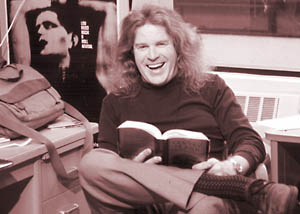 issue is on the table. Of course work would still be conditional, but you wouldn’t always be shaking in your boots that you’ll be suddenly cut off or lose your benefits. It really affects morale deeply."
Cuesta: Conditions Are Better, But Pay’s Worse
Cuesta part-timers appear to have the opposite problem. Unlike at Poly, they are invited to be part of faculty governance and curriculum development and are also eligible for benefits if they teach more than a 50-percent load, but the pay is even lower than at Cal Poly. And for the first time last year, part-timers taught more than half of all classes at Cuesta.
As one Cal Poly part-timer put it, "They treat you better out there, but the pay is even shittier."
This year, however, Cuesta officials say they plan to hire an almost unheard of 12 full-time, tenure-track positions to keep up with new growth and the college's North County campus. That number is, however, contingent on funding from the state and more recent budget projections have been less optimistic.
John Fetcho, who has been teaching part-time in the math department for 10 years, was just recently hired for a full-time, albeit still temporary, position. He is one of the founding members of Cuesta’s faculty union and until recently was the part-time representative to the union negotiation team.
Fetcho says that while job security was one of the main concerns at Cuesta, "we’ve done pretty well with that." Part-timers at Cuesta now have reemployment preference. That means if a faculty member has taught for eight semesters or more, she will get first offering of whatever her historic teaching load has been.
According to Fetcho, at Cuesta and statewide, pro rata pay is going to be the next big push for part-timers. Fetcho, who after 10 years is near the top of the Cuesta pay scale, says he regularly taught nine units, which is 60 percent of a full-time load. His pay, however, was the equivalent of only 34.5 percent of a full-time workload. A pro rata pay scale, like Cal Poly’s, would mean that if Fetcho taught a 60-percent load, he would be paid 60 percent of what a full-timer makes.
Susan Cotler, vice president of instruction, maintains that part-timers at Cuesta are paid well. But like many part-time issues, Cotler concedes that Cuesta’s part-timers are paid well compared to their colleagues at other community colleges. She says pro rata pay hasn’t been negotiated at Cuesta. "If it were, full-time faculty wouldn’t be getting the raises they are getting."
But is this an issue that must pit part-timers against full-timers? Marilyn Rossa, an English professor and president of Cuesta’s union, doesn’t think so.
"Just this past week the board of trustees voted 4 to 1 to give [Cuesta President] Grace Mitchell an 8.5-percent salary increase. It’s really up to the college, how they want to spend money. They’ve chosen to spend it elsewhere," Rossa says. "This college is growing on the backs of part-timers."
But with additional funding this year, thanks to the new growth, things are getting better. Part-timers who work more than 40 percent of a full-time load are now paid for one office hour per week (half of which is paid by the state). "The provision for office hours is very important," Cotler said.
And although part-timers aren’t required to hold more office hours than they are paid for, most do–on their own time, their own dime. "I have yet to see someone not hold office hours," Fetcho says.
That is, of course, for those who have offices. Not everyone has an office at Cuesta, even to share. But Cotler says that thanks to the last bond measure, three new buildings are going up, replete with more office space for part-timers.
Regardless of money and space, many part-timers are happy at Cuesta. "Cuesta has been good to me," says Fetcho. "I’ve never had a problem getting classes. I think that’s unique. At Poly you don’t know what you’re getting. Once, my wife was told the day before that she wouldn’t get the classes she had lined up. That’s one of the reasons she teaches full-time at San Luis High now."
But it’s not over yet for John Fetcho. Because his full-time position is only temporary, he must go through the interview process again in the spring. After which he will either be offered a full-time, tenure-track position, or he must go back to teaching part time. Faculty at Cuesta cannot remain full-time temporary for longer than one year.
A Happy Part-timer at Poly
Of course, unhappiness among part-timers cannot be overgeneralized. One, in particular, says things are more than good. "Good is not the word," says Jimm Cushing, a part-time instructor of English and literature at both Cal Poly and Cuesta. "It’s luminous. I have the highest job satisfaction of anyone in the world."
Cushing, who says he makes a more-than-comfortable living, has been teaching four classes at Cal Poly every quarter and two every semester at Cuesta for the last 10 years and says being a part-timer is great. "I get to focus on what I love most–the actual dramatic encounter the student has with the material."
Cushing has no sympathy for his fellow part-timers' gripes. "Resentment is bursting out of them like pimples on a teenager," he says.
And he’s no easier on the full-timers. Cushing says that all the full-timers he comes into contact with complain mightily about their additional duties, as well as the politics and cliques tenured professors must wade through.
"When I hear it," he says, "It sounds to me like junior high school with Ph.D.s and credit cards. I don’t have to deal with that shit at all. It’s just me and the text and the student, and I love it."
Tracy Idell Hamilton is a former New Times intern and part-time contributor.