













Actually They’re Not Professors, Never Will Be Professors, Because Nearly Half of Local College Teachers Are Temps
By Tracy Idell Hamilton
Richard Schmidt is a man adrift–a teacher with no one to teach.
Until recently, Schmidt was a part-time lecturer at Cal Poly. And although that position was temporary, it was one he has held for 12 years, teaching classes in the university’s Architecture and City and Regional Planning departments.
But last quarter, with little notice and almost no explanation, Schmidt was not rehired. And while he could theoretically be rehired next quarter (on the same short notice), he has now lost his benefits, which are contingent upon both continuous employment and working more than 50 percent of a full-time load.
Schmidt has filed a grievance with the university over entitlement, which is supposed to give any temporary part-timer who has taught for more than three consecutive quarters priority to any work available.
"They pulled this on me back in 1989," Schmidt says. "I filed a grievance then and was given a one-year contract. I thought this was settled."
He is not alone in his dissatisfaction. Across the nation debates are raging about the growing use and treatment of adjunct (part-time and nontenure-track full-time) faculty.
While they offer much to both the institution and students, there is no denying their main benefit: cost. Part-timers can be had for a fraction of what their tenured and tenure-track counterparts earn, both in salary and benefits.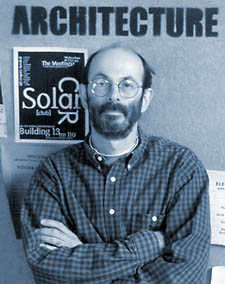
For example, part-timers at Cuesta College make between $573 and $1,182 per unit per semester, about a third of what their full-time brethren take in. That’s an average of about $45 an hour in the classroom. Unless you count prep time, office hours, and grading time, the salary is about what some of their students make busing tables. And benefits, well, we’ll get into benefits in a bit.
Since 1970, the use of adjunct faculty has been rising steadily, from 22 percent to more than 40 percent in 1993. The nationwide average is now just under 50 percent, with community colleges averaging even higher.
This growth in part-timers means that a significant portion of instruction is now carried out by faculty who earn lower pay and benefits, lack the protection of academic freedom or job security, and have little opportunity for professional advancement.
Cal Poly has a lower than average number of part-timers, about 25 percent. That number jumps to 45 percent when including full-time but nontenure-track faculty. At Cuesta, about two-thirds of the faculty teach part time. And while both groups seem to be faring better than their counterparts at other institutions, dissatisfaction can be found among part-timers at both schools.
While working conditions vary widely, in comparison with their full-time counterparts the majority of part-time faculty teaches under what the American Association for University Professors calls "emphatically substandard conditions."
For example, part-timers are less likely to have office space and access to computer equipment or institutional resources. This can translate into less preparation for class instruction.
They are less likely to receive regular evaluations, interact with colleagues, or participate in faculty governance, contributing to the feeling by many part-timers that they are cut off from the university or treated as second-class citizens.
Part-timers also lack job security, including sufficient notice of employment or nonemployment, and benefits are tenuous at best. Without security, part-timers are often afraid to speak out, afraid of losing what they do have. Several local part-timers weren't comfortable going on the record to discuss job issues.
Benefits the institution receives from part-time faculty, however, are hard to deny. All the part-timers contacted for this article said they teach because they love to teach. Adjunct faculties also bring in outside experiences that would be hard to duplicate with permanent faculty. And they are often more flexible.
Part-time faculties have been historically used as a buffer against economic downturns, like in the early 1990s when many part-timers were let go to avoid laying off tenured faculty. Now they are being rehired at record rates to help meet the needs of a rapidly growing student population.
There seems to be no dissension that the increased use of adjunct and part-time faculty will be a permanent part of the higher education landscape. What is unclear is whether colleges and universities have adjusted their policies to meet this new reality.
Some people and organizations, like the AAUP, fear that institutions will be left with a two-tiered system, with a shrinking base of tenured faculty who enjoy academic careers and institutional support and a growing majority who will remain "educational service workers," poorly compensated, with short-term jobs and few career prospects.
So concerned are they that in 1997 the AAUP attended a conference, sponsored by almost a dozen teaching associations, on the growing use of part-time and adjunct faculty. While criticizing working conditions of part-timers, the AAUP did not question the relevance or the benefits of part-time faculty. Instead, they focused on what should be the conditions of that faculty's contracts, compensation, and work.
Poly: Five to an Office
The biggest issue at Cal Poly is job security, according to many part-timers contacted for this story.
While no one is cheering about being cramped three or even five to an office, often with one phone and one computer, part-timers at Cal Poly have a sense, at least, that they have something and that many others go without. One part-timer said he knows faculty whose offices are the front seats of their cars.
Joe Lynch, a full-time lecturer in the Philosophy Department ("lecturer" is Cal Poly’s term for any faculty not on the tenure track, full- or part-time), is the faculty union’s representative for lecturers.
Lynch says the union is at the negotiating table with the university right now. "We’re trying to get longer contracts for lecturers who have been teaching for a certain number of years," he says. Even though he’s been there for 10 years, Lynch has to apply for his temporary job every two years. When successful, he is still awarded only a one-year contract.
But there is still the issue of supply and demand, according to Linda Dalton, vice provost for institutional planning: "If you’re trying to meet the needs of the students and you have every last instructor booked and something happens–illness, or someone gets a research grant–we need that flexibility."
Lynch says part-timers would also like to change the threshold of benefits.
Faculty are eligible for benefits if they work half-time or more, within one department, consecutively for six months of the year or more. And a part-timer must have at least a six-month contract to be eligible. Those who work on quarter-to-quarter contracts, even if they work the required amount of time, are not eligible.
Ken Swisher, spokesman for the CSU Chancellors Office, says the CSU’s benefit package for part-timers is considered one of the best in the country, illustrating, perhaps, that when it comes to part-timers, good, better, and best are relative.
"When you need consecutive quarters and 60 percent [of full-time hours] to get health care," says Lynch, "it’s easy to shuffle papers around and lose it."
That's what happened to Richard Schmidt. "For the last four years, I’ve been teaching 30 to 39 units–36 is considered full-time. It strikes me as bizarre that I’m still considered part-time and temporary. At what point does someone stop being temporary?"
Last year, Schmidt taught six units in the fall, 12 in the winter, and 12 more in the spring. But because he worked under different contracts for each quarter, he was not eligible for benefits.
Anyone can keep up their benefits with Cobra, a federally mandated program which lets part-timers, or those between jobs, keep their benefits–at their own expense. "Once they have benefits, that is," clarifies Sue Bethel of Cal Poly’s Academic Personnel Office.