













Mystery
Guy
Whether true or not, Scott Barnes’ yarns have caught the attention
of ABC’s Peter Jennings, the CIA, and Ross Perot
BY DANIEL BLACKBURN
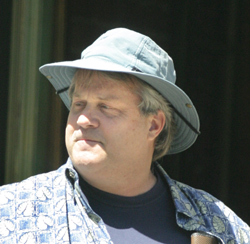
PHOTO BY CHRISTOPHER GARDNER
|
HERE TO HELP |
At first glance, Scott Barnes looked like a man with something important to offer: a wide array of globetrotting experiences, for example, and expertise in complex investigations and military disciplines. He was retired, with lots of free time. And he apparently had independent resources.
Barnes popped up recently at meetings of a citizens' oversight committee that is forming to examine SLO County Sheriff's Department policies and procedures. He has in recent months also spent a great deal of time at his own expense looking into the 2002 GHB-related death of Cal Poly student Brian Gillis, a 19-year-old Sigma Chi fraternity member.
In both endeavors, Barnes was making genuine progress. His assistance was welcomed.
He reportedly told Patricia Gillis, Brian's mother, that he was a retired private investigator and others that he was a former federal investigator for numerous agencies including the FBI. He told New Times he specialized in probing the circumstances of suspicious workplace deaths involving youth.
Penny Harrington thought she smelled a rat.
"He had too many stories in the air," she said of recent county transplant Barnes.
She just didn't know how many stories.
An experienced investigator in her own right and former chief of police in Oregon, Harrington is spearheading the citizen oversight group. She thought she had encountered in Barnes a man who could be an asset to the fledgling organization.
She soon learned that she had a world-class chameleon-a man whose personal story could shift with the wind-in her sights.
Indeed, Barnes is a man with a past, albeit a fascinating, colorful one that caught the attention of ABC's Peter Jennings, put him before a Senate Select Committee, and in the middle of the controversy surrounding Texas billionaire H. Ross Perot's sudden demise in the 1992 presidential campaign.
Barnes also finessed himself into a key role in U.S. attempts in the mid-1980s to recover missing American POWs from Southeast Asia, and in the process buffaloed the legendary Army Green Beret Col. Bo Gritz. He publicly embarrassed the outgoing Carter administration.
His actions forced ABC's news anchor Peter Jennings to make a humiliating retraction on the air. And Barnes was the subject of a full chapter in a book titled "The 60 Greatest Conspiracies of All Time."
Ever adaptive, Barnes-at various times in his career-is said to have presented himself as an Army military police officer, a Navy SEAL, a Green Beret, a DEA agent, and even a CIA assassin. (He acknowledges the first, denies ever claiming the next two, and coyly declines to discuss the fourth: "That's an area we don't discuss," he says.)
By his own assertion, he also has been involved in civil defense operations, nuclear-weapons training, real estate, and retail clothing endeavors as part of his "cover."
As engaging as he is enigmatic, Scott Tracy Barnes is probably best described professionally as a freelance soldier of fortune. He's authored a book about his exploits, "Bohica," which is a versatile Navy SEAL term meaning "Bend over, here it comes again."
He has hobnobbed with international personalities, the famous and infamous. Names of people known and clandestine roll easily off his tongue. He has the places, the people, the pertinent facts, all ready to deliver.
He's a compact man with an easy smile and a level gaze who at 50 is losing the battle of the bulge. His thinning gray hair is often covered by a hat. He walks at a leisurely pace, like a guy with some time on his hands.
But at this particular moment he is sitting . at a creekside table at Higuera Street's Novo restaurant. He's savoring a sampling of ceviche and pondering a reporter's question.
"You know," Barnes confides, "I really don't know why people say some of the things about me that they do."
***
A 1972 graduate of Redondo Union High School in Southern California, Barnes grew up in the shadow of two of the nation's biggest storage grounds for transitory CIA and other covert agents. TRW Space and Defense Park and Hughes Aircraft facilities to this day host a virtual parade of incoming and outgoing intelligence officers and spooks.
After graduation, the teenage Barnes almost immediately took off on a year-long journey during which he traveled to Mexico, Tahiti, American and Western Samoa, Fiji, Tonga, New Caledonia, New Zealand, Australia, Bali, Cuala Lamphoor, Hong Kong, China, Philippines. And Vietnam.
(A U.S. Senate Select Committee 20 years later would see proof of that journey in Barnes' passport, and hear his explanation that he funded the trip by cashing in some inherited stocks. Barnes told committee members that the trip had been a vacation-except for Vietnam. Pressed by the committee to reveal the purpose of the trip to Vietnam, Barnes invoked the 5th Amendment against self-incrimination.)
Upon his return from the fast-paced trip, still just 19, he enlisted in the Army. According to his sworn testimony before that Senate committee, Barnes received Advanced Individual Training (AIT) at Fort Bragg, which he described as "counter-insurgency, recognition of booby traps, guerilla warfare, data analysis, body language courses."
By his own assessment, soon after his initial training was completed, he was assigned to "work with" Army military police intelligence units on drug interdiction operations involving traveling military personnel.
He spent several years at Fort Lewis in Washington state, according to military records produced by the Senate committee, ferreting out illicit drugs hidden in the coffins of service personnel killed in action.
After that, Barnes' life apparently began to get really interesting. In 1974, by his reckoning, Barnes was approached by two men who introduced themselves as "CIA" and offered him the opportunity to get an "early drop pass"-to get out of the Army early and join them, in a roundabout sort of way: He would go back to college, get his degree, and then enjoy recruitment from all of this nation's intelligence community.
He earned a two-year degree at El Camino College in Torrance in 1976.
For the next few years, as documented in data developed by the Senate committee, Barnes did a variety of things, including involving himself in religious activities, only partly as a cover. A self-expressed believer, he helped run Hope Chapel in Maui with a friend, and even walked the sands of Hermosa Beach preaching the gospel according to Barnes.
In 1981, Barnes said he was contacted by an anonymous female who said she worked for Hughes Aircraft in El Segundo. She wanted to know if Barnes had ever heard the name James Gordon Gritz. Barnes had not. She asked if Barnes would be interested in helping Gritz gather information on American prisoners of war still in captivity years after war's end. Though skeptical that such captives still existed, Barnes affirmed his interest.
 |
SMELLED A RAT |
Fast forward to April 2004. Bo Gritz is growling into the phone: "Scott Barnes? I haven't heard that name in 10 years, and it's too damned soon now."
Gritz (pronounced gr-EYE-tz) is as close to a military war hero as exists today, partly because of his bold career and partly because of his expert self-marketing.
Gritz was the principal character in the United States' attempt to find and rescue any leftover POWs from the Vietnam struggle. He says Barnes presented himself as someone who could assist in gaining access to portions of Laos and Cambodia by introducing Gritz to a man named General Vang Poa, a Thai tribal leader.
Meanwhile, Barnes reportedly approached Poa with the same offer: He could introduce him to the American war hero with whom Poa was familiar. Barnes told Poa that Gritz was his friend and he'd make the arrangements.
That introduction paved the way for a series of top-secret U.S. incursions into Southeast Asia in search of the missing POWs. None were successful.
Gritz and Vang Poa would become lifelong friends, and only much later would they realize that Barnes had known neither of them at the time, yet had nonetheless finessed the introduction.
Gritz said Barnes manipulated himself onto the rescue team, comprised of highly trained Special Ops personnel, and soon was in Laos.
Three weeks into the sojourn, Gritz, overseeing the operation from a separate command post, said he got a call from his field leader.
"He said, 'Get this guy the hell out of here before we kill him and bury him.' And they would have," said Gritz. Barnes had not made a big impression on the rescue team.
Barnes, reminded recently about the incident, grins widely.
"Boy, that's true," he says. "They would have." Barnes doesn't say why.
And Gritz probably doesn't smile when he remembers what happened next.
"That sonofabitch Barnes went back to the states, contacted a bunch of newspapers, and told them all that I was trying to assassinate the remaining U.S. Vietnam-era military missing in action in order to validate the American government's assertions that there were no more MIAs," said Gritz. "I'd have killed him myself if I'd have seen him then."
Barnes, however, was just getting started. And his next project was going to get a whole lot of attention.
In 1983, a Hawaiian businessman, Ronald Rewald, went on trial to answer fraud charges that he had looted his international investment firm for millions of dollars.
At his trial, Rewald claimed that his company had been set up as a CIA front and that all of his activities were done at the behest of his immediate superior, the local CIA station chief.
Astoundingly, Rewald had the documents to prove his allegations.
The intelligence agency remained mute, until Scott Barnes made a spectacular charge: ABC's Peter Jennings breathlessly reported to a transfixed nation that Barnes had been hired by the CIA to terminate Rewald and put an end to Rewald's stories.
The source of that story was none other than Barnes himself.
In response, the CIA-breaking its historic tradition of stonewalling-sent a top spook lawyer to prosecute the case, and he successfully debunked the story.
That forced Jennings to suddenly reverse field and retract ABC's version on the air. Rewald's documents never made it into the public record; he was convicted of fraud and sentenced to 80 years in federal prison. The presiding judge died a decade later, and a scant 30 days later Rewald was paroled and soon disappeared.
And so, for all practical purposes, did Barnes, reappearing in 1992 to make his biggest mark.
He had spent the years following the ABC debacle in the campaign to locate MIA/POWs. He would approach families of missing military personnel and support groups to update them on current news and, occasionally, to seek funding for private searches in Southeast Asia.
"I'll say this about Barnes," Gritz said recently. "I don't think he ever did that for money. That wasn't his motivation. He was really just trying to attach himself to people who were doing something important."
Barnes had managed to establish a friendship with H. Ross Perot because of their mutual interest in the MIA/POWs, and the two had frequent telephone conversations.
As the three-way presidential race heated up between Bill Clinton, George Herbert Walker Bush, and Perot, Barnes approached the latter with a disturbing story.
Author Gerald Posner, in a 1996 book titled "Citizen Perot," identified Barnes as the person responsible for Perot's sudden and surprising withdrawal from the presidential campaign, even though he was pulling at least 20 percent of voters his way at the time.
Posner wrote that Perot dropped from the race "after receiving multiple reports that there was a Republican plot to disrupt Perot's daughter's wedding, and to distribute a computerized false photo of the daughter showing her in compromising positions with other women."
Perot appeared on CBS's "60 Minutes" to elaborate on his astounding decision.
"Some aspects of this scandal have long been known, yet the details were always murky," wrote Posner. "The full account reveals that while Perot did have some basis for his bizarre charges, he appears to have relied on sources of dubious credibility."
That would have been Scott Barnes.
Barnes told Posner that "no such pictures existed and that he concocted the story. But [Barnes] insists he did so on explicit instructions from Perot so that Perot would have an excuse for his withdrawal from the race. It is hard to imagine, though, that Perot, so concerned about the privacy of his family, would encourage anyone to circulate such a story."
But before the fiasco concluded, Barnes would carry the matter all the way to wearing an FBI wire in an attempt to get top Texas Republican Central Committee members to admit to the conspiracy on tape. That failed, of course, because the GOP supporters in fact had absolutely no knowledge of the plan.
Posner concluded that Barnes' intention was to force Bush out of the campaign by laying responsibility for the events at Bush's door, but the idea backfired royally.
Today, Barnes insists that the FBI was responsible for the information provided to Perot, and that "we used Posner . because we needed to." Barnes identified "we" as Intelligence Support Activity (ISA).
In a book titled "Secret Warriors: Inside the Covert Military Operations of the Reagan Era," by Steven Emerson, the author calls ISA "the least known and most classified unit within the realm of U.S. special operations. It is a small, highly trained and capable intelligence unit."
The agency's existence was not revealed until 1982, when reconnaissance over-flights revealed a possible location of POWs still believed held by the Viet Cong. A rescue operation was planned involving Seaspray, Delta Force, and the ISA. But, ISA also sponsored the parallel, secret mission by Gritz, an action that caused ISA to be pronounced a "rogue" outfit by Congress.
Barnes shrugs off criticism from others with an air of "what can a guy do?" He's heard all this stuff before.
"You have to look at things in a grander scale. Who is really working for whom?" he wonders rhetorically. "I just retired from the federal government last year"-and here he displays a laminated identification card from the U.S. Department of Defense. "I couldn't have worked for them in the capacity that I did had any of the negative stuff been even close to accurate." I retired as a senior investigator, got a great pension, worked for a lot of agencies under those auspices."
What does he think about Bo Gritz's observation that "I consider it my patriotic duty to warn the American people about Scott Barnes"?
Barnes chuckles. "Good old Bo. He's one flamboyant Green Beret. He was just never brought in on the loop. He was used, too, sad to say."
Penny Harrington says she doesn't plan to be used. She's shown Barnes the door, and will do without his help on the citizens' oversight committee.
Pat Gillis will reserve judgment on Barnes; she says she can use all the assistance she can get in her efforts to find out how her son got the fatal dose of GHB.
Either way, it's okay with Barnes.
"I just do what I do," he says. "I'm an absolutely honest man." ³
News Editor Daniel Blackburn
can be reached at dblackburn@newtimesslo.com.
 |
