













Right-Wing
follies
Will the Democrats in this election learn from their progressive past
or repeat their centrist mistakes?
STORY BY PAUL ROCKWELL
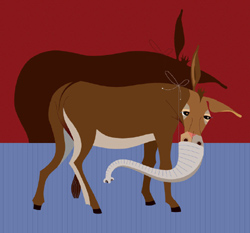
ILLUSTRATION BY MIGNON KHARGIE
|
Democrats can always find a way to blow a national election. As Michael Moore puts it: “We cannot leave this 2004 election to the Democrats to screw it up.”
To make matters worse, as a candidate for president, Senator John Kerry is a centrist.
Ever since the demise of the once-progressive Johnson administration in 1968, when a lawless war in Vietnam destroyed the hopeful War on Poverty, centrist Democrats have blamed the misfortunes of the Democratic Party in national politics on excessive liberalism, on progressive politics that appear too radical for the general population.
Centrists claim that only by moving the party to the right, even to the point of co-opting nationalism and military postures of the Republicans, can Democrats regain the White House.
The centrist theory, so often repeated in media commentary, contradicts the historical record—not only the record of three successive defeats in presidential elections from 1980 to 1988, when the party shifted to the right—but the overall record of Democratic presidents from Roosevelt to Carter.
Since 1932, Democratic presidential candidates have achieved five landslide victories, and all five landslides were created through progressive campaigns that identified the Democratic Party with movements for social reform. The four campaigns of Franklin Roosevelt and the landslide victory of Lyndon Johnson in 1964 were grand coalition campaigns.
These great crusades did not dwell on the white middle-class. Nor did they fawn over lost Democrats. Instead they reached beyond the party establishment to the unemployed, to the poor, to the new, rising electorate of the times.
With only one telling exception, no Cold War Democratic candidate ever won a decisive majority of the popular vote. Truman got 49.5 percent in 1948; Kennedy got 49.9 percent in the squeaker of 1960. Carter got a bare majority over Ford in 1976, a result of public hostility over Watergate. The one candidate who did sweep the country was Lyndon Johnson, and he made support for civil rights central to his crusade for the Great Society. The great Democratic victories (Roosevelt and Johnson) were progressive, highly ideological crusades against poverty and injustice.
History does not vindicate the viewpoint of the right-wing Democrats.
The centrist theory is wrong, not only in terms of electoral results; it is also wrong in terms of those huge fiascos that brought down three Democratic presidents—Truman, Johnson, and Carter.
While fidelity of FDR to progressive causes kept him in the White House for four consecutive terms, no Cold War Democratic president kept the White House beyond a single elected term. The policies and mistakes of Democrats in office set the conditions for subsequent elections. What did the presidents of one elected term—Truman, Johnson, Carter—do wrong in office?
The answer to that question tends to discredit the centrist position.
Every one-term Democratic president made right-wing errors that precipitated his own downfall and betrayed the liberal mandate that held the Democratic Party together. The fall of Truman in 1952, the humiliation of Lyndon Johnson in 1968, the defeat of Carter in 1980—great Democratic traumas—were all direct results of right-wing follies in office.
McCarthyism and war-crippled Truman
As a New Dealer, Truman was popular, but Truman made a right-wing shift away from FDR: the establishment of a conservative cabinet, the use of troops and injunctions against steel workers and miners on strike, the red-baiting of Henry Wallace, the State Department persecution of Paul Robeson, Truman’s reactionary government loyalty oath that paved the way for the rise of McCarthyism, and the Korean War, especially the disastrous march to the Yalu River on China’s border.
All this split the Democratic Party, confused the electorate, emboldened the Republicans, and brought Truman’s demise. Clay Blair summed up the effect of Truman’s right-wing shift in “The Forgotten War, America In Korea”: The war “fostered a national climate which strengthened the appeal of McCarthyism and similar repressive ideologies and unseated the Democratic Party, which had held the White House for 20 years.”
Trapped in his own undeclared land war in Asia, Truman was so unpopular by 1952 that he declined to run for a second term. And the Democratic Party leadership had become so right wing that the Republican adversary, Dwight D. Eisenhower, outflanked the Democrats from the left. When Eisenhower promised to end the Korean War—“the time has come to bring our boys home”—Adlai Stevenson lost any chance for victory. (The same pattern repeated itself in 1968 when Democrats were trapped in Johnson’s war in Vietnam).
Johnson won as a dove, lost as a hawk
It was a progressive not a centrist strategy that set off the landslide of 1964. Johnson did not “hug the center.” He used a mass, grand coalition strategy similar to FDR. Three progressive themes—peace, commitment to ending poverty, full civil rights—dominated the 1964 campaign.
“We can’t just push a button,” Johnson would say at his campaign stops, “and tell an independent country to go to hell. We cannot keep the peace by bluff and bluster and ultimatums.” Johnson also challenged the conservative premise that mass poverty is the fault of the poor, a permanent part of American society.
In civil rights, Johnson took the most advanced position on racial issues of any Democratic Party nominee in post-war history. Johnson toured southern states, confronted the residual fears of his southern brethren, and appealed to the enlightened self-interests of black and white together. Under the impact of the civil rights movements, the Johnson team rejected the centrist strategy, the kind of campaign that seeks to avoid civil rights issues and panders to whites’ fear to change.
As early as the 1960s the centrist approach already had a record of failure. Adlai Stevenson, the experienced governor of Illinois, cultivated a liberal image, but practiced a centrist strategy in his in campaigns. During the 1956 campaign against Eisenhower, a black woman asked Stevenson to take a clear stand on the historic Supreme Court ruling against segregated schools. Stevenson, who became a two-time loser, refused to support the use of federal troops to enforce the ruling. He even reached an agreement with Eisenhower to keep the issue of race and segregation—an issue on the mind of all Americans—out of the campaign. As a result of default on civil rights, Stevenson lost by a bigger margin in 1956 than in 1952.
By 1960 it was becoming clear that Democratic candidates could not win presidential elections, much less a real popular mandate, by running away from civil rights. In the Kennedy campaign of 1960, a mere phone call to Coretta Scott King on behalf of Dr. King in jail may have made the difference between defeat and Kennedy’s slim victory.
Johnson wisely did not repeat the mistakes of Stevenson. Johnson even went beyond FDR, Truman, and beyond Kennedy on civil rights, passing the historic Civil Rights Bill of 1964, then attacked Goldwater for his opposition to the 14th Amendment. No congressman who voted for the 1964 civil rights bill was defeated for reelection, and 11 congressmen who voted against the civil rights bill (out of 22 northern congressmen) were defeated for reelection.
The Johnson campaign discredits the prevailing “white-flight” theory, not only in contrast to Stevenson’s defeats, but in contrast to the subsequent centrist campaigns of Walter Mondale and Michael Dukakis, former liberals who tried to play down civil rights. Since 1944, Johnson was the only Democratic candidate to win a majority of white voters.
In the post-Johnson period, it was Democratic Party default on civil rights, not identification with black progress, that made the Republican “southern strategy” successful. When Democrats keep faith with progressive traditions, when they stand on principle, the Republicans become the whiners and weaklings, like Goldwater in 1964.
Theodore White, award-winning conservative chronicler of post-war national campaigns, called the Johnson crusade of 1964 “the most successful campaign in all American history.” The enlightened, progressive tone of the campaign, its connection with grassroots movements outside the official Democratic Party, garnered 61 percent of the popular vote, the largest percentage at that time in U.S. history.
To be sure, the Johnson campaign did not take place in a vacuum. Democratic leaders resisted change and only took progressive positions under pressure. Electoral campaigns that reflect the aspirations of democratic-minded voters will rarely succeed unless they are backed by an aroused, active movement. The peace movement and civil rights movement were decisive parts of the Johnson landslide. Reluctant at first, the Democratic Party leadership finally identified the party with movements for social reform, and they portrayed those movements, not as “special interests,” (as centrists treat them today), but as just causes of concern to all Americans.
So long as the leadership of the Democratic Party upheld its progressive mandate, the credibility of the party remained high. Lyndon Johnson, once a segregationist himself, earned worldwide respect for the passage of the Voting Rights Act of 1965, commended the freedom fighters who marched in Selma, and sang “We Shall Overcome.”
In January 1966 Johnson and Congress got unprecedented high ratings in the polls for liberal legislation. A Harris poll rated public approval of the Great Society legislation: Medicare for the aged, 82 percent; federal aid to education, 90 percent, excise tax cuts, 92 percent; the voting rights act, 95 percent.
What went wrong? What brought about the most dramatic shift in public opinion since 1932?
The centrist Democrats have forgotten the somersault, the betrayal of Lyndon Johnson. It was not the liberal agenda that precipitated the long-term decline of the Democratic Party in the 1970s. It was only after Johnson’s rightward shift, and the escalation of the illegal wars in Indochina, that mass defections from the party took place. In making fateful concessions to the generals, the Pentagon, the arms manufacturers—that “military industrial complex” of which Eisenhower warned—the Democrats “converted the greatest mandate, the greatest personal triumph of any election, that of 1964, to the greatest personal humiliation of any sitting president,” wrote White.
The deployment of 500,000 troops to Vietnam, the carpet bombing of North Vietnam, the CIA atrocities (like Operation Phoenix that killed 20,000 South Vietnamese civilians), the growing contempt for world opinion and the rule of law, the drafting of black and brown high school graduates whose new hopes for social progress were transformed into search and destroy operations abroad, the gutting of domestic programs ($6 billion cut in 1966), the war-induced inflation that stretched into the late 1970s—all caused a period of decline and disillusionment from which Americans and Democrats have yet to recover.
White writes that “the confidence of the American people in their government, their institutions, their leadership, was shaken as never before since 1960. … The Vietnam decisions of 1965 were to initiate a sense of helplessness in American life which no candidate could cure.” In its fatal right-wing shift, the party leadership turned its back “on all the great promises and domestic experiences of one of the most visionary administrations ever to hold helm in America.”
In 1968 Hubert Humphrey, once proud of his liberal record, campaigned as Johnson’s proxy. His centrist campaign, his broken spirit, his refusal to make a clean break from Johnson’s war, his refusal to call for withdrawal of U.S. troops from Vietnam, made Nixon’s victory possible.
The Republicans have a history of goading liberal Democrats into right-wing wars against Third World countries, then leaving Democrats with the results of their own folly. And once again the Republicans outsmarted the Democrats. Notwithstanding his record as a witch-hunter and war hawk, Nixon became—by default of the Democrats—the “peace” candidate.
The Democrats, so far gone in pro-interventionist policy, were outflanked again.
The Johnson betrayal made subsequent Democratic victory nearly impossible. Both Hubert Humphrey, who campaigned as Johnson’s proxy, and McGovern, who was forced to campaign against his own party leadership in a time of disarray, were part of the aftermath of Johnson’s folly.
In their right-wing shift in the mid-’60s, the Democrats turned from a party of peace to a party of war, a party of hope to a party of despair, a party of civil rights to a party of vacillation and Bakke backlash (the dismantling of affirmative action).
Today’s centrist Democrats have a lack of clear democratic principle, disregard for the opinions of mankind, contempt for constitutionalism and the international rule of law, immersion in the ideology of imperialism, dependency on corporate finance and the PAC system of electoral bribery, loss of faith in human progress and empowerment. All these centrist maladies go back to the period of self-destruction when the Democratic party leadership betrayed its mandate for peace, equality, and social reform.
The centrist strategy today is merely a continuation of what took place in the mid-’60s when the Democratic Party made its fateful right turn.
Carter goes down with the Shah
The Carter administration was no exception to the right-wing follies of one-term Democratic presidents. Betrayal of his own human rights policy brought Carter’s downfall. The American people first liked Jimmy Carter. They respected his stand in support of human rights, and they viewed him as a genuine humanitarian. The historic Camp David accords generated worldwide respect and brought widespread approval at the polls.
Then Carter made one of those right-wing mistakes that prove to be the undoing of the Democratic Party. There is an old saying: “Lie down with dogs, get up with fleas.” On New Year’s Eve in Teheran in 1978, at a private party in the sumptuous home of the Shah of Iran, whose SAVAK was notorious for terror and torture, Carter toasted the Shah and called Iran “an island of stability” in a troubled world. It was not long after that riots broke out, and the hated Shah was deposed.
While South Africa offered asylum to the Shah, most countries, including Britain and France, closed their doors. President Carter first resisted the Shah’s requests for safe haven in the United States. After all, the U.S. Embassy in Iran had warned the president of potential repercussions if the U.S. aided the Shah, whose hopes for a counter-revolution were public knowledge. In one prophetic moment Carter asked: “What do we do if our embassy personnel are taken hostage?”
But right-wing pressures on Democratic presidents are unceasing. David Rockefeller, whose banks held $8 billion in Iranian assets, a personal friend of the Shah; and Henry Kissinger, mastermind of the illegal secret bombing of Cambodia for the Nixon administration, urged Carter to bring the Shah to the U.S. American arms dealers, who concluded $15 billion in arms sales to the Shah between 1974 and 1978, also put pressure on the White House.
When Jimmy Carter succumbed to the pressure, he not only reversed his own position on human rights, he touched off a crisis that ended any chance for winning the campaign of 1980. Having goaded Carter into an open alliance with the deposed Shah, Kissinger and Rockefeller never took responsibility for the subsequent disaster. They let the Democrats take the blame.
Just as Eisenhower became the “peace” candidate against Truman’s Korean war, just as Nixon capitalized on Johnson’s war and Humphrey’s timidity, so Ronald Reagan got credit for bringing home the hostages.
Defeatism in the 1980s
Antipathy to progressive politics still dominated the conservative, PAC-financed leadership of the Democratic Party throughout the 1980s. In 1982, for example, national party leaders, including Walter Mondale, opposed the progressive campaign of Harold Washington for mayor of Chicago. They even endorsed and worked for Washington’s right-wing opponents—Jane Byrne and Richard Daley—before Washington (who spent $1 million compared to Byrne’s $10 million and Daley’s $4 million) achieved an historic victory.
In the national campaign of 1984, before his rout by Ronald Reagan, Mondale rejected all of Jesse Jackson’s convention platforms. The Congressional Quarterly called Mondale’s platform “economically the most conservative platform in the last fifty years.” Mondale called for cuts in social spending, higher taxes (without specification of corporate and wealthy categories), and an increased military budget. In their 1980s campaigns, both Mondale and Dukakis minimized the concerns of African-Americans and Hispanics, and both degraded the peace movement and women’s movement to the level of “special interests.” The Dukakis silence on the atrocities against Nicaragua, his media tank ride, (a pitiful attempt to out-macho Bush), all weakened the Democratic campaign for the presidency.
Will centrist Democrats repeat their past mistakes in the pending national election?
We cannot predict the future with certainty. “History,” as Barbara Tuchman writes, “is only a lantern on the stern.” But we can prepare for the showdown of 2004 in two ways. First, by connecting history’s dots, perceiving the connection between the long, sorry record of Democratic right-wing follies and the recent decades of reaction and defeat. Second, by turning our burgeoning protest movement into an electoral force. Yes, protest movements (like the movements that retired Johnson and Nixon) affect elections. They change consciousness. They focus on principles and issues that both parties try to avoid.
Our strategy for defeating Bush is not a question of pessimism or optimism. It’s a matter of where we place our hopes—in our young movement, or in a corporate-financed political party.
Sure, we will vote for Kerry, and Nader is almost irrelevant. But we cannot limit ourselves to Democratic Party themes or tactics, or fold our peace movement into a Democratic Party tent. Through teach-ins, marches and mass demonstrations, truth-squads at Bush rallies, soap-box rallies on the streets of poor communities—through action—we can hold Bush accountable for his impeachable offenses—his lies, bribes, assassinations, and lawlessness.
Vaclav Havel, Czechoslovakian playwright and revolutionary, commented: “Society is a mysterious animal with many faces and hidden potentialities, and it’s extremely short-sighted to believe that the face society happens to be presenting to you at a given moment is its only true face. … None of us know all the potentialities that slumber in the spirit of the population … or all the ways in which the population can surprise us when there is the right interplay of events, both visible and invisible.”
Under the impetus of the mass movement, even some centrist Democrats may recall their own history and try to recover their lost progressive heritage. While there is no greater imperative facing our nation than the defeat of George W. Bush, Michael Moore is right: “We cannot leave this election to the Democrats to screw it up.” ³
Paul Rockwell is a Bay Area writer and librarian. He can be reached
at
rockyspad@hotmail.com.
 |
