













Order in the Court?
Claims of sexual harassment and mismanagement linger at SLO County’s courthouse
BY MATT MCBRIDE
 |
COURTHOUSE CAPERS SLO County's courthouse has undergone significant changes since the fusing of the superior and municipal court systems. Employees say the changes have made a mess of things. |
| PHOTO BY PHIL KLEIN | |
Sometimes a great idea on paper ends up bad in reality.
Take two families, both set in their ways, with rules and guidelines,
chains of command, and pecking orders clearly established. Then cram
them both together under one roof, with new rules and guidelines that
seem to change regularly, blurry chains of command, and a new pecking
order that’s yet to be established.
Then tell them to solve the world’s problems.
Meet your San Luis Obispo County Superior Court.
Unfortunately, the court has enough of its own problems, including an investigation into complaints of sexual harassment against the system’s executive officer, Wayne Hall.
Additionally, current and former employees say the recently reconfigured superior court system in San Luis Obispo County is a mess because judges are now required to handle personnel matters.
Several workers there complain of mismanagement, which has created a hostile work environment and fears of reprisals among court reporters and secretaries.
Ann Burum was court reporter from September 2000 until she left this past July.
“[Management] totally created a hostile work environment,” she said. “I’ve never encountered anything quite like it. They created this atmosphere where it brought out the worst in a lot of people who aren’t normally bad people. And I think people who weren’t that great to begin with were allowed to flourish.”
The problems seem to have arisen from the fusing of the superior and municipal court systems after California voters approved Proposition 220 in 1998. The proposition allowed counties to consolidate the two courts, if approved by a majority vote of the superior and municipal court judges. SLO County consolidated its courts July 1, 1998.
Then, in 2002, Proposition 48 did away with the municipal court system entirely.
It seemed like a good idea at the time, but former employees say the combined courts created a monster. The fused system threw judges into managerial roles for which they were ill-prepared. They were now being asked to handle personnel matters in addition to their usual courtroom responsibilities.
Court executive officer and presiding judge Barry T. LaBarbera says that many of the problems that have occurred since the change are simply growing pains.
“It was a big change,” he says. “There were a lot of changes in staff. In the old days, [the courts] were really separated, really specialized, and to move people into change is tough. People who were set in their ways had to change, they had to learn a new job, in a sense, because there was more to it than before, and that’s always a struggle. But I think from the public’s standpoint it’s been a positive change,” LaBarbera said.
Former employees such as Burum, however, see it differently.
Debra Burton, a court reporter for 14 years, was the first court employee to alert LaBarbera to sexual harassment complaints she’d heard regarding Hall.
“I had heard from so many people that I felt I needed to talk to the judge and let him know what was going on,” Burton said. She told LaBarbera, “You’ve got a real problem with this guy.”
Hall, Burton said, “had to be told by several people, ‘Stop touching me, I don’t like you to touch me,’ so we’re not talking about a low-level sort of harassment—a glance—it was really unbelievable human resources 101 kind of stuff.
“The thing that triggered me going to Judge LaBarbera was the husband of one of the court employees came to me and said he was shocked to overhear Wayne say to a new employee, ‘Are your nipples always hard when it gets cold?’ He was constantly commenting on people’s appearances, constantly commenting on their physical attributes.”
Tommie Josephson was a court executive secretary for 10 years, working closely with Hall until, she says, he fired her in 2001. She agreed that many of the court’s managerial problems can be attributed to Hall.
 |
WRONGFULLY TERMINATED? Tommie Josephson was a court executive secretary for 10 years, working closely with Wayne Hall until he fired her in 2001. Josephson filed suit for wrongful termination. |
| PHOTO BY CHRISTOPHER GARDNER | |
Burton’s sexual harassment claims in 2001, she said, led to the court’s first in-house investigation.
Josephson was Hall’s secretary at the time. She said that, during the investigation, Hall was placed on paid administrative leave for six weeks.
Josephson said she was one of at least 20 people interviewed by investigators and she told them everything she had witnessed Hall do in the past.
“I was in there over two hours,” she said, “and I told them things I had observed. … I was at a party with six court staff. We were outside sitting on the wooden steps to a hot tub and Wayne decided that he was cold and shoved his hands up a woman’s crotch and said, ‘Oh, my hands are cold, warm me up.’
“At another party, with some of the same people there, Wayne used a female employee to demonstrate a sexual position that he had created.”
As executive officer, Hall is in charge of nearly 150 employees of the court. While Hall was on leave, assistant executive officer Jeff Hamm alerted employees in an internal e-mail.
The office e-mail, dated Aug. 2, 2002, states: “Presiding Judge Burke has asked that the following information be shared with court staff. Court Executive Officer Wayne Hall has been placed on paid administrative leave. In his absence, Assistant Court Executive Officer Jeff Hamm has assumed his duties.”
Investigators summoned Hall for questioning.
“I was questioned by the investigator and it was very painful,” Hall said, “because of how much was fabricated. I could tell just by the questions. If you throw up enough on the wall, some of it’s going to stick. Whether it has a right to or not, something will stick. That’s what a lot of this amounts to, that’s the strategy here. The fabrications have just amazed me. I’m sure in the law there are protections for people from this kind of thing, but even if those protections exist they’re never going to be extended to someone like me. I just have to continue to sit back and take it.”
As for some of the claims leveled against him for comments he allegedly made, Hall is dumbfounded.
Did he make references to hardened nipples?
“Never happened,” he said, “absolutely never. There was a picnic where an employee had talked about it—it wasn’t me—but had talked about when he’s cold his nipples get hard, but he was joking. But this is where these people are able to take something like that and try and … that’s something I’ve never said. I wouldn’t say a thing like that. I just don’t do those kinds of things. I’m pretty reserved.”
In regard to the “hands up a woman’s crotch” comment, Hall was even more flabbergasted.
“Wow, this is sounding like libel. I hope you print all this because … this is just going way too far.”
And Hall’s mystified about claims of using a female employee to demonstrate a sexual position at a party.
“I don’t even know what party this would be,” he said. “I don’t really go to very many parties. It’s disgusting. This is very disgusting. It’s just amazing that people would be willing to fabricate stuff like that so much. It’s so unbelievable.”
Hall said the investigation’s results vindicated him, and he was subsequently reinstated as the court’s executive officer.
“At the end [of the investigation],” Hall said, “they told me that there were no problems. That it was unfounded.”
Judge Jeff Burke informed court employees in an e-mail dated Sept. 6, 2002 that Hall was returning to work.
“I wish to advise you that the Court’s inquiry into certain workplace issues is complete. We believe the issues were fully and fairly investigated and that they have been appropriately addressed.
“Court Executive Officer Wayne Hall will return to work on Monday, September 10, 2001.”
Burton said no details or results of the investigation were available for employees’ review.
Employees don’t know how or why Hall was reinstated. But when he returned, they claim, Hall was a man bent on retaliation, and the turnover commenced.
Since 2001, eight of the department’s 10 court reporters have left their jobs and there are presently three openings available.
Nancy Lutge was a court executive secretary for more than 13 years. She was also surprised at the decision to reinstate Hall but said she thought the judges just couldn’t decide whether to get rid of Hall or keep him.
“I know that there were judges there that did not want to keep him and there were judges there that wanted to keep him. In the beginning, I thought he would do a wonderful job, but as time wore on, and bad things started happening, you start looking at it in a different light.”
Burton was floored.
“They reinstated him and we all went, ‘Oh my God!’”
Josephson, Hall’s secretary, was terminated soon after Hall’s return. She said she was fired in retaliation.
“He [terminated me] to send a message to people: ‘Don’t talk, [because] your job’s not as secure as you might think.’ I’m sure he believes that I was the reason he got in trouble.”
Josephson eventually filed a claim of unlawful termination. The claim has since been settled for an undisclosed amount, but both Josephson and Burton said the workplace has suffered as people walked out the door because of the resultant hostile environment.
“There was a huge exodus and they lost a lot of very experienced people that had many, many years of experience. They just said, ‘This place blows,’” Burton said.
Burton puts a good amount of blame on the judges, who never had to deal with personnel issues like this before.
“It seems the judges have not accepted their role as private employers. None of them are fully addressing the role, and I think that’s why things have gotten so chaotic and turned into such a mess at the court,” she said.
“There’s this whole undertone of a hostile work environment that’s been created by the judges not really knowing what they’re doing.”
Hall, however, said the department is experiencing a high turnover because of the changes employees have had to go through since the merger and not because of alleged retaliation.
“First of all, I don’t know if there was any whistle-blowing. All I really know is there was a complaint where the judges were uncomfortable with me being around while it was being investigated.
“I don’t know who did what, and that’s probably a good thing. That’s not in my nature to be retaliatory.
“I’m actually happy to hear that they’ve gone that outrageous because people will see that and go, ‘Oh my god, this is ridiculous!’”
The turnover is more likely the result of heavier workloads and a shift in job duties since the merger between the two court systems, he added.
Before the merger, all court reporters worked in the superior court system with its five judges. They were assigned basically to one judge, and worked only when that judge presided.
When the two courts consolidated, however, five judges were added from the municipal system and court reporters were assigned wherever needed. The new arrangement significantly increased their caseload.
That created a lot of unhappy court reporters, according to Hall.
“The old days were ‘This is my judge, and I’ll come and go as I please, when the judge is off, I’m off,’” Hall explained.
Now, with a larger workload, reporters are no longer allowed to work for only one judge.
“What we’ve done is said, ‘We can’t allow that to go on anymore, it’s a [waste] of public funds to allow you to take off for part of the day. So you’ll work 8-5.’ That was a significant impact on a lot of the people who were used to feeling like freelancers,” Hall continued. “I suspect that that contributed to some of the turnover we’ve had in different departments in the court.
“I got the impression that they didn’t get into court reporting school and get into court reporting to be told that you have to work 8-5.”
Despite the turmoil, LaBarbera said there has been some good to come out of all this. While he can’t comment on any personnel issues regarding his employees—state and federal law prohibits him from doing so—he said the public is benefitting from the merger.
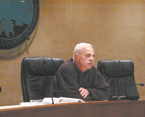 |
CHANGE IS HARD Judge Barry T. LaBarbera said changes at the county's courthouse have been difficult but overall the public is benefitting. |
| PHOTO BY CHRISTOPHER GARDNER | |
He said now there are more judges available to handle the same amount of cases. Judges are able to pick up other judges’ cases because they can pass the work around. If one judge is busy, another can step in and hear cases.
As the court tries to work out its problems, more just keep rearing their ugly heads.
Through their contacts at the courthouse, former employees claim there is yet another third-party investigation into sexual harassment complaints against Hall. Sources have said that another investigator is again asking employees questions about sexual harassment, retaliation efforts against employees, and concerns of management lying to employees and judges.
Hall confirmed that there is an investigation, but said that sexual harassment was not an issue being covered.
“There is an investigator, I believe, who has been brought in to ask some questions of people who had some problem, but if it is sex harassment I will be amazed.
“I am very aware of what sexual harassment is and I am very confident that that isn’t occurring and has never occurred in this court while I’ve been in this court.
“This is a case where you can see one person who is just plain nasty and bent on hurting other people and it’s amazing to me how far a person will go to do that. It’s like a poison in the court and there’s been an effort by just a small minority to keep the poison alive as much as they can.” ³
Staff Writer Matt McBride can be reached at mmcbride@newtimesslo.com.
Pick up New Times at over 600 locations in
San Luis Obispo and Northern Santa Barbara Counties.
home | 55 fiction | about new times | ad info | archives | avila bay watch
best of slo | classifieds | connections | hot dates | menus
movies | the shredder

©2003 New Times Magazine San Luis Obispo, CA USA
web site hosted and maintained by ITECH Solutions
