













They Raise Both Awareness and Concern
BY CONNIE BAKER
The scenic roads of SLO County provide an aesthetic, usually stress-free commute, but for some they are a constant reminder of pain. At a certain spot on a certain street they can hear the excruciating crunching of metal, the smashing of glass.
For it’s at that spot that their lives were forever changed. A mother killed by a moment’s indecision. A son lost to a drunken driver. An entire family decimated by a careless attempt to save a few minutes.
They remember. And they don’t want us to forget.
As a result, an increasing number of "roadside memorials" have been springing up in recent months. Sometimes, it’s just a few discreetly placed flowers. Many have crosses. When a child is killed, possibly you’ll see a favorite toy.
And then when we pass by they catch our eye, remind us of a headline or news report of the accident that happened there.
As these symbols of love and loss increasingly dot our communities, questions are raised as to the true meaning behind them and if they are positive healers or negative reminders.
Steve Brody, a psychologist who practices in San Luis Obispo and Cambria, sees the memorials as a positive development.
"It definitely helps the grieving process. It gives [the survivors] something concrete to mourn. I believe these memorial sites help the families to move on. They challenge our minds to move on but not leave the memory behind. For a lot of people, particularly the more traditional religious people, that special place where their body and spirit separated becomes a shrine of very personal significance."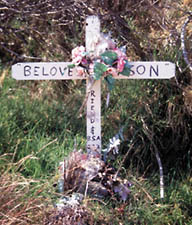
As a private citizen, Brody says, it touches him deeply on a personal level whenever he drives by a roadside memorial.
"I drive by and see these sites and I immediately get sad, and I don't even know the people. Imagine the unbelievable pain the families must be going through."
For some, however, the makeshift memorials are an eyesore.
"I think it's all well and good to memorialize the loss of a loved one," says David Poe. "But, in a way, I think it's kind of morbid. If you stop and look at them, a lot of them are just two sticks nailed together to impersonate a cross and a bowl with a bunch of plastic flowers. It looks tacky."
Poe's perspective on the issue is to plant a tree at the memorial site and put a ribbon around it or something for personal significance.
"Planting a tree is the perfect solution," Poe explained. "With the planting of the tree the survivors of a tragedy will have their reminder and the rest of us who know nothing of the situation will benefit from the new trees."
Throughout San Luis Obispo County there are at least 20 memorial sites depicting everything from the tragedy of a traffic accident to the heinousness of homicide.
Just this past January, 9-year-old Tommy Radich was riding his bike across the intersection of Laurel Lane and Augusta when he was struck by a school bus leaving nearby Sinsheimer Elementary School. Now a touching memorial of flowers and poetry entwine a telephone pole on the corner.
Although Tommy's parents could not be reached to discuss their very personal loss, two of the boy's schoolmates offered their input on seeing the memorial.
Ten-year-old Johnathan Heinze and 10-year-old Jamie Sivongsa think about Tommy every time they walk by that pole.
"Probably somebody really cared about that boy and wanted to remember him," Johnathan said. "You should always remember to tell your mom and dad and brothers and sisters goodbye because you never know what can happen in a day."
Mike Gill was sitting in his pickup truck across from the site when New Times caught up with him. When asked his point of view on these minimonuments of memory, Gill replied, "Knowing what the significance of those individual memorials means to the individual families is the main thing here. Stop and think. Think about a child trapped in a burning car, a young mother helplessly watching her child die before her eyes. Think of the very real horror these people went through in their final seconds of life. It's an eye-opener, man. A real reality check."
Being a small community, many of the deaths are well-known, but fade with time.
The Thanksgiving week tragedy that claimed the life of Telegram-Tribune editor Jeff Fairbanks, his wife, and a daughter prompted a series of improvements along Highway 46, work that continues to this day. But three years after their deaths, many of the motorists on that route between Paso Robles and the San Joaquin Valley are reminded of the deaths only when they approach the spot of the accident, where two roadside memorials stand constant vigil.
Of course, roadside markings of tragic accidents are not new along the road. Near Cholame stands a monument to the Sept. 30, 1955, crash that took the life of youth icon James Dean.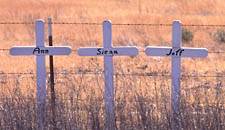
Not all the memorials are for traffic deaths. Probably the most publicized in recent months is the memorial site on San Luis Obispo's Jennifer Street Bridge paying homage to slain college coed Rachel Newhouse. Newhouse was last seen leaving Tortilla Flats last November. Blood that proved to belong to Newhouse was discovered on the Jennifer Street Bridge. Her body was found in April and a sole suspect, Rex Allan Krebs, has been charged with her murder.
The memorial, located in the middle of the bridge, sprang up after the blood was identified as coming from Newhouse. People, some who knew the student and others who didn’t, left letters describing what her life and death meant to them.
Between psychologists, counselors, friends, and families, the idea of the roadside memorial, for the most part, is a positive and helpful one. A vehicle in which to travel through the painful process of bereavement.
But even in dealing with the most sensitive of issues, such as the sudden and often tragic loss of a loved one, there will always be the ever-present eye of the government.
"We definitely discourage these roadside memorials," said Clifford Howe, assistant road maintenance engineer for the San Luis Obispo County. "We won't knock them down, but we really don't want them up."
Howe said the county will not issue an encroachment permit for the memorials, yet he sees them continually being erected.
"Safety is our primary concern," Howe added. "Most of our county roads are easements, so technically a good portion of the property these things are being constructed on belong to private parties. Someone installed a memorial in the right-of-way of a property owner who simply did not want it up there. Fortunately, the matter was handled without us having to step in and remove it.
"If the memorial is deemed a safety hazard, though, you can bet we'll be out there and take it down. Luckily, that hasn't happened yet, but I'll tell you, those things are getting bigger and bigger and more and more visible, and they just might cause another senseless accident."
Theresa Mortilla, a bereavement counselor at Hospice of San Luis Obispo County, disagrees.
"If anything, these memorials raise awareness. I believe there is a real need for today's society to create some sort of ritual–ritual has become somewhat lost in our culture. These memorials somehow give people a lasting connection to that loss and they, in their own silent way, keep the community bonded. It's a true expression of remembrance and love."
Whether these memorials raise eyebrows, awareness, controversy, or concern, their numbers are growing and that, in itself, is a message to all of us. Just like the song says:
"Will you remember me?.... I will remember you...."
Connie Baker is a freelance writer.