













By Lea Aschkenas
Karl Hovanitz is a rail fan. In his earliest memories, he is a 3-year-old scribbling between the outlines of diagrammed cabooses, filling in railroad coloring books, an adolescent traveling with his family to visit railroad structures in varying states of refurbishment and disrepair.
"My dad was a rail fan, but not as much as I am," Hovanitz says, standing in the potholed ground between the Jennifer Street Bridge and Railroad Square on a windy Saturday morning. Just down the hill lie dozens of buses from Silverado Stages, Hovanitz’s charter tour company that takes tourists to museum exhibits and historical sites throughout North America.
"It’s hard to point a finger at one incident that hooked me [on railroads]," Hovanitz says. "But what I do know is I’ve been here 20 years and things are disappearing too fast."
Last June SLO created the Railroad District plan which established the former town center as one of SLO’s five historic areas. Of the 21 historic structures outlined in the plan, four have either burnt down or been demolished since they were built at the turn of the century when Southern Pacific constructed the railroads. Now a fifth structure, a dilapidated warehouse behind the Pacific Home Do-It Center, is threatened with extinction.
At the end of January, Pacific Home Do-It filed a permit to demolish the old warehouse, which the hardware store owners claim is unsafe, uninsurable, and beyond repair.

SLO's chief building official, Tom Baasch, granted the permit on the basis that the old warehouse is an accessory building and, essentially, a dilapidated shack.
"According to demolition regulations, that means we have the right to issue the permit," he says.
Steve McMasters, the chairman of the city’s Cultural Heritage Committee, has filed an appeal. Although he agrees the old warehouse is in bad shape and would probably need a whole new frame to assure stability, McMasters argues in his appeal that the warehouse is not a shack, but a significant piece of SLO’s history.
Yet it stands on a teetering foundation. It’s red roofing peels off to reveal a green underlayer, and "No Trespassing" signs, like the last remnants of a ghost town, adorn its outer walls.
Anthony Whalls, the general manager of Pacific Home Do-It, at first refuses to even discuss the situation with anyone who has not traversed the warehouse’s interior.
"Have you been in it or under it?" he asks. "Good God, it’s falling apart. You have to see how it leans and its structural engineering or lack thereof. The foundation has slipped out from underneath it, and unless you go in it and get scared about it collapsing, you can’t really understand. It’s got a negative termite report, and my insurance company won’t even insure it."
"There are so many conflicting issues here," he says. "Some are emotional. Some are business. Where do you draw the line?"
Beyond economic concerns and sentimental attachments lingers the seemingly silly but still essential question of when is a shack a shack and when, because of its history, is it something more? And then, what is history anyway?
History lies in unlikely places. It is not just a museum collection on the gold-mining era or the stories retold in the worn pages of a grade-school history text. History is often more subtle and less polished. In SLO County, some argue, it lies in a dilapidated shed behind the parking lot of a hardware store or in a dark corner of a modern underground parking structure.
"There is the history of a community—its events and the activities of the people—and then there are the buildings and places," says Andrew Merriam, a SLO architect specializing in historic restoration and rehabilitation.
In the 1980s, while a construction crew was building the Palm Street Parking Structure that Merriam designed, workers came across remnants of the area’s history—Chinese pottery, Chumash beads, bits of Mexican adobe, and even a prescription bottle from the now-defunct Booth and Lattimore’s neighborhood pharmacy.
Archaeology experts were called in to direct a three-week-long excavation in which many community members participated. Today, on the first level, a glass display case reveals some of the stone footings that littered the ground.
"It’s just a little display, but I think the parking structure and the community are richer for having it there," says Merriam.
As an architect, Merriam says he usually looks for a creative compromise.
"I try at least to save the facade," says Merriam. "It’s a whole process where you ask, ‘Could the building be saved? Could part of it be saved? Could it be incorporated into a museum so that people could understand the context?’"
But, Merriam adds, sometimes he finds that a building is just, well, a building.
"The issue is really its significance in a community," he says. "Did it represent a defining moment or element in the community? If every historical building was saved, we couldn’t move forward. The community would be stymied. But if we destroy everything, we end up with a lot of towns like you’ve got in Southern California, with no past and no history."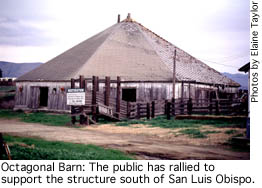
McMasters says there’s something about the character of a historic neighborhood that attracts people.
"The ambiance of a community is not just how many sidewalks and what type of stores it has, it’s also its historic culture," he says. "And it’s hard to put a price tag on that."
But in reality, there is often a price tag on a historic renovation.
In 1967, under pressure from Lady Bird Johnson, the U.S. Congress passed the National Historic Preservation Act, giving tax cuts to those who refurbished old homes and buildings.
There are also low-cost historical preservation loans, but expenses can still be prohibitive.
"There are real economic considerations, such as what if it costs $10 million to save a 30-foot-by-60-foot building?" says Dan Krieger, a Cal Poly history professor and former member of the Cultural Heritage Committee. "It would be worth that to save such an old building as the Mission or to save a place where George Washington stayed, but it’s only worthwhile up until a point."
The age of a building and the historical personalities with whom it might be associated are part of the criteria considered by the Cultural Heritage Committee when it is nominating a building for SLO’s Master List of Historic Resources, which contains 175 properties including the Ah Louis Store, the Mission, and the Sinsheimer Building (now home to Beverly Fabrics) on Monterey Street.
One building not on the list, because it’s just south of the city limits, is the Octagonal Barn out on South Higuera. Volunteers have committed hundreds of hours of work restoring the barn, and a campaign is still under way to raise the $100,000 needed, mostly to put a new roof on the turn-of-the-century structure.
The barn is unusual because it has captured public interest, perhaps because of its proximity to U.S. 101.
"People say, ‘I’ve been driving by that barn my entire life.’ Everybody seems to have a story," says Ray Belknap, executive director of the Land Conservancy, which is coordinating the restoration.
The barn also sports an impressive historical pedigree. George Washington is said to have built the first barn of its type, and the Shakers made them popular because they optimized space with the least amount of building materials.
Another attractive element is the Land Conservancy’s plan to make the barn complex into an agricultural instruction center. The barn will house a farmers market of sorts, and a nearby creamery will be used as a display area for agricultural equipment.
No such grand plans are envisioned for Pacific Home Do-It's warehouse, which is not included on the city’s list, but local historians say this only indicates that no one has gotten around to examining the property and initiating the Cultural Heritage Committee nomination process.
Sometimes buildings not included in the list are in such an advanced state of disrepair that preservation means complete renovation.
Even a rail fan like Hovanitz, who also serves on the boards of directors for the County Historical Museum and a local railroad museum that is in the planning process, realizes that sometimes a building cannot be saved.
Although Silverado Stages inhabits what was once the powerhouse for all the trains, the lot next-door where Hovanitz parks his buses was a mill house where lumber was planed during the early and mid-1900s. The building was demolished five years ago.
"It was seriously damaged," says Hovanitz. "It was impossible to fix up."
This is a state which Krieger refers to as "benign neglect."
"People figure if they ignore an old building, it’ll just go away," says Krieger. "It makes me a little sick."
Another preservation option for buildings that are so near collapse is a partial renovation, where whatever still has some structural integrity remains and newer materials are used to fill in the gaps.
But that approach brings up another question about history. If a "historical" building is only partially comprised of the historical materials, is it still historical?
"Then you have the whole issue of replicas," says Hovanitz. "If you go to a Van Gogh exhibit and there’s a painting that looks like a Van Gogh but it’s not, are you having the same experience as looking at a Van Gogh?"
Ironically, the proposed railroad museum, which will be housed in a railroad freight house, will contain many items and railroad parts that are not from SLO’s Southern Pacific railroad.
"It does seem ironic," says Krieger. "But most of the parts that were once here are gone now. There’s enough railroad material out there that’s similar to what we had that you really can’t tell the difference."
It is often said that history lies, that it is just a story created to justify the past, and that the versions change with the times and the political sentiments.
But standing with Hovanitz atop the remnants of a once great railroad town that in its heyday employed nearly 500 people, there is a sense of something true. It’s not too difficult to envision the hobos he describes who slept under the pepper trees or the community’s recent dismay when the railroad turntable was torn up by Southern Pacific a few years ago without any input from area residents.
On this Saturday morning, the old warehouse, despite its aging state of disrepair, looks somehow in place among Pacific Home Do-It’s lumber stacks that surround it.
"It’s hard on a microscale, taking each building individually," says Krieger. "You have to look into how it benefits community as a whole."
But, when the community that this warehouse and its ancestral buildings once supported is long gone, when their way of life has become just a passed-down tale, examining these benefits may be as difficult and ambiguous as defining history itself.
Lea Aschkenas is a New Times staff writer.