


As
American as Apple Pie
Having the courage to stand up for our civil liberties
Three Republican candidates for the 33rd Assembly District try
to distinguish themselves
STORY BY STACEY WARDE
PHOTOS BY CHRISTOPHER GARDNER
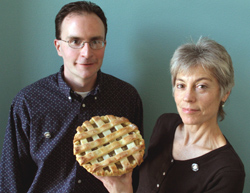 |
SERVES YOUR RIGHTS Mike Zelina and Teresa Campbell cook up a dialogue on protecting the Bill of Rights.
|
After a dignified Nov. 10, 2003, panel discussion on threats to the U.S. Constitution and Bill of Rights, a listener from the audience approached the microphone.
"Does anyone know who David Ickes is?"
The forum on the risks posed by the USA Patriot Act to the nation's civil liberties was about to disintegrate into a senseless speculative debate over conspiracy theories.
"Isn't he the guy who thinks the world's leaders are a bunch of lizards?" responded another.
"You don't know anything!" shot back the first speaker, who then turned to the panel, arguing that the terrorist attacks of 9/11 were part of a larger conspiracy involving the Bush administration.
Members in the audience, which included respected figures such as Marguerite Bader, president of the county's League of Women Voters; and panelists Brian Reynolds, the county's head librarian; and Dr. Phil Fetzer, a Cal Poly professor who teaches constitutional law; shifted uncomfortably in their seats.
The forum, "Civil Liberties in Times of Crisis," was about to reach its own crisis, and beautiful free speech was about to devolve into a stream of babbling nonsense.
The forum's organizer, Mike Zelina of the SLO-Bill of Rights Defense Committee, calmly responded: "Let's not get sidetracked here. We don't really know all of the details about what happened on 9/11. But we do know the real threats to our constitution and the Bill of Rights. We need to stay focused on those."
Zelina, a soft-spoken software engineer from Cambria, earnest in his love for American freedoms bought and paid for with a bloody Revolution, didn't want to lose this moment of getting the word out in a rational, nonpartisan way.
Zelina joined forces with Teresa Campbell, a North Coast potter, last May to form the committee and to spread the word throughout SLO County that citizens need to act quickly to stop federal authorities from intruding into their private lives.
They also drew up a resolution urging county officials to take a stand against federal tampering with constitutional liberties.
That kind of protest, they say, is as American as "Apple Pie," which is what they decided to call their resolution.
The Apple Pie Resolution warns of the detrimental impacts on several constitutional amendments by the Patriot Act, the Homeland Security Act, and various executive orders.
It then "affirms a united stance against terrorism," but not "at the expense of essential civil rights and liberties of the people of San Luis Obispo County."
It also directs local law enforcement to protect citizens from the abuse of powers by federal authorities, ensuring that no one will be subject to "military detention; secret detention; secret immigration proceedings; or detention without access to counsel."
The resolution also affirms "the right of an individual to read what he or she chooses without the government's knowledge," and recognizes the importance of an open government.
"It's important that people realize what's happening to their civil liberties," Zelina says later in an interview with Campbell at Kelley's Espresso and Desserts in Cayucos.
The pair is convinced that the Patriot Act, a 342-page document passed by Congress on Oct. 26, 2001, to fight terrorism, goes too far providing extra police powers and too much authority to the executive branch.
Additionally, emboldened by the act's sweeping reach, the Bush administration has issued numerous executive orders that have resulted in increased surveillance, the suspension of habeas corpus in some cases, the indefinite detention of "suspected" terrorists, and the establishment of trials by military tribunals, as well as a host of other constitutionally questionable actions such as the flaunting of the Freedom of Information Act.
The ramifications of the Patriot Act and the consequent federal executive orders have so alarmed citizens throughout the United States that an unlikely coalition of organizations such as the American Civil Liberties Union and the National Rifle Association have found themselves working together to repeal or reform the legislation passed in the shadow of 9/11.
"We're not saying we should get rid of the Patriot Act, but we need to look at the portions of the act that violate the basic principles of our democracy," says Zelina. Legal experts, civil libertarians, and citizens groups have pored over the document, sounding the alarm over the sections that pose a risk (see infobox).
Among the more vigorous grassroots organizations to address the issue is the Bill of Rights Defense Committee based out of Florence, Mass.
The Massachusetts organization has inspired hundreds of similar committees throughout the United States and has served as a model for putting the issue before local public officials.
Their efforts have resulted in nearly 250 communities throughout the United States, including the city of Santa Barbara and most recently New York City-hardest hit in the 9/11 terrorist attacks-to pass resolutions condemning the sections of the Patriot Act that pose dangers to the American people.
The rights most directly threatened, according to the ACLU, include the freedom of religion, speech, and press; freedom from unreasonable searches and seizures; the right to due process of law; the right to a speedy trial; the assistance of legal counsel and the opportunity to confront one's accusers; the avoidance of excessive bail; and cruel and unusual punishment and the guarantee of equal protection of the laws.
These rights are enumerated in the First, Fourth, Fifth, Sixth, Eighth and 14th amendments.
"The assumptions about the Patriot Act are that we need these tools to fight terrorists," says Zelina. "That's not true." The tools law enforcement has needed to protect Americans against terrorism have always been available in existing laws.
 |
EAT YOUR APPLE PIE The SLO-Bill of Rights Defense Committee has garnered at least 1,500 signatures from county residents who want to protect the Bill of Rights. |
But in the immediate aftermath of 9/11, when the nation was still reeling from terrorism at home, Congress passed this far-reaching legislation, broadening police powers, with very little discussion.
It's taken the efforts of grassroots organizations like the SLO-Bill of Rights Defense Committee to bring legislators back to their senses. Congress is finally beginning to question whether or not the Patriot Act goes too far, and that's due largely to communities around the nation passing resolutions like Apple Pie.
Jurisdictions in 37 states have agreed to protect the local citizenry against government abuse, and three states-Hawaii, Alaska, and Vermont-have passed statewide resolutions.
Unfortunately, for Zelina and Campbell, locally those efforts have met a great deal of skepticism. The SLO County Board of Supervisors, for example, has so far refused to endorse the resolution or even put it on the agenda.
A typical response to the resolution, says Campbell, has been, "'Have you forgotten 9/11?' People think it's a liberal issue or a political issue when it's really not."
Recently, while on the air with KPRL's Joe Benson, Zelina and Campbell met considerable scorn and skepticism from Benson's listening audience.
They thought it was more Bush-bashing propaganda from people who failed to understand the necessity of fighting terrorism, says Benson.
Zelina and Campbell were perceived as liberal agitators whose only goal was to discredit Bush.
"You wouldn't believe the shock I felt," Benson says of the audience reaction. "Here were are in lock-and-load-your-muskets country," where citizens tend to favor minimal government, people who would likely share the concerns being raised by the SLO Bill of Rights Defense Committee, and they're screaming foul.
"I fully expected people to call in and say, 'Right on! We need to keep government out of our lives,' but that's not what happened at all."
Callers accused Zelina and Campbell of being commie-pinko left-wingers and of hating Bush, Benson says. "They looked at it as a left-wing agenda. I was very surprised at the reaction."
This is one of Zelina's biggest concerns-to avoid polarization, to get people of various political persuasions to come together on this one issue: protecting our civil liberties.
Unfortunately, Benson says, even with Zelina's and Campbell's attempt not to politicize the subject, to present the facts without sensationalizing, his listeners refused to soften their stance and never came around to acknowledging the real threats posed by the Patriot Act.
"They're not going to change until something affects them personally," Benson says.
Part of the problem, he says, is that "people are scared to death. It's easier to react than to respond. They don't want to say anything critical or go against Bush" in the fight against terrorism.
Nonetheless, Benson argues that the erosion of these rights will continue unless people like Zelina and Campbell stand up and do something about it. If we don't put a stop to this, who knows where it will lead, he says.
Campbell says that now, more than ever, Americans need to take a stand to protect their civil liberties, and to exercise the same level of courage demonstrated by the Revolutionaries who garnered those liberties for generations to follow.
"It's odd that we'll send our young soldiers overseas to fight the war against terrorism, while at home we acquiesce to equally real threats to our freedoms," she says. "Why wouldn't we have the same courage defending our constitution and Bill of Rights that our soldiers have in defending us against terrorists?
"It's our duty as citizens to be brave enough to fight terrorism and protect the U.S. Constitution and Bill of Rights."
So far, approximately 1,500 residents agree with Campbell and Zelina, and have added their signatures to support the committee's resolution.
At the Nov. 10 forum, Bader from the League of Women Voters was the first to publicly and formally endorse Apple Pie.
"We certainly have to defend ourselves against terrorism, but some of the provisions of the Patriot Act are pretty extreme," she says.
Bader sent a letter Feb. 7 to the board of supervisors urging their support for Apple Pie: "Since your first duty as Supervisor is to uphold the Constitution, the League believes it would be appropriate for you to adopt the Apple Pie Resolution to defend the Bill of Rights."
District 5 Supervisor Mike Ryan was the board's chairman when the SLO-Bill of Rights Defense Committee asked him to consider its resolution.
He refused.
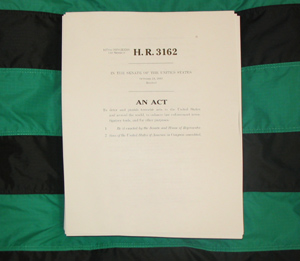 |
USA PATRIOT ACT The 342-page legislation passed by Congress on Oct. 26, 2001, to fight terrorism threatens to alter the color of American liberty, activists say. |
"We take a little narrower view of what our responsibility is," he says. The board doesn't have any compelling interest in the resolution because it doesn't have as direct an impact on the community as making sure there's enough money in the budget to provide services.
"We'll take care of our responsibilities in San Luis Obispo County. We're going to stay focused on issues here locally that we can have a direct effect on."
Additionally, he says, there's nothing in the legislation, or in Zelina's and Campbell's presentation, that would require a strong local denouncement of the Patriot Act.
"It hasn't proven to be unconstitutional," he says. "Just because a group says it's unconstitutional, doesn't make it unconstitutional. If it was, in fact, unconstitutional, yes, it would be a local concern."
District 4 Supervisor Katcho Achadjian, a naturalized U.S. citizen, born in Lebanon and of Armenian ancestry, agrees with Ryan. The fears expressed by Zelina and Campbell so far seem unfounded.
And he's experienced the extra scrutiny that higher security levels require.
Achadjian speaks with a noticeable accent and bears a foreign name. He expects to encounter the inconvenience of searches and questioning from security at airports and other checkpoints such as border crossings.
Last summer, while traveling, he warned his children not to get upset if they were stopped and questioned. That's the price he expects to pay now to ensure safe travel.
"It bothers me," he says, "but if it's for a good cause, so be it." If it makes us safer, he's willing to tolerate the inconvenience of being questioned and examined more closely, even as a result of suspicions arising from his foreign birth.
He watched a video produced by Zelina and Campbell, which features a wide spectrum of activists, including former Republican Congressman Bob Barr and the American Conservative Union's David Keene, who express grave concerns about the Patriot Act.
The information Zelina and Campbell presented, including the video, wasn't convincing enough to warrant the board's attention, Achadjian says.
"Yes, I saw the video, but it didn't hit me where it should have hit me." The potential abuses cited in the video and voiced in the forums haven't occurred with the degree and regularity that proponents of the resolution fear.
Citizens aren't being arbitrarily arrested, he offers. "That just doesn't seem to be happening," certainly not on a large scale, and the few citizens who have been arrested or detained were likely held for good reason.
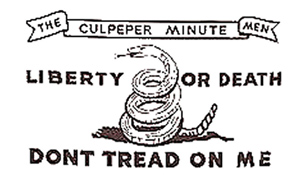 |
WATCH YOUR STEP |
"The Apple Pie input wasn't the type I needed for me to carry the flag for them." There wasn't enough convincing evidence, "but certainly it's coming from their heart, I can see this."
Achadjian says he'd like to see more local response to the resolution. A town hall meeting with a wide range of participants, including representatives from the FBI, might have helped. At least, it would give a more rounded picture.
Additionally, a town hall meeting with federal authorities would allow them an opportunity to explain how they're using their police powers and why the Patriot Act's new provisions enlarging those powers are so necessary.
Police agencies, Achadjian is convinced, need the extra powers to do their jobs effectively. Sure, we'll sacrifice some liberties in the process but that's what we must do to ensure our safety, he says. Until more clear violations of civil liberties occur, there's really nothing to be worried about.
If enough citizens were to show real evidence of abuses, people's minds would change, Achadjian says.
Moreover, it's not really the board of supervisors' prerogative to issue its approval on such a resolution. "The pressure should really be at the federal level."
Ironically, Zelina points out, Congress largely ignored problems with the Patriot Act until grassroots efforts such as those of the Bill of Rights Defense Committees put enough pressure on local representatives to take another look.
District 23 Congresswoman Lois Capps sent a July 31, 2003 letter to Santa Barbara Mayor Marty Blum lauding the city for its effort to protect civil liberties. The city approved a resolution on Aug. 26, 2003.
"Like you, I also believe that preserving our civil rights and liberties is essential. We cannot sacrifice our hard-won freedoms in the face of fanaticism and violence. That would be un-American."
Capps is cosponsoring the Freedom to Read Act (H.R. 1157), protecting library and bookstore patrons from unlimited government surveillance.
Congress has heard what the American people think on the issue because of grassroots efforts such as those organized by people like Zelina and Campbell, says Susan Epstein, founder of Santa Barbara's Bill of Rights Defense Committee.
By the time 50 jurisdictions had passed similar resolutions, it had reached "critical mass," she says, and Congress seemed finally willing to take on the issue.
"Suddenly, there was this groundswell. About 30- to 40-million people are represented by the communities that have passed these resolutions."
At this stage, local communities voting to repeal the troublesome elements in the Patriot Act would be engaging in what is now essentially a symbolic gesture. Congress has already acted.
Nonetheless, it's a gesture that Zelina, Campbell, and a number of SLO County residents say is more than worthwhile.
There's too much trust being given to government, says Zelina. That's not how the American revolutionaries felt about government.
They had good reason to distrust leaders and institutions that gained too much power. That's always been the American way.
That's why our founding fathers provided clear checks and balances in the compact that we have with our government, to keep one branch-the executive, judicial, or congressional branch-from becoming too powerful.
"That's why we have our country, because the government was perceived as a threat," says Zelina. Americans have always stood up for their rights. It's their birthright. . "We don't see this as a political issue. We're everyone's friend." ³
Managing Editor Stacey Warde can be reached at swarde@newtimesslo.com.
Pick up New Times at over 600 locations in
San Luis Obispo and Northern Santa Barbara Counties.
home | 55 fiction | about new times | ad info | archives | avila bay watch
best of slo | classifieds | connections | hot dates | menus
movies | the shredder

©2004 New Times Magazine San Luis Obispo, CA USA
Website Hosting & Maintenance by iTech Solutions, LLC
