













It's
a Wonderful Life
Jennifer Wayland's struggle to provide a normal life for her daughter
TEXT AND PHOTOS BY CHRISTOPHER GARDNER
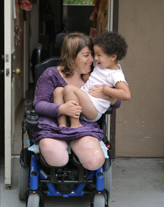 It’s
a typical Tuesday morning at the Wayland household: the smell of coffee
fills the small apartment, toys litter the couch, crayon drawings are
pinned to the wall, 4-year-old Amandalyn is bouncing around singing a
popular kid’s song, and Jennifer, her mother, is hopelessly entreating
her to get dressed for school.
It’s
a typical Tuesday morning at the Wayland household: the smell of coffee
fills the small apartment, toys litter the couch, crayon drawings are
pinned to the wall, 4-year-old Amandalyn is bouncing around singing a
popular kid’s song, and Jennifer, her mother, is hopelessly entreating
her to get dressed for school.
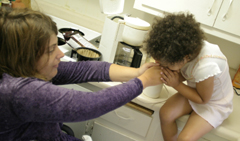
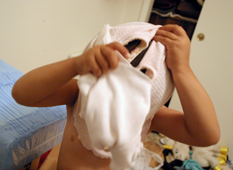
Amandalyn becomes entangled in her shirt and struggles to get it on correctly. This morning, Jennifer can’t find any underwear and must root around in the clothes dryer until she can locate a pair.
Amandalyn jumps up on the counter to grind the coffee beans for her mom.
“I’m a good girl today,” she chirps.
“You’re always a good girl,” her mother responds.
It’s typical home in the sense that a single mom is struggling with morning chores common to all parents — however, Jennifer must do these from the vantage point of her wheelchair. Born with Spina Bifida 32-years ago Jennifer has fought to live a normal life with this paralyzing birth defect.
* * *
To most people, having a leg amputated would not be a relief — but for Jennifer, it was the best option.
This last April, an infection in her left leg turned gangrenous. She knew the course to take was to remove the leg. It wasn’t the first time she’d been through this.
Jennifer lost her right leg in 2002 after living with an intravenous tube in her neck for nine months in a vain attempt to save her legs. They were important to her balance and without them, she will need to learn how to maneuver outside of her chair again.
 A
child of divorce, Jennifer bounced between her father and mother until
she settled in Morro Bay and finished her senior year at Morro Bay High
School. She’s since spent time studying computer repair and hopes
to someday get a job that deals with people and computers.
A
child of divorce, Jennifer bounced between her father and mother until
she settled in Morro Bay and finished her senior year at Morro Bay High
School. She’s since spent time studying computer repair and hopes
to someday get a job that deals with people and computers.
Six years ago she met a man whom she thought was Mr. Right, the man she hoped could protect her from a cruel world. Jennifer had always wanted a child — so when she became pregnant, the choice was obvious.
That was when the controversy started. The father offered to pay for an abortion but she declined. He headed for the hills and is currently incarcerated for a drug-related crime.
During the pregnancy, practically everyone (except her minister) advised Jennifer to abort. She steadfastly refused and carried on, much to the dismay of her social workers and family. Their next strategy was to convince her to give the baby up for adoption.
Their arguments were strong: how could she care, feed, clothe and financially support the child? Jennifer didn’t know the answers but felt in her heart that she was doing the right thing.
During the third trimester of her pregnancy, her doctors decided to induce labor a month early. All went well until the delivery went on too long and the baby became distressed. Amandalyn was born not breathing. She was revived quickly but still required an extensive intensive-care stay.
Jennifer was not allowed to hold Amandalyn for several days nor allowed to have her in room until almost 10 days after delivery. It was a tense and worry-filled time for the new mother; she was convinced the hospital social worker was trying to separate her from her baby.
Finally, at home, Jennifer needed to learn all the fun things about being a mom; diapers, feedings, dressing and bathing the newborn were all tasks. Now it’s much easier as young Amandalyn is adept at chores that older kids still struggle with.
* * *
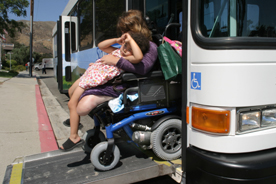
 The
journey starts at 2:04 p.m. Airbrakes whoosh as the SLO transit bus comes
to a stop. A beeping noise signals that the driver is already engaging
the special platform that allows wheelchair access to the bus.
The
journey starts at 2:04 p.m. Airbrakes whoosh as the SLO transit bus comes
to a stop. A beeping noise signals that the driver is already engaging
the special platform that allows wheelchair access to the bus.
The driver deftly secures Jennifer’s chair and they’re off to pick up Amandalyn from preschool, Unity Montessori in San Luis. Jennifer catches the No. 4, which takes her on a roundabout journey to the city’s center. From there she catches the No. 3, which takes her to within a few blocks of Amandalyn’s school.
Crossing busy streets, she arrives at school 10 minutes later. Amandalyn is there waiting by the gate and runs to hug mom. Holding hands, they retrace Jennifer’s journey back to the bus stop.
The love and companionship Amandalyn and Jennifer share is obvious, and it’s easy to see the important role each plays in the other’s life.
“It is only in the last year that I’ve come to realize no one is going to take Amandalyn away from me,” Jennifer says.
While describing her life with Amandalyn, Jennifer smiles softly and relates qualities her daughter possesses: “I’ve never had anyone trust me like she does. She brings me life, dignity, respect. I love her willingness to try things,” she says.
Sometimes Amandalyn acts like the caretaker. She helps fold laundry, put dishes in the sink, and comb her mom’s hair. Amandalyn often becomes an extension to Jennifer’s arms by picking up items she can’t reach.
Riding the bus that afternoon, Amandalyn is full of energy but on the brink of exhaustion. She needs a nap, and Mom knows it. Jennifer makes her daughter rest on her lap for a bit and they idly stare out the window listening to the rattling song of the bus’s engine, air conditioning, beeps, and brakes. Amandalyn is cranky by the time she gets off the bus and wants to ride on Mom’s lap.
The journey has taken Jennifer two hours and 35 minutes. In a car, it would take less than 19 minutes.
* * *
 At
day’s end, dinner is finished, the evening’s chores are complete,
and it’s time to unwind and read a story. Tonight Jennifer and Amandalyn
are reading “101 Dalmatians.” Amandalyn knows the story well
enough to finish sentences for Mom, and soon the book is done.
At
day’s end, dinner is finished, the evening’s chores are complete,
and it’s time to unwind and read a story. Tonight Jennifer and Amandalyn
are reading “101 Dalmatians.” Amandalyn knows the story well
enough to finish sentences for Mom, and soon the book is done.
Jennifer begins to turn off the lights around the apartment while Amandalyn protests that she’s not tired.
Amandalyn jumps into bed while her mom struggles to follow. A kissing, tickle and snuggle session ensues until finally it is time for sleep.
“I’ll turn off the lights,” Amandalyn says. ³
Christopher Gardner is the New Time’s staff photographer. Contact him at cgardner@newtimesslo.com.
 |
