













Why Their Few Feet of Asphalt Matter in Their Own Words and Pictures
BY SARA JONES
Anyone who has been to Thursday night SLO Farmers Market knows the kids of Garden Street.
They're the teens who congregate in front Linnaea's Cafe. They stand out. Hair dyed, metal spikes, leather, unusual piercings. As Kurt Weatherly, a 16-year-old who has been a Garden Street regular for three years, put it: "We’re the outcasts,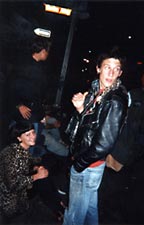 basically."
But the irony of this unorganized group of nonconformists is that they’ve all gathered here to have someplace where they can belong.
I know; I was one.
Now, as plans are underway to kick these kids out of the only place they can feel comfortable, I've returned to try to let them explain to you, through this story and their own photographs, what Garden Street means to them.
I realize this might not be easy. To many, the Garden Street kids are a community eyesore, a troublemaking rabble that needs to be evicted for the community good.
The Downtown Association says that the way these kids look scares potential customers enough that they avoid Garden Street completely. Merchants complain about vandalism blamed on the Garden Street kids.
Currently, a proposal is being worked up by Jerry Whitaker, owner of Stressbusters and a member of the Downtown Association Board of Directors, called the "Greening of Garden Street." Last year the Downtown Association, along with Cal Poly, set up booths along Garden, hoping to drive the Garden Street kids from their usual spot, but the effort was in vain. The booths disappeared while those dressed in spikes and leather remained.
Those with long memories tell me that fear and loathing of cruising is what brought about Farmers Market on Thursday nights in the first place. I suppose the powers that be hope for a similar renaissance along Garden. But you should know what is being lost.
At least make an attempt to look at what underlies the colored, spiked hair and heavy metal. And for most of these kids that is sadness.
"Most of the people on Garden tend to be running from something," said Jonie Rodeo, who looked quite mainstream except for bleach-blond streaks in the front of her cropped hair. And it's true. Lots of kids I spoke with live in broken homes. I spoke with one girl who chose to become homeless because her mom and little sister get along better when she's not at home; and another boy who at 15 is already on his own.
Not all those on Garden, however, come from sad home lives. Some have parents who are still together and pretty well off. They are running often from the oppression of expectations and the scary world of high school.
What all these kids have in common is that Garden Street provides the unconditional acceptance that we all crave. It is a support system for these kids that is so important to them that they continue to come back every week. It's a place where they can alleviate the pressure of their daily lives by being surrounded by friends who have felt the same kind of pressure.
Now "the outcasts" who hang out on Garden are in danger of losing their precious support system.
The kids on Garden are aware of the complaints. A few years ago there was a rash of tickets handed out to kids for loitering, although it seems the frequency of these tickets has dwindled. Cory Evans, a fixture on Garden for six years, said that an agreement was made between the kids, Linnaea Phillips (owner of Linnaea's), and the cops that has allowed them to remain on Garden for this long.
"We don't come down here unless it's Thursday night [there used to be kids on Garden at any hour, on any day], we're not going to make any problems, and after 9 o'clock we'll get off the street," Evans reported, detailing the agreement. "We've given up a lot to be down here."
Although the street did not clear at 9, the high-school-age kids, who are the prime target of complaints, were slowly replaced by an older, over-21-looking crowd. At 9 o'clock I looked for Cory and she was gone.
Much of the conflict centers around the presumption that the kids with the piercings and leather on Garden are dangerous, scary. But the truth is they are not. Freshman year I was a Garden Street wannabe, no chains, no spikes, but liked to be down there because I had a hard time with the social scene in high school and I knew on Garden I could find some peace.
I was pleased to discover that the same "be who you want to be" philosophy is still alive and well. So the irony is that these kids are nonjudgmental, yet they are judged for the way they look; and they are peaceful, yet they are thought to be menacing.
I come away with my discussions with the Garden Street kids not with any great revelations about how they are unique. More I realize how they are like their strait-laced counterparts.
They are all heeding that insatiable teenage itch to rebel that most everyone has felt. The question is, how did you do it? Were you like my cousin, the prep in the collared shirt and Dockers who drank in the closet? Or were you like me, more obvious?
The kids on Garden are rebelling in a way that you and I can see; they are not hiding this natural part of their development. In fact, they are showing it off.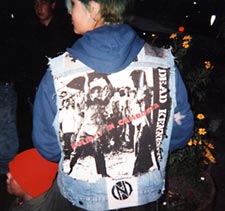
Beyond all the complaints there is one undeniable truth: Kids need a place where they can grow up. Garden Street is a place where kids can do so safely, and the best part is they are safe from both physical harm and (this is the big one) emotional harm.
"You don't get stereotyped or made fun of here," said Vanissa Vonberg, a 16-year-old with thick black eyeliner. Garden Street is a place where the kids feel accepted, supported, and they even feel what I thought unimaginable in high school: belonging.
And in the word of Jaden, a 21-year-old who had "ERACISM" written on his shirt in felt pen, "Everyone has to have a place; Garden Street is our place." Æ
Sara Jones is a freelance writer.