













Training for the Worst
When Disaster or Terrorism Strikes, a CSTI Student Will Likely Be Called Upon to Respond
BY TOM WILMER
Any action-movie fan knows the setup well: The clock is ticking down and the Good Guys have to determine where the target is going to be and who’s behind it. And should they fail in advance, the police/bomb squad/SWAT team need to find the perpetrators and calm the populace.
This time the movie is real. The timer will go off at midnight Dec. 31, and if the people of the California Specialized Training Institute have anything to say about it, it will happen with a fizzle not a bang.
If you haven’t heard of CSTI you’re not alone. For, although it’s one of the world's foremost anti-terrorist training facilities and based right here in San Luis Obispo County, few locals are aware of what it is and what an important role its graduates will play not only come Y2K, but whenever a disaster strikes California.
CSTI operates as the training branch of the Governor's Office of Emergency Services. The program originated in 1971 when then-Gov. Ronald Reagan and then-U.S. Attorney General Edwin Meese authorized the creation of an institute to train military and police organizations in techniques to quell potential anti-war civil disorders.
From its primitive beginnings, CSTI has evolved into an internationally respected multidiscipline operation. Its Anti-Terrorist program has won numerous accolades. Jim Petroni, CSTI's chief of the Emergency Planning and Criminal Justice sections, says, "Our program is the most experienced civilian training and education agency in the field.
"It has been both recognized and commended by the Congress of the United States and the director of the Federal Bureau of Investigation as a model of appropriate training."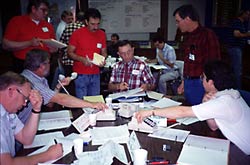
CSTI training stresses a dispassionate response to terrorist activity. Petroni uses a recent civil aviation disaster as an example. "Within moments of the EgyptAir flight 990 crash, there were those who wanted to make it a terrorist action, but no one knew.
"Our classes teach participants to replace speculation with facts. We've gotten into trouble in the past because of fact-free analysis."
There is actually much more than just anti-terrorist stuff that goes on at the Camp San Luis facility.
* * *
Tucked away in various remote parts of Camp San Luis you'll discover some of their real-life scenario facilities, such as a complete mock village and adjacent warehouse used for anti-terrorist and officer safety field-tactics training.
They even maintain their own small fleet of Blues Brothers-era cop cars. In conjunction with the earthquake preparedness program, CSTI has created an intricately detailed city, complete with street maps and businesses–it only exists on paper, but once you have participated in the earthquake program you'll swear the town is real.
Follow the road beyond the Camp San Luis Auditorium and you'll come upon a 13-car train wreck with an adjacent truck tanker-trailer turned on its side. The train derailment site offers Haz-Mat students an ideal hands-on field training opportunity.
Back in the hills, on the eastern side of Highway 1, there's a state-of-the-art 800-yard combat shooting range used for live-fire, day and night tactical response scenarios.
The training that officers receive at the range is true cutting-edge technique. (New Times was forbidden from photographing any live-action activities while on the range.)
A host of specialized training programs address specific areas, including but not limited to Earthquake Preparedness, Officer Safety and Field Tactics, Disaster Medical Operations, Disaster Mitigation, Hazardous Materials (Haz-Mat), Damage Assessment & Recovery, Flood Management, and Standardized Emergency Management Systems.
Even though each of the sections are taught on a regular basis as stand-alone programs, they are simultaneously looped into the big picture of anti-terrorism training. Petroni points out that participants from all of the various disciplines have the very real possibility of at some time responding to a terrorist action.
"When the federal building was bombed in Oklahoma, specialized earthquake response teams were quickly activated and arrived on scene within hours. They were trained initially as earthquake specialists but also functioned as anti-terrorist responders," Petroni says.
When the state decided to add the Anti-Terrorist program, CSTI did not have to reinvent curriculum. "For example, we tweaked and adjusted the details of our Emergency Medical Response Hazardous Materials class to address the specific issues that pertain to a terrorist attack involving chemical or biological agents. At the conclusion of the course, our graduates depart as cross-trained experts."
One of the most important aspects of the CSTI mission is to train students in the methodology of the California State Standardized Emergency Response System.
"It makes things so much easier when responding to any crisis situation anywhere in the state, as you already know and are familiar with a standardized chain of command structure, procedures, and protocol," Petroni says.
CSTI maintains a simulated emergency command center that is staffed with role-playing students during the weeklong programs. "The interesting thing," says Petroni, "is that if the state emergency command center in Sacramento were put out of commission, our facility is fully capable and ready to coordinate a response to a civil disaster anywhere in the state.
* * *
Just who are the "students" who attend CSTI classes? Primarily they're midlevel supervisory personnel from state, county, and local organizations, including police, sheriff deputies, fire personnel, and city government employees (e.g., city managers, parks and recreation, and emergency medical personnel).
Additionally, private sector personnel, such as corporate fire and security, often participate, although private industry participants are charged full cost for the state-funded program (33 percent of CSTI's funding comes from the state; the remainder is generated from grants and tuition fees).
Petroni says there are more than 60 highly trained haz-mat teams throughout the state. Local civilian response teams can respond immediately to virtually any crisis, whereas a federal or military response can take hours and often days to saddle up and arrive on the scene.
"For example," Petroni notes, "the U.S. Marine Corps maintains the Seabirds, a highly trained, specialized chemical/biological response team, but it can take as long as three days to load all their equipment on military transports and arrive on location, and by then it's often too late."
John Mirolla, director of the California Specialized Training Institute says, "Throughout its existence, CSTI has continually sought to develop and present courses to help prepare emergency managers and public safety officials at all levels for not only the problems of today but also tomorrow.
"Through this commitment, we modify courses, add new seminars, develop special and custom programs, and always respond to the needs of those charged with public safety."
Terrorism Preparedness for the Los Angeles World Airports (LAX), one of CSTI's latest seminar additions, is a prime example of adapting and creating programs to the present and future needs of our society.
"The possible consequences of a terrorist attack on the international air transportation system are most severe," says Petroni. "Whether the terrorist seeks a large number of casualties, or merely mass-media attention, history and current intelligence suggests that civil aviation is an attractive target that offers nearly unmatched potential."
The first airport preparedness seminar was held this past October. The seminar is predicated on a holistic, coordinated approach, involving the participation of numerous federal and state agencies, including the FBI, FAA, FEMA, DOD, CDC–an alphabet soup of virtually every relevant California state and Los Angeles city and county health, fire, police, and public safety organization.
The seminar was so well-received that CSTI has received numerous requests from airport authorities around the country–and internationally–to assist in creating similar programs.
CSTI’s activities provide a substantial economic infusion into the local economy.
In addition to 35 full-time employees, more than 250 students from around the state, across the country, and overseas attend a variety of weekly classes, most certified for university credit, held at Camp San Luis. Additional off-campus outreach courses certified by CSTI reach an additional 10,000 students annually.
The economic impact, via CSTI student attendees alone, translates into more than 14,000 SLO County hotel room-nights per annum and thousands of dollars spent annually through per-diem stipends in local restaurants and businesses.
* * *
Petroni plans to ring in the new year in a bunker. Not because he fears a Y2K breakdown, but because it’s his job. He’s the state’s No. 2 in charge of response to any problems come midnight.
And the problems are not just limited to computer glitches. The FBI has warned local police agencies about millennialists who might cause havoc to bring about a biblically foretold end of the world. And then there are terrorists, domestic and foreign, who may see the large community gatherings of New Year’s revelers (there will scores of them in California alone) as a target of opportunity as they did during the Atlanta Olympic Games.
Should any of these eventualities occur, Petroni will be on the job, as will the graduates of CSTI, each a little better prepared to respond because of what they learned here. Æ
Tom Wilmer is a Morro Bay-based freelance writer.FYI: CSTI's website address is www.oes.ca.gov.
Training for the Worst
When Disaster or Terrorism Strikes, a CSTI Student Will Likely Be Called Upon to Respond
BY TOM WILMER
Any action-movie fan knows the setup well: The clock is ticking down and the Good Guys have to determine where the target is going to be and who’s behind it. And should they fail in advance, the police/bomb squad/SWAT team need to find the perpetrators and calm the populace.
This time the movie is real. The timer will go off at midnight Dec. 31, and if the people of the California Specialized Training Institute have anything to say about it, it will happen with a fizzle not a bang.
If you haven’t heard of CSTI you’re not alone. For, although it’s one of the world's foremost anti-terrorist training facilities and based right here in San Luis Obispo County, few locals are aware of what it is and what an important role its graduates will play not only come Y2K, but whenever a disaster strikes California.
CSTI operates as the training branch of the Governor's Office of Emergency Services. The program originated in 1971 when then-Gov. Ronald Reagan and then-U.S. Attorney General Edwin Meese authorized the creation of an institute to train military and police organizations in techniques to quell potential anti-war civil disorders.
From its primitive beginnings, CSTI has evolved into an internationally respected multidiscipline operation. Its Anti-Terrorist program has won numerous accolades. Jim Petroni, CSTI's chief of the Emergency Planning and Criminal Justice sections, says, "Our program is the most experienced civilian training and education agency in the field.
"It has been both recognized and commended by the Congress of the United States and the director of the Federal Bureau of Investigation as a model of appropriate training."
CSTI training stresses a dispassionate response to terrorist activity. Petroni uses a recent civil aviation disaster as an example. "Within moments of the EgyptAir flight 990 crash, there were those who wanted to make it a terrorist action, but no one knew.
"Our classes teach participants to replace speculation with facts. We've gotten into trouble in the past because of fact-free analysis."
There is actually much more than just anti-terrorist stuff that goes on at the Camp San Luis facility.
* * *
Tucked away in various remote parts of Camp San Luis you'll discover some of their real-life scenario facilities, such as a complete mock village and adjacent warehouse used for anti-terrorist and officer safety field-tactics training.
They even maintain their own small fleet of Blues Brothers-era cop cars. In conjunction with the earthquake preparedness program, CSTI has created an intricately detailed city, complete with street maps and businesses–it only exists on paper, but once you have participated in the earthquake program you'll swear the town is real.
Follow the road beyond the Camp San Luis Auditorium and you'll come upon a 13-car train wreck with an adjacent truck tanker-trailer turned on its side. The train derailment site offers Haz-Mat students an ideal hands-on field training opportunity.
Back in the hills, on the eastern side of Highway 1, there's a state-of-the-art 800-yard combat shooting range used for live-fire, day and night tactical response scenarios.
The training that officers receive at the range is true cutting-edge technique. (New Times was forbidden from photographing any live-action activities while on the range.)
A host of specialized training programs address specific areas, including but not limited to Earthquake Preparedness, Officer Safety and Field Tactics, Disaster Medical Operations, Disaster Mitigation, Hazardous Materials (Haz-Mat), Damage Assessment & Recovery, Flood Management, and Standardized Emergency Management Systems.
Even though each of the sections are taught on a regular basis as stand-alone programs, they are simultaneously looped into the big picture of anti-terrorism training. Petroni points out that participants from all of the various disciplines have the very real possibility of at some time responding to a terrorist action.
"When the federal building was bombed in Oklahoma, specialized earthquake response teams were quickly activated and arrived on scene within hours. They were trained initially as earthquake specialists but also functioned as anti-terrorist responders," Petroni says.
When the state decided to add the Anti-Terrorist program, CSTI did not have to reinvent curriculum. "For example, we tweaked and adjusted the details of our Emergency Medical Response Hazardous Materials class to address the specific issues that pertain to a terrorist attack involving chemical or biological agents. At the conclusion of the course, our graduates depart as cross-trained experts."
One of the most important aspects of the CSTI mission is to train students in the methodology of the California State Standardized Emergency Response System.
"It makes things so much easier when responding to any crisis situation anywhere in the state, as you already know and are familiar with a standardized chain of command structure, procedures, and protocol," Petroni says.
CSTI maintains a simulated emergency command center that is staffed with role-playing students during the weeklong programs. "The interesting thing," says Petroni, "is that if the state emergency command center in Sacramento were put out of commission, our facility is fully capable and ready to coordinate a response to a civil disaster anywhere in the state.
* * *
Just who are the "students" who attend CSTI classes? Primarily they're midlevel supervisory personnel from state, county, and local organizations, including police, sheriff deputies, fire personnel, and city government employees (e.g., city managers, parks and recreation, and emergency medical personnel).
Additionally, private sector personnel, such as corporate fire and security, often participate, although private industry participants are charged full cost for the state-funded program (33 percent of CSTI's funding comes from the state; the remainder is generated from grants and tuition fees).
Petroni says there are more than 60 highly trained haz-mat teams throughout the state. Local civilian response teams can respond immediately to virtually any crisis, whereas a federal or military response can take hours and often days to saddle up and arrive on the scene.
"For example," Petroni notes, "the U.S. Marine Corps maintains the Seabirds, a highly trained, specialized chemical/biological response team, but it can take as long as three days to load all their equipment on military transports and arrive on location, and by then it's often too late."
John Mirolla, director of the California Specialized Training Institute says, "Throughout its existence, CSTI has continually sought to develop and present courses to help prepare emergency managers and public safety officials at all levels for not only the problems of today but also tomorrow.
"Through this commitment, we modify courses, add new seminars, develop special and custom programs, and always respond to the needs of those charged with public safety."
Terrorism Preparedness for the Los Angeles World Airports (LAX), one of CSTI's latest seminar additions, is a prime example of adapting and creating programs to the present and future needs of our society.
"The possible consequences of a terrorist attack on the international air transportation system are most severe," says Petroni. "Whether the terrorist seeks a large number of casualties, or merely mass-media attention, history and current intelligence suggests that civil aviation is an attractive target that offers nearly unmatched potential."
The first airport preparedness seminar was held this past October. The seminar is predicated on a holistic, coordinated approach, involving the participation of numerous federal and state agencies, including the FBI, FAA, FEMA, DOD, CDC–an alphabet soup of virtually every relevant California state and Los Angeles city and county health, fire, police, and public safety organization.
The seminar was so well-received that CSTI has received numerous requests from airport authorities around the country–and internationally–to assist in creating similar programs.
CSTI’s activities provide a substantial economic infusion into the local economy.
In addition to 35 full-time employees, more than 250 students from around the state, across the country, and overseas attend a variety of weekly classes, most certified for university credit, held at Camp San Luis. Additional off-campus outreach courses certified by CSTI reach an additional 10,000 students annually.
The economic impact, via CSTI student attendees alone, translates into more than 14,000 SLO County hotel room-nights per annum and thousands of dollars spent annually through per-diem stipends in local restaurants and businesses.
* * *
Petroni plans to ring in the new year in a bunker. Not because he fears a Y2K breakdown, but because it’s his job. He’s the state’s No. 2 in charge of response to any problems come midnight.
And the problems are not just limited to computer glitches. The FBI has warned local police agencies about millennialists who might cause havoc to bring about a biblically foretold end of the world. And then there are terrorists, domestic and foreign, who may see the large community gatherings of New Year’s revelers (there will scores of them in California alone) as a target of opportunity as they did during the Atlanta Olympic Games.
Should any of these eventualities occur, Petroni will be on the job, as will the graduates of CSTI, each a little better prepared to respond because of what they learned here. Æ
Tom Wilmer is a Morro Bay-based freelance writer.