













CDF Firefighters at Station 11 Spend a Busy Season Traversing the State
BY STEVEN T. JONES
It's officially known as California Department of Forestry and Fire Protection's Station 11 in Cayucos, but the firefighters who live there shorten that to "the Cay."
As far as summer homes go, Dan Trabucco, Bill Fisher, Matt Cole, JD Heller, Paul Lee, and Beth Thompson couldn't ask for anything better.
The Cay has a gorgeous ocean view stretching from Cayucos to Morro Rock. Its property includes a large hill that's great for climbing during early morning physical training. And the accommodations are better than ever, with firefighters last year replacing the old barracks with private rooms.
"You can't ask for a better place to work, right here on the ocean," Matt said.
But in a few days or weeks, whenever we get a couple inches of rain, the Cay will be shut down, marking the end of the 1999 fire season, a busier-than-normal season that has taken the Cay's Engine 3469 and its crew all over the state.
Two of the seasonal firefighters are already gone. Paul is back at Cal Poly, where he'll graduate in June with a forestry degree, preparing for a career as a firefighter. Matt left two weeks ago to begin his year-round firefighting career, having just landed a coveted permanent job with the city of Tracy Fire Department.
Beth and JD are still waiting for that permanent job. JD will improve his chances by attending paramedic school starting in March, while recently increased staffing levels are allowing Beth to work until February fighting structure fires for CDF out of Nipomo.
Dan and Bill, the station's two captains, are already longtime, permanent CDF firefighters and will likely to transfer to the San Luis Obispo headquarters with the closing of the Cay.
Dan will reopen the Cay again next May with a new group of seasonal firefighters, just like he's done every year since 1985. Bill might return, but he's starting to get restless again and next season could be on a firefighting helicopter out of Bear Valley.
As the Cay goes into its winter hibernation there will be no sign of the summer's intense activity, with its rapid departures and weary returns. The voices and personalities of the ’99 crew will fade into memory. Except, that is, for the following account:
Season Opener
Even before the season officially began, back in early May when Dan took Engine 3469 by himself to help fight a 365-acre fire near Parkhill, it was clear the heavy winter rains and early dry conditions would make for a busy season.
"I've been doing this for 27 years and I've never seen the brush take off like that," Dan said. "It burned in May like it normally does at the end of August."
Dan wasn't worried about the coming season, just excited to be doing what he loves with a crew of experienced young people he has fought fires with before. The Cay is lauded even by other stations as perhaps this county's best.
"We've got a great crew," he said. "They're supermotivated and all go-getters. It's like a big family."
Matt and JD were already buddies when the season began, having worked together at the Cay last season, and that pair easily became a trio with the May arrival of affable, hard-working Beth.
"With Beth, it's just like she's been here forever," JD said.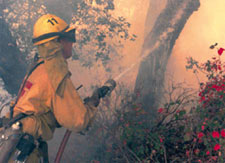
The feeling was mutual. Later that evening, as Beth was sunk into the couch watching the Home and Garden Network on television, she was asked when the Cay started to feel like home.
"Pretty much right when I got here," she said with an embarrassed smile that revealed the truth in her statement.
The last two seasons in Nipomo, Beth's unit didn't respond to accident or medical calls, something she was excited about doing this summer. Like all the firefighters here, Beth is a certified emergency medical technician.
"So this is the first year I get to do the whole thing," said Beth, who still lives in Santa Maria. "That's the main reason I came here."
She definitely had a full dose of firefighting in Santa Maria, then Nipomo, including being on an engine that got burned over by the Logan Fire along Highway 166 in 1997.
"There was no visibility. It was awful," she recalled. "They (a crew of ‘hot shot’ firefighters) were running for their lives, and they couldn't see and kept hitting our bumper. You just heard this, ‘thump, thump, thump.’"
Matt–stocky, confident, the youngest of the group–is big on nicknames. He tagged JD as "Squirrel," perhaps because of his smaller stature. Beth became "Bob" after telling Matt, "You can call me anything you want." Matt said it stands for Bad Old Beth, adding, "We'll see if it sticks."
"Matt's the one with the names," shrugged Beth, who really doesn't mind what Matt calls her.
Yet Matt wasn't thrilled with his own nickname, "Thumbs," given to him by Dan after a few clumsy incidents–"I was all thumbs," he admitted–early in his time at the Cay.
Even the visiting journalist's notebook got a name: Ned. Ned the Notebook. They all laughed. Later, a camera was dubbed "Camie."
"We are a tight crew," JD said, "and I don't know how it will be when Paul arrives."
Paul didn't join the group until mid-June when Cal Poly let out, and Bill was on light duty for the first month of the season after the hitch of a trailer crushed his big toe. After two weeks he was antsy and tired of taking it easy.
"It's the longest I've gone without running," he said then, just before a superior teased him about his restlessness, telling the story of coming to visit the hobbled captain and finding him limping around his front yard laying sod.
Gearing Up
At the beginning of the season, each firefighter is issued about $1,300 worth of gear by Janet Ford, who runs the CDF warehouse for SLO County. She tells them all that they are responsible for keeping their gear clean. For blood stains, she advises using 409 cleaner.
"But if you get a lot of blood on it, that's called grossly contaminated, and you put it in a red bag and come get new stuff," she said matter-of-factly.
The gear includes a jacket, pants, boots, and helmet for structure fires; a different helmet and set of turnouts (a yellow Nomex jacket and pants) for wildland fires; and web gear that holds canteens, gloves, tools, and the all-important fire shelter.
Smaller than a shoe box, the shelter is attached to every firefighter's belt, readily accessible if you become trapped with nowhere to escape the approaching wildfire.
The shelter is your last hope, allowing the fire to burn right over you, hopefully without inflicting fatal injuries. Matt calls them "Shake’n’Bake bags."
"Nobody wants to pull those," he said. "But when it gets to the point of trying to survive you'll do what you have to do."
The shelters are like reflective silver fitted sheets. Once you pull it and get it open, the idea is to get inside, lay flat on the ground with your face in the dirt, and have the shelter tented over you with all edges held fast to the ground.
Any part of your skin that touches the shelter while the fire sweeps over you will burn. If part of the shelter isn't held to the ground the fire and smoke that get in will likely kill you. All firefighters, as part of their training, must be able to properly open and secure themselves in the shelter within 30 seconds.
The shelters can also be placed along the cab windows of an engine being burned over by a wildfire, as Beth had to do at the Logan Fire. Dan even keeps extra fire shields in the engine for such instances.
"Engines getting burned over is pretty common," Dan said, noting that firefighters try to keep an already-burned area between them and the refuge of the engine.
"As bad as it gets in the engine," Matt said, "it'd be worse outside."
The crew keeps all their gear, and out-of-county bags with a week's worth of clothing and toiletries, on the engine at all times. A simple trip to the grocery store could turn into a trip that keeps them away from the Cay for weeks.
"They could call us right now and say respond out-of-county," Dan said. "We keep everything onboard. So we pretty much do literally live out of a suitcase."
If they get called out-of-county, they just go with whoever's on at the time, driving as far as need be, often several hours, and immediately joining the fire lines upon arrival.
"Those first shifts you can end up working 36 or 48 hours straight," Dan said. "Calls where you get called out at 8 p.m. after working all day, then driving to San Diego or wherever, then you're considered a fresh crew and you start fighting the fire."
Around the Station
Their days at the Cay begin at 6:30 a.m. with an hour of physical training, usually either climbing a steep hill wearing full gear and a 50-pound hosepack, running on the beach, or working out in the weight room.
After that, it's time for breakfast, showers, and preparing for a day that could include fighting a local fire, responding to a car accident or other medical emergency, rescuing someone from the ocean or cliffs, inspecting properties for defensible space, suddenly leaving the county to fight a fire or cover someone else's CDF station, or just hanging around the station.
But for firefighters, hanging around the station entails lots of work: checking and maintaining all the myriad gear on the engine, doing training exercises, record keeping, administering tests and training of part-time firefighters, and working around the Cay–cleaning, cooking, painting, trimming trees, carpentry, and whatever else needs doing.
Early in the season what needs doing the most are drills like laying hose, building the precision and teamwork they'll need later when they have to quickly get water on a roaring blaze.
"It's a coordination thing," Dan explained. "We want to get it smooth and going good, so when there's a fire it goes smooth."
During one early season hose-lay drill Matt took the lead position, meaning he's the one calling the shots, operating the nozzle, and riding shotgun in the engine. Shotgun rotates among the firefighters.
Once Dan yelled "Go!" the drill began with Matt unpacking one of his two 100-foot sections of hose from his red canvas hosepack, hooking it up to the engine's 100-foot section, and putting on the nozzle. Then the group of four firefighters charged up the hill holding the hose, spraying as they went.
As the hose ran out, Beth at the rear yelled "Hose!" and the group stopped. JD then clamped the hose to stop the water flow before the next section was attached. Then he yelled "Water coming!" to Matt, released the clamp, and the group was running again.
They repeated the procedure until everyone's sections were attached to the hose, eventually extended 900 feet along the fence line behind the station.
In this drill, they were going for speed and Beth bore the brunt of it, being in the rear position and therefore carrying a full hosepack longer than anyone. "Whoa, shit, too fast," she yelled at one point.
"On a real fire we'd pace ourselves more," Matt explained.
Dan agreed: "The way we train is if you can move that fast when you're not fighting a fire it'll be that much more natural when you are."
Another drill regularly done at stations like the Cay is the mobile attack drill, in which Dan slowly drives the engine while the rest of the crew runs along in front, spraying as they go.
"Mobile attack is a fun way to fight fire," Dan said.
During drill, they just do circles around the garage, spraying as they go. The engine holds 500 gallons of water, mixed with a mild, biodegradable detergent that helps suppress fire.
Dan said he was proud of the crew, but mused on their age during the hose lay drill.
"My whole crew wasn't even born when I started CDF," Dan said with his usual broad smile. "I'm too old to hike these hills."
Understanding Fire
With age comes wisdom, especially when it comes to fighting fires. At the blackboard in the station house Dan explained how fires burn and how to keep them from burning areas you want to protect.
Fires burn in a V-shape, he explained. The apex of the V, where the fire started, is known as the "area of confusion" or the fire's "heel." On each side are the fire's "flanks"; the opening of the V is the "head"; and the middle of the V is the "burn." Unburned areas are known as the "green."
The safest part of the fire is the burned area because fire has already consumed the fuel, so Dan will often drive the engine right onto the burn upon arriving at a fire.
"I like to be one foot in the burn and one foot in the green," Dan said. "We always try to keep an out, to keep a safety zone around us."
Attacking a fire with water directly at its head or flank can be the most effective attack, but also the most dangerous because hot fires can spit flames forward, igniting spot fires that can trap a firefighter.
"So it's real critical when you have a direct attack that someone is looking out for you," Dan said.
That's why firefighters often opt to literally fight fire with fire. After using hand crews or a bulldozer to cut fire lines that are generally one-and-a-half times as wide as the fuel height, the firefighter will then use drip torches or flares to light "backfires," sending their fire back at the fire they're fighting in order to get rid of the fuel and control the fire line.
But in the field, things are rarely so simple. Instead, they are complicated by inaccessible terrain and structures, protection of which is a top priority for firefighters.
"What we like to do is offense, to jump in and put out the fire," he said. "But structures put us in defensive mode. Then we can't fight the fire; we have to defend the house."
Structures complicate firefighting, not just because they put crews on the defensive, but also because there can be "a whole lot more houses than there are fire engines."
In such cases, Dan said, they usually prioritize which structures to defend, and the houses that get defended and ultimately saved are the ones with defensible space, where the brush and other fuel has been cleared around the house.
Such decisions are made in the field, not by rules or procedures but by people like Dan and Bill. Wildfires are so dynamic and unpredictable that strike team leaders must may often make snap decisions that are carried out by the team.
"Be aware of what you're doing and listen to what Dan says," Matt advised. "And don't get off by yourself. Stay with the team."
Contrasting Captains
In Dan Trabucco and Bill Fisher, the Cay's firefighters are lead by two of the most experienced and effective captains–the guys who drive the engine and command the team–that SLO County CDF has to offer.
But Dan and Bill are also a study in contrasts.
Dan has always been a firefighter, always wanted to be a firefighter, and wants to continue as a firefighter until retirement. And at the Cay he has found the ideal home, a base in the middle of the state from where can fight fires under all kinds of conditions and enjoy an idyllic quality of life when he isn't on the line.
"It doesn't seem like a risk factor to me because I love doing it," Dan said. "There's a challenge, so it's always exciting."
The schedule–usually four days on, then three days off–is unpredictable and can suddenly turn into weeks at a time away from home with no notice, but he likes that kind of excitement. That has become his routine.
"It suits me, but it's hard on your other half sometimes," said Dan, who is engaged to be married next year.
At the Cay Dan has found his place.
"Dan is content here," Bill said. "He'll probably retire from here."
Bill is not quite so at peace. There is a restlessness to Bill you can sense from your first conversation, and it is that restlessness that has fueled his varied accomplishments.
He has left SLO County and come back twice, juggled firefighting with lifeguarding, worked on the county's crack Technical Rescue Team, taught various firefighting and rescue classes, and followed other personal pursuits.
"I always find something new to do to keep me motivated. I keep it new.... I'll get bored of this job and want to do something else," Bill said, his tone seeming to indicate that has already happened.
He's talking about perhaps getting on the fire helicopter crew out of Bear Valley, although his wife and two daughters are rooted here, and that could complicate his plans. He might try to advance through the local ranks instead.
"You get a good round background, then you can move up to battalion chief," Bill said (there are 12 battalion chiefs in SLO County). "I'll probably promote at some time, but I want to stay on the Central Coast."
Bill is also as self-effacing as he is motivated. He didn't want the fact that he was awarded the Medal of Valor for a 1995 swiftwater rescue in Morro Bay Creek to be mentioned in this article, and he downplayed its significance.
"I've done other swiftwater rescues that were tougher, but the mayor was out there that day," he said, explaining the award.
As a member of the county's Technical Rescue Team, Bill is involved in the area's most complicated rescue operations, such as last year's washout of Highway 166 that killed two CHP officers and others.
But for this summer Bill was very much involved in the here and now, leading his crew against fires all over the state.
A Month in the Life
It's been a busy summer for the Cay's crew, as the station log for July shows.
July began with Matt, Dan, and JD going to Kern County to fight a fire along Interstate 5 near the Grapevine, spending two days working on steep terrain.
On July 4, while Cayucos residents were having their annual community party at the Cay station house, the crew had a busy day, first with a medical aid in Morro Bay, then over to cover the Parkhill Station, and that night fighting a vegetation fire in California Valley from 9 p.m. until after 3 a.m.
Over the next week, they fought a vegetation fire south of Cuesta Grade, responded to some medical aid calls, and performed an ocean rescue on a kayaker stranded near Spooner's Cove. It was a slow week compared to the rest of the summer.
July 13, Dan, Beth, and Matt left for Tulare County to cover the station in Porterville, arriving back two days later to fight a vegetation fire along Madonna Road.
The next day it was battling a fire off Little Morro Creek Road near Morro Bay, while the following day saw Beth, Paul, and Bill doing a cliff rescue call, saving a hiker with a broken leg stranded off South Bay Boulevard.
That night the out-of-county call came at 1 a.m., and the crew hit the road for Ventura County to fight the Piru Fire. But that fire was quickly contained, and they were back at the Cay by 2 p.m., hoping to get a little sleep.
But that didn't happen. Instead, they got called out at 5 p.m. to a big fire at Hi Mountain, where Beth, Paul, and Bill laid more than 4,000 feet of hose fighting the backcountry blaze.
"It's probably the best fire I got this year," Beth said, although that would change in September.
By noon the next day the trio was finally back at the Cay, weary and ready for sleep, but they wouldn't get much. At 1:30 p.m. the call came for a structure fire in Cayucos. Their quick response got the fire knocked down before there was much damage.
But while at that fire the call came in to help fight the Spanish Fire along Highway 166 near Cuyama, which had grown in size and ferocity with gusty afternoon winds. While they were en route firefighters at the scene got the upper hand, and the trio was spared and headed back to the Cay.
Matt, in the meantime, had already been sent to the Spanish Fire, where he would spend the last two weeks of July doing data entry work, keeping track of crews checking in and out. Once released he would be sent to a fire in San Bernardino to do the same thing. While their engine was on the road, Dan and JD were getting moved around to various assignments.
Dan saw some action driving engines out of Nipomo (from which Matt was sent to the Spanish Fire) and Shandon. In fact, on the afternoon of July 22, during a vegetation fire on the top of Cuesta Grade, Bill and Engine 3469 covered the fire's right flank while Dan's company from Shandon fought along the left flank.
The following day at 5 a.m. the Cay's crew (now Bill, Paul, and JD, as Beth got a couple of days off) would finally go to the still-burning Spanish Fire, which they would spend the next three days fighting (joined there by Beth) before being sent down to a fire in San Bernardino.
"That's typically what we do, go from incident to incident," said Dan, who was also sent to the San Bernardino fire, leading a different strike team, but was diverted to a fire in Riverside while en route.
Between early June and the end of July they put more than 7,000 miles on Engine 3469. Yet the biggest fire of the season was still to come.
Big Sur: The Big One
On Sept. 8 lightning fires along the Big Sur coastline sparked five different fires–collectively dubbed the Kirk Fire Complex–which quickly began burning out of control through the steep, largely inaccessible terrain.
More than 3,000 firefighters would pour into the area, operating out of base camps at Fort Hunter-Liggett and Andrew Molera State Park that had every feature of a small town, spending their days and nights cutting fire lines to prevent its spread while letting more rugged areas burn.
With Bill and Dan off or on other assignments, Matt and JD were working on their Engine 3469 with Capt. Mike Lawry on Sept. 16, fighting a small brush fire along with Station 12 firefighters and others, when the call came to head to Big Sur.
Matt had recently gotten word that he was being hired by the Tracy Fire Department and had medical and psychological exams scheduled that weekend. And JD was headed south that weekend to test for an opening with the Los Angeles Fire Department.
So, as much as going to fires like the Kirk is what CDF firefighters live for, because of both the experience and overtime pay, they traded spots with the two Station 12 firefighters then and there.
"Until our engine comes back, we'll be here," JD said from Station 12.
A week later, Dan, Beth, and another firefighter from Parkhill rented a car and drove to Hunter-Liggett to relieve Lawry's crew and take over Engine 3469, one of five engines on Strike Team 9340C.
They were immediately deployed to the fire line being cut and defended around the New Camadoli Hermitage, a Benedictine monastery that was evacuated as the then-33,000-acre fire (it would eventually consume almost 90,000 acres) closed in around it and other structures.
"It went to heck when we got there. We had fire all around us at one point," Dan said. "They were really taking off because the winds were going strong that night."
Working through the night on 24-hour shifts (followed by 24 hours off), the strike team would spend the next 10 days helping to extend the fire line along the rugged ridge to Highway 1, as helicopters and planes dropped water on the heart of the blaze.
The winds that first night blew flames across the line, sparking dozens of spot fires that could easily have burned across the monastery if Dan, Beth, and the rest of the strike team weren't there to put them out.
The situation was so dangerous that the crew worked right past when they should have gotten off at 6 a.m. and didn't arrive back at the base camp until 3 p.m. Dan, a big 49ers fan, had to be awakened for the Monday Night Football game that evening to watch his team win before going back to sleep until 5:30 a.m., when they had to get up and return to the line.
The crews on the line told them things had been quiet, but as soon as they left, Dan said, the wind picked up and spot fires started breaking out. It was another difficult night.
"The dust and smoke were real bad, and it was hard to breathe," he said.
After one more night the line was completed, and Strike Team 9340C was sent to a ridge further north, deep in the backcountry of the Ventana Wilderness.
The dirt road to the fire lines, a two-hour drive, was so precarious that a bus filled with inmate fire crews plunged off the side, injuring many. Luckily, it hung up on a tree before going into a ravine, thus preventing fatalities.
Access in and out was so long and difficult that Dan, Beth, and more than 60 other firefighters camped out near the lines after working all day on extending and securing a fire line along a steep ridge. The ridge was so steep that the crews had to install a portable water tank and pump midway up a ridge to maintain adequate pressure on the 3,500 feet of hoseline.
"It was tough work, but you feel good at the end of the day," Dan said.
Beth had to spend much of her time there tending the portable water tank, ensuring a proper flow to the lines. It was boring but necessary work, she said.
After two days there they went to the Molera base camp and were given three days worth of R&R. When they returned the fire was largely under control, and they were released.
Both say their first night at the Kirk Fire was the most exciting.
"That first night is when things really started to take off," Dan said, noting a crazy bout with high winds at 3 a.m. "There were fires all around us."
Were they scared? Beth says no.
"It wasn't scary, it was fun," Beth said. "Maybe I'm kind of naive, I don't know. I've only been burned over once."
Perhaps she is naive, for just a week later two CDF firefighters were critically injured while battling a 7,700-acre blaze in the Cleveland National Forest near San Diego. One later died from his injuries.
At the CDF headquarters in San Luis Obispo, a plaque on the wall commemorates the 13 CDF firefighters from this county who have died in the line of duty since 1946.
It serves as a stark reminder that, underlying the excitement and camaraderie of the firefighter's life, this is a dangerous job that entails risk, sacrifice, and an inherent unpredictability. Æ
Reporter Steven T. Jones has been working with Station 11 in Cayucos on and off since June 8: training there, sleeping there, responding to calls, getting to know the firefighters, keeping track of their deployments, and covering the biggest fire they helped fight, the Kirk Fire Complex near Big Sur.