













A Local Man Is Set to Challenge the Women-Only Policy at Cory Everson’s
BY JEN STEVENSON
San Luis Obispo resident Scott Marcotte wants to boldly go where no man has gone before: Cory Everson’s Aerobics and Fitness for Women, a women-only health club.
Marcotte’s quest for admission to the fitness center could ignite a debate locally that has already been played out in several states across the country. Namely, is denying men access to women-only health and fitness clubs an act of discrimination or an issue of privacy?
The controversy was set in motion in mid-July when Marcotte, a 30-year-old Cal Poly international business major, visited Cory Everson’s and requested an application to join. Marcotte said that he was treated politely and shown around the facilities, but the official answer he received was "no."
Now Marcotte is crying discrimination, while gym owners Randy and Lisa Bush say the matter is simply a privacy issue, nothing more. And their patrons are saying they want to get what they came to Cory Everson’s for: a health club exclusively for women.
As for the law, it remains murky. The U.S. Supreme Court has never ruled on this issue precisely. Nor has the California Supreme Court, and other state courts, while largely ruling with the all-women clubs, are not binding here.
***
Cory Everson’s Aerobics and Fitness for Women doesn’t look like the potential battleground for women’s privacy rights and male rights that it may become. The club stands on one end of the Marigold Shopping Center off Broad Street in an unassuming gray brick building.
On a murky Tuesday morning, a side door is propped open, allowing the peppy voice of an aerobics instructor to drift out and a cool breeze to blow in, offering some relief to those laboring inside.
The main entrance is hiding down a side alley but is easily accessible from the club’s private parking area located behind the center. It’s easy to slip from car to club unseen, a blessing for those who just want to roll out of bed, throw on some sweats, and hit the StairMaster bereft of public scrutiny.
Women of all ages, shapes, and sizes walk through the doors, wearing a mixture of shorts, sweatpants, baggy T-shirts, and sneakers. There’s not a spandex workout suit or thong leotard in sight. The women behind the counter in the entrance greet many customers by name, all with a smile. Ricky Martin plays in the background, encouraging everyone present to live the vida loca.
There is no hint of controversy here, only an aura of comfort and camaraderie. There’s also one more thing that’s immediately evident–the complete absence of men. And that’s how they like it, many members say.
Ellen Smilovitz is a graphic and interior designer and owner of her own business, Design Studio One. She minces no words when explaining why she joined Cory Everson’s two years ago.
"It’s all women," she says emphatically.
"I don’t like the sweaty young guys with muscles rippling all around me," Smilovitz explains. "I don’t feel comfortable with that at my age, and neither do my friends my age. I like the insulated feeling of being around women my age. It’s a lot more comfortable."
Smilovitz says the activity she engages in at the gym isn’t merely physical.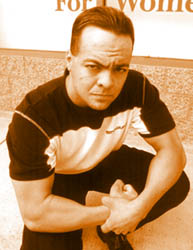
"It’s a cathartic kind of thing; the whole outside world is shut out when you’re in here," says Smilovitz, who works out regularly, four times a week. "Women have a lot going on in life–kids, work, family. I have seven or eight messages for me when I get home. But this is my time; I made a big commitment of my time–my most valuable asset at this point in my life–to spend time on my mental and physical health, and this is the perfect place for me."
Were a man to join the club, Smilovitz says, her sense of enjoying her own cozy little fitness utopia would be shattered.
"There’s a different energy about men," she says. "I would be very aware of them being there, and I don’t want to be aware of that. I don’t want anything interfering with my personal space. They don’t need to be here."
"If a man joined, I probably would reconsider being here," she adds.
Deborah Brigham started working out regularly at Cory Everson’s in January of this year. Her reason for joining wasn’t specifically because the gym was for women only, although it was a consideration, but her past experiences allow her to understand the struggle that going to a gym can be for women who are unhappy with their bodies.
"I don’t think it would matter if I worked out with guys," she says. "I think that for me, I have a routine that I know; I stay focused; I’m not worried about who’s around me. But initially, I was 30 pounds heavier, and being that heavy it did matter."
Brigham, who has belonged to co-ed gyms, points out a very elderly woman working out.
"I see women here who are 80 or 90 years old, older women, and it feels really great seeing them in here," she says. "I never saw older or heavier women where I used to work out. I see many women here who wouldn’t be here if there were men."
Robin Hayhurst, a 47-year-old executive director of a contractor’s board, has belonged to women-only and co-ed fitness clubs in Chicago and Los Angeles.
"I prefer the women’s club," she says. "There’s no competition. You don’t have to worry about some guy looking at your butt on the StairMaster. You don’t have to get all dolled up."
Hayhurst points at her workout attire–a baggy T-shirt and old black sweatpants.
"I used to get all dolled up; now I come like this," she says with a laugh.
Jamie Jennings, who has belonged to Cory Everson’s for eight months, is showing her friend Maile Pepper around the club for a day.
They both like the all-female setting.
"It smells better in here," she says with a laugh.
"It’s cleaner," agrees Jennings. "The staff is all female; they know about you. I feel more comfortable here."
When asked how they would feel if a man were to join the club, the two answer in unison, "Why?"
"Why would he feel comfortable in here," Pepper asks.
After a moment of contemplation, the two come up with a solution.
"He would have to be a..."Jennings pauses.
"...a weird guy," Pepper finishes.
"Yeah, a weird guy," Jennings says.
***
Scott Marcotte doesn’t think he’s weird. In fact, he envisions himself as a modern-day Rosa Parks.
"For me, it’s like taking the bus and being told to sit in the back, like in the days of segregation," Marcotte says. "It’s a women’s gym, but they can’t discriminate against men who apply."
Still, Marcotte doesn’t believe that women should be up in arms about his membership try.
"I don’t think I’m a troublemaker," he says. "I just want to get what I want out of this. I don’t want to make a dispute of men’s and women’s rights. I just want a membership."
It seems like a simple enough argument. After all, haven’t decades of movements for civil rights ended legally protected discrimination by gender?
Lisa Bush says as far as she and her husband are concerned, discrimination is not what is happening in their facility, which serves around 1,500 women. Rather, she calls the ability of women to choose to work out in a health club filled exclusively with other women a privacy issue. Part of the allure of a women-only club is the privacy and security it affords women today, in a world that often contains little of either of those qualities.
"There’s so many issues for women today–body image, plastic surgery, even teenagers are going in for liposuction and breast augmentation," Bush says. "What a women’s club offers is a real, friendly place where women don’t have to worry about exposing their bodies. They can improve their fitness level without worrying about all the male-female stuff."
It’s not an unfamiliar desire of women in this country, she says.
"In almost every city there is a women’s club–in San Luis Obispo County, and across the United States–because women’s body-image issues are so prevalent," she says. "Women come here to have privacy."
In fact, there are 1,250 women-only clubs in the United States, according to figures provided by the International Health, Racquet, and Sportsclub Association, a Boston-based nonprofit organization that has taken a firm stance on the necessity of women-only health clubs. Half of those are strictly women-only throughout the entire establishment, like Cory Everson’s, and the other half are regular co-ed gyms with separate women-only facilities.
California is home to 10 percent of those clubs, about 125. In all, an estimated 2 million American women work out at women-only health clubs.
For those who might wonder why Marcotte wants to join a women’s gym in the first place, he says his reasons are very specific–cardio and cleanliness.
"The cardio equipment is really nice, and I like the way the place is organized," he says. "Where I work out it’s like 1960s Schwinn bicycles; it just doesn’t do the job."
Besides the superiority of the equipment, the club’s high standards of hygiene were a large factor in Marcotte’s decision to fight for membership.
"The equipment is just cleaner," he says. "You feel better when you handle clean equipment. I’m really clean. I constantly wash my hands and rinse my arms. Hygiene is a big thing; you can get sick if equipment isn’t clean. Good hygiene makes a big difference. You want to touch something that’s clean."
***
Marcotte insists that he isn’t joining to ogle or pick up women.
"Well, you know, I have a girlfriend, so I’m not trying to join for sexual purposes," he says frankly.
Were he to be able to join the club, Marcotte says, being the lone male in a sea of women would not make him feel uncomfortable.
"No, not at all," he says. "I’d just go in and be myself. I’m just like any other person. I’m just a normal male. I’ve lived here for 22 years, and as long as I pay my monthly fees and I’m a good honest member, I don’t see why I shouldn’t be able to join."
The question of "why" a man would want to join a women-only gym hasn’t been addressed yet by the Bushes. Lisa Bush said that in her club’s two years in existence there have been no requests by a male to join–until now.
But this club is not the first to face a challenge to its women-only status. They won’t be fighting the first battle in this incendiary war of privacy versus discrimination.
"This issue has been challenged across the United States," says Lisa Bush, "and it’s been upheld as a privacy issue, like having separate women’s restrooms and men’s restrooms is a privacy issue."
The courts have been kind to women-only fitness centers in states where the issue has been challenged, showing a sensitivity for the argument that a customer-based privacy interest can be an occupational qualification allowing women-only clubs to legally discriminate.
So far, California has no official legal precedent on women-only health clubs. However, Colorado, Hawaii, Illinois, Massachusetts, New Jersey, Tennessee, and Pennsylvania have all exempted single-sex health clubs from discrimination laws.
The most recent legal action on the matter taken by a state was in February 1998, when the Massachusetts Legislature gave final approval to an amendment of the state’s anti-discrimination rules, allowing single-sex gyms.
The amendment was in response to a Superior Court judge’s ruling in 1997, which said that Healthworks–a women-only health club in Boston–was violating Massachusetts public accommodations laws by excluding men. In his ruling, the judge said that because people were clothed when they exercised, admitting men to a women’s health club was not interfering with privacy rights.
The ruling ignited controversy among members of the National Organization for Women there.
"We opposed that legislation because it would legalize gender discrimination," says Cheryl Garrity, president of the Massachusetts chapter of NOW. "While it would allow women-only health clubs, it would also allow men-only health clubs. We felt it was undermining the civil right protections that women had fought so hard to gain."
Helen Grieco, president of the California chapter of NOW, agrees with that principle, but takes a different slant on the matter.
"Whenever a business is privately owned the owner has the right to be sex-selective. When a business is publicly owned there has to be equal opportunity," says Grieco. "NOW is fine with spaces being for women only as for men only. Surely, we know that health clubs can be meat markets."
The dangerous difference between women-only clubs and men-only clubs is related to the business influences exclusively male clubs have traditionally had–as she explains, the power of the "old-boys network."
"The objection we have is when an institution is male-only and that’s going to excuse women from powerbroking–then we see it as discriminatory," she says.
This is International Health, Racquet, and Sportsclub Association’s bone to pick with male-only clubs as well.
"Membership in a men-only club has traditionally had an inherent economic benefit," says Kristen Adams, government relations manager for the association. "A large part of these clubs’ function is social and business-related. This type of setting often produces the added benefit for its members of access to employment opportunities, establishing and maintaining business contacts, and meeting prospective clients."
Not allowing women into such a highly competitive atmosphere puts them at a disadvantage, according to both Adams and Grieco.
The same argument in reverse, she says, does not apply.
"Men are saying, ‘We have to get into these women’s health clubs,’" she says. "But how many private women’s health clubs are changing the NASDAQ and deciding who will be the next president?"
As of yet, this very complicated dispute has been taken on in entirety by only a handful of states. One reason more states have not officially reached a decision on the matter is that many such lawsuits are settled privately by clubs wishing to avoid lengthy and expensive lawsuits.
As far as Marcotte’s dispute is concerned, he says that he is ready to go all the way through the judicial system to get satisfaction.
He sent a written complaint of discrimination to the San Luis Obispo chapter of the American Civil Liberties Union, which was unable to reach a conclusion on the matter and forwarded the complaint down to the ACLU legal foundation in Los Angeles, said chapter President Hank Alberts.
"We haven’t encountered anything quite like this before," Alberts said. "I’m not sure if it will set a precedent."
Meanwhile, Marcotte just wants the word out about his struggle.
"For right now, I’d just like the media to know about it," he says. "Since I’m in school, I’ll try to pursue it as much as I can while in school. I’ll probably research the issue more."
While the Bushes’ future course of action on the matter remains uncertain, club manager Kathy Jennings hints at one possibility.
"Randy told me he thinks they may pass a privacy statute in California," she says.
***
Lisa Bush, who speaks quietly and thoughtfully, doesn’t understand why a man would want to join a club that is so carefully crafted for women, as she explains.
"God made us equal in many, many ways, but physically we’re not the same," she says. "We offer equipment made just for women; we offer classes in tune with what women want and need."
"Most men," she says, "do not want to work out on women’s equipment. It’s smaller, the weights are too light, the dumbbells don’t go up as high in weight."
Marcotte, who is 5-foot-9’ and 181 pounds, says he isn’t bothered by the difference in the equipment. In fact, he thinks distinguishing between men’s and women’s equipment is rather silly.
"The equipment is made for women–does that mean that RuPaul can’t use the StairMaster because it’s designed for women?" he asks. "It doesn’t make any sense."
Marcotte says one of his main complaints is that he was not given anything officially denying his attempt to apply. He wants a copy of corporate policy, something tangible to justify what he calls discrimination against men.
"I want something in writing," he says.
But Bush says because Cory Everson’s is a franchise, each club is individually owned and there is no corporate policy. She and her husband haven’t developed an official policy, she says, because they haven’t needed one.
A spokeswoman for Cory International seems baffled that anyone would even question the chain’s stance on women-only facilities. She says one reason the company itself has not developed a policy on its women-only status is because it has not yet been seriously questioned about it.
If the company does get questions, she says, it refers them to the International Health, Racquet, and Sportsclub Association, which represents more than 4,300 health, fitness, and racquetball clubs around the world.
Adams says that the unique purpose and benefits of women-only health clubs justify their existence and that discrimination really is not a factor. Without the availability of single-sex workout facilities, many women simply would not exercise, she says, losing the health benefits that regular workouts bring.
"It’s important that all women exercise," Adams says, "And a good chunk of members will not work out in the presence of men. If women-only clubs didn’t exist, we would lose what we call ‘the deconditioned market’–women who are older, not in shape, overweight, self-conscious–they would not work out if they didn’t have access to women-only gyms."
Nancy Carlton, a local dietitian and nutritionist who joined the club two years ago because it was women-only, says she understands this well.
Carlton says she herself wouldn’t be too bothered if a man sat down on the exercise bike next to hers–"I’d just check him out," she jokes.
But as a dietitian, she often encounters women who are stricken at the thought of joining young, buff musclemen in lifting weights or running treadmills. She recommends Cory Everson’s to many of her private female clients who need to get out and exercise but are too self-conscious to join a co-ed gym.
The uniqueness of these women’s privacy issues is why the International Health, Racquet, and Sportsclub Association is not too worried about a retaliatory backlash of men’s fitness clubs to match the spreading of women-only health clubs.
"IHRSA is confident that there is simply not the demand for men-only health clubs that there is for women-only health clubs," she says.
One reason for that may be that men just aren’t as concerned as women about maintaining their privacy while exercising.
In 1997, psychologist Robert Tanenbaum testified before the Massachusetts Legislature that there is a significant difference between men and women as to how the sexes regard personal privacy.
"Women tend on average to be more concerned with their bodily privacy than men," he said. "For example, women are provided with individual stalls in bathrooms (as compared to men who generally use semipublic urinals). Frequently, schools accommodate girls by providing separate showers or changing stalls in school gyms."
***
Tricia Williams, who owns and runs two women-only Slender Lady franchises in the North County, has found that females do have different needs than males when it comes to privacy.
"Women are much more conscious about their appearance, and a women-only club provides a safe and comfortable environment for them to deal with those issues and reach their goals," she says.
Williams, who took over ownership of the Atascadero franchise in September of 1998, and opened the Paso Robles branch in March of 1999, says her clubs filled a niche in the North County, and business is booming.
"I just opened in March in Paso Robles, and I already have 100 members," says Williams, whose Atascadero franchise has 500 members. "There were so many women in the North County desiring a women-only facility."
The demand for women-only fitness centers is easily explained, she says.
"Number one, it’s because of their own self-confidence; a lot of women feel very bad about their physical condition," she says. "At my club they don’t have to worry about trying to compete with women weightlifter gals running around in thongs. They come simply to reach their weight loss and fitness goals."
While Williams says she hasn’t dealt with a man trying to join one of her clubs, she has received comments from women members who tell her they wish their husbands could benefit from her program.
"If a man wanted to join my club I’d probably send him to Champions across the freeway," she says. "Which is what I have done when a woman tells me she wishes her husband could do what she is doing."
***
For Marcotte, the future of this dispute isn’t clear. He does, however, know what he wants out of it.
"As far as a settlement, I think they should offer me a free membership," he says.
Marcotte feels he is being reasonable about the whole situation. Were he to gain a membership, he realizes that he would have some limitations.
"There’s some things I won’t be able to use," he says thoughtfully. "Like the showers."
"I go home and take a shower anyways. As long as I have a place to wash my hands before I get in the car, I’m fine."
Like the women who say they have nothing against men, they’d just rather not work out with them, Marcotte says his fight isn’t personal.
"I’d hate to have a gym and deny membership to women, or someone in a wheelchair, or someone who's black or Caucasian," he says. "It’s about discrimination. It’s not personally about women." Æ
Jen Stevenson is a New Times intern.