













A New Times Investigation Finds That Lax Oversight, Spotty Safety Checks, Frequent Accidents, and Unrealistic Schedules Plague SLO’s Bus System
BY STEVEN T. JONES
SLO Transit bus driver Bernard Micu sat at a red light on Santa Rosa Street, waiting to turn left onto Palm Street.
He was running late. He may have felt anxious. After all, it was 12:50 p.m., and he should have arrived at his next stop–the main transfer station next to City Hall, for the end of his shift–at 12:47.
His predicament is not unusual. Despite facing possible punishment from their company, drivers often find themselves running late.
Seizing on a break in traffic, Micu stepped on the gas and made the turn, rolling right over 89-year-old pedestrian Lena Wilson, who was crossing the street on the green light, killing her almost instantly.
It was a tragic accident, but one a police investigation reportedly blamed solely on Micu, who had a clean driving record during his seven years with SLO Transit until that incident. The District Attorney's Office is still working on the case, and an announcement of what charges will be filed against Micu is expected at any time.
Is this simply a case of one driver making a terrible mistake? Or could there be more to this story? Could some blame lie with the SLO Transit system–created and overseen by the city of San Luis Obispo and operated by Laidlaw Transit Services Inc.–that pushes drivers to sacrifice safety to keep schedules that are unrealistic?
Former SLO Transit driver Gerald Burgess believes that is the case. It's a concern he raised repeatedly during his three years with SLO Transit–both to the city and bus company–and a concern he is reviving in the wake of the May 23 fatality.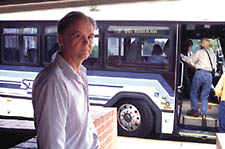
"As soon as I heard the senior got killed, it just all came back and I knew I had to do something," Burgess said.
He says the city has set routes that are too difficult to complete on time, forcing drivers to speed and skip safety inspections required at the daily shift change. Drivers can be punished for failing to be on time, even as Laidlaw tells them "safety first."
"The buck is being pushed onto the drivers by Laidlaw," Burgess said. "It never gets back to the city, and that's where the problem starts."
While Laidlaw, the city, and others may dismiss Burgess as a disgruntled ex-employee trying to get back at the company that fired him, much of what Burgess charges can be verified by simple observation.
Indeed, a New Times investigation found that required safety inspections like pressure-testing the brakes and checking the horn and signal lights are routinely skipped when a bus is running behind schedule. And on Routes 1 and 3–half of the city's bus system–the buses run behind schedule almost every day.
But observing that bus drivers on Routes 1 and 3 face unrealistic schedules doesn't take the five days worth of surveillance done by New Times for this story. All someone has to do is look at the bus schedule.
The Route 1 bus is scheduled to arrive at the Osos Street transfer station every day at 12:52 p.m. The drivers must then unload passengers, perform a check on all signal lights and the horn, walk around the bus looking for leaks and at tire pressure, take a mileage reading off the rear wheel hub, inspect the interior of the bus, test the brakes, and write down a brake pressure reading and other information on an inspection report [see accompanying graphic].
Then the old driver gets off the bus, the new one gets on, and the new passengers are loaded onto the bus. And this must be done before the scheduled departure time of 12:52.
That's right, both the arrival and departure times are 12:52.
It's the same story with Route 3–a route that everyone interviewed for this story admits is notoriously difficult to complete on time–which arrives and departs at 12:53 p.m. Meanwhile, Routes 4 and 5 are each given five minutes to complete the 12:50 p.m. shift-change routines.
That time difference allows for observable differences in the safety routines. Route 4 and 5 buses usually go through the full battery of shift-change tests, including a low-pressure test on the brakes, which can be heard as a series of bursts from the air brakes.
But on the other routes, New Times observed drivers routinely omitting safety procedures. In a couple of instances, new drivers skipped safety inspections completely, simply trading places with the departing drivers and driving away, in violation of not just Laidlaw policies, but also of state law as spelled out in Title 13 of the California Code of Regulations.
In addition, New Times and citizens in the community have seen buses running red lights, rolling stop signs, speeding, failing to yield the right of way, and other violations that can have dangerous–even fatal–consequences.
‘No Cutting Corners’
Officials with Laidlaw and the city say SLO Transit is a safe system. They say the fatal accident is an unfortunate aberration and that drivers hold safety as their top priority, as they are trained to do.
"Outside of this very unfortunate accident, we have not had any serious accidents [in San Luis Obispo County]," said Irwin Rosenberg, Laidlaw's area general manager.
Harley Kempter, the division manager who runs the SLO Transit system, said he couldn't talk to New Times, instead referring all questions to Rosenberg.
"They are never to sacrifice safety for time. Our direction is clear; nothing takes precedence over safety. Nothing is more important than safety," Rosenberg said. "I would want to know about any employees cutting corners to be on time."
Told of employees skipping parts of the shift-change safety inspections, Rosenberg said that shouldn't happen, but emphasized that employees are given plenty of time to complete the full morning inspection before buses hit the road just after 6 a.m.
San Luis Obispo transit manager Brandon Farley oversees SLO Transit operations for the city. He downplayed the significance of concerns about cutting corners on safety procedures to keep a tight schedule.
"So far, I'm happy with them on the safety issues," Farley said. "I'm very confident that Laidlaw is doing what's required by state and federal law and industry standards."
Yet Farley admits that confidence is not based on his direct observations, as he doesn't check to see whether drivers are following safety procedures during shift change or whether late bus drivers are speeding to make up time.
"There are weekly inspections, but it's more on a cosmetic level, making sure the buses are clean," Farley said.
Farley notes that buses receive thorough examinations and maintenance work every 3,000 miles, ensuring that buses won't operate with mechanical problems for very long.
"It doesn't take a bus very long to go 3,000 miles," he said.
Rosenberg was unaware of some of the specific information regarding shift-change procedures requested by New Times, so additional information was provided by Frank Ciccarella, Laidlaw's director of driver development and safety out of its corporate headquarters in Kansas City.
"We are not a company that is going to create unnecessary safety concerns," Ciccarella said.
Yet it is also a company that must operate a system designed by another entity: the city of San Luis Obispo. Even if certain routes are difficult to complete on time, Ciccarella said drivers are told not to rush through routes or safety procedures.
"We tell our drivers that we want them to perform these operations. We want safety first," Ciccarella said.
Still, the underlying reason for shortcuts in inspections and drivers feeling hurried lies with the routes, some of which are too long to complete on time without rushing.
"We don't control the planning and the scheduling of the bus lines," Rosenberg said. "I've heard the concerns about [Routes] 1 and 3, and they are very difficult to complete on time."
After years of concern over difficult routes, the city this September is finally changing Route 3, breaking it up into two shorter loops.
That should help with some of the problems. But it begs the question: "Why did it take some long to address the problem?" And, "What about Route 1?"
‘It Takes Time’
"Route 3 is the only one I've known where there is a problem," Farley said.
Everyone else interviewed for this story–from Laidlaw officials to bus drivers and passengers to the chairman of the city's Mass Transit Committee–say both 1 and 3 are difficult routes to keep.
"I have heard there is a problem with 1 and 3," Rosenberg said.
Even assuming the city only knew that Route 3 was a problem, that begs the question of why such a situation was allowed to continue for so long. Farley said he knew Route 3 was difficult to complete when he arrived on the job a year and a half ago.
"It was known when I came here we had problems with Route 3," Farley said. "The existing Route 3 has continuous problems. It is too long."
Industry standards dictate that buses can't complete a loop of more than 15 miles in an hour, Farley said. Route 3 is 15.5 miles. And it has been that length for more than 20 years, a time during which the route has been slowed even more by increased traffic, more riders, and changes to accommodate riders with disabilities.
Those are also factors that can cause buses on all of the city routes to sometimes go behind schedule, even on Route 5, which Micu was driving during the fatal accident.
Route 3 has gotten the most attention because it is so difficult to complete on time and can be delayed even on problem-free days. Records show Farley's predecessor knew of inherent problems on the route as well.
"Thank you for your letter of December 3, 1997, on the difficulties you have had driving route three," former transit manager Harry Watson wrote on Dec. 10, 1997, responding to a letter from Gerald Burgess outlining his concerns about safety. "We have been struggling with on-time performance on this route for some time. As yet, we have not identified the funding with which to address the problem. Please know that we too are concerned and consider it a high priority."
Finally, after years of concerns being expressed about the route, a redesigned, shorter Route 3 will be put in place starting Sept. 5.
Why did it take so long to deal with such an obvious safety problem?
"It takes time," Farley said. "It takes a lot of time."
Time and money, probably more the latter than the former, according to Walter Rice, chairman of the city's Mass Transit Committee, which oversees the bus system and designed the new route.
"The basic problem has been resources for transportation," Rice said.
Rice said changing the routes is not a simple undertaking. He said the alternatives for dealing with overly long routes are to eliminate stops, eliminate part of the route, find the money to increase service, or do nothing.
Eliminating stops or parts of the route create practical and political problems, as certain parts of town get cut out of the public transportation infrastructure. Also, older and disabled riders are forced to walk longer distances to a bus stop.
"If you eliminate stops, you are effectively reducing the service," Rice said, noting that the system's main mandate is to expand service whenever possible.
Without resources available to pay for additional bus miles and driver time, the city has opted for the "do nothing" option until this year, when city officials found the money to expand the system and the Mass Transit Committee met an unusually frequent six times in seven months to hammer out the new system.
Making the changes to Route 3 in the new schedule increases the city's annual expenditures on the bus service from about $1.2 million currently to about $1.4 million starting this fall.
"It is all about money," Farley said. "We have a limited budget and we've been balancing administration, capital expenses, and operating expenses."
Even with the change in routes, there are still lingering concerns about why the city doesn't know about some of the more obvious, and easily observable, problems with the system.
Who's Watching?
Most of the oversight of Laidlaw is done through Farley's review of a packet of documents the city receives from the company each month.
That packet includes an invoice (with charges broken down by monthly rates, hourly personnel costs, and mileage rates), a "Report Card Summary" (outlining accidents, road calls, missed trips, complaints, compliments, and on-time records), daily ridership figures, driver lists and training dates, and maintenance records for each bus.
Farley said he is satisfied with Laidlaw's maintenance and safety performance, and if he were a teacher giving grades he would give the company a B+.
But judging from the records given to the city, one would think that a late bus is an aberration rather than the norm on some routes, which is the reality.
On a seemingly detailed sheet outlining on-time performance, Laidlaw shows a daily log in which all buses are called by the dispatcher at 11 a.m. and 4 p.m. every day. Farley said buses more than five minutes behind schedule at the time of the call are considered late.
According to that log, SLO Transit has had only between three and five late buses every month in recent months. Yet anyone who rides the buses knows that just isn't accurate. Even saying SLO Transit has three to five late buses a day would probably be on the low side.
Why the discrepancy?
Because for all its seeming detail, the on-time performance chart is based on something that just doesn't happen. Buses aren't called at 11 a.m. and 4 p.m. every day.
"They would call occasionally, but I would say it's less than once a week," Burgess said.
A current bus driver, who doesn't share Burgess' belief that there are safety problems, agrees that they are not called twice a day.
"Once in a while they'll call to see how you're doing," said the driver, who requested that his name not be used.
Indeed when New Times twice rode 4 p.m. buses, no calls were placed.
Told of what would appear to be deliberately inaccurate data being given to the city, Rosenberg said he is surprised to hear the on-time calls are not going out as required.
"We are going to ensure that on a going-forward basis [the on-time call requirement] is adhered to," Rosenberg said. "But there is no conspiracy to provide inaccurate numbers."
If some records in the packet Farley uses to monitor Laidlaw are inaccurate, others that are needed to truly regulate the company simply aren't there. For example, there is nothing in the packet that would allow the city to monitor labor conditions at Laidlaw.
Farley was asked about SLO Transit drivers potentially working double shifts after New Times watched one driver go from one bus to another at shift change. Federal law precludes drivers from working more than 10 hours in a 15-hour period. SLO Transit drivers generally work six- to eight-hour shifts.
"To my knowledge, no driver has been working beyond the legal limits," Farley said.
But he also admitted that none of the documentation he receives from Laidlaw would allow him to monitor how many hours an employee works. Nor does he know how Laidlaw does its schedule, when shift change occurs, or what safety procedures are required at shift change.
"I'm unaware of how Laidlaw does their scheduling of drivers," Farley said.
Laidlaw denied a New Times request to review employee time cards, said they were unaware of the incident in question, and said Laidlaw obeys all labor laws.
If there were any labor problems or drivers with safety concerns, Farley believes there are avenues available to resolve those issues.
"They can talk to their boss. They can call me," Farley said. "It's my hope that if a driver has concerns, he will call me."
Burgess got a laugh when told of that comment. "[The drivers] don't even know who this guy is," he said. And even if they did, Burgess said, few employees would be willing to risk their jobs by reporting the company to city regulators, as Burgess had done before he was fired.
Farley said no current SLO Transit drivers have approached him with safety concerns. "I only hear about drivers' complaints after they leave SLO Transit," said Farley, a fact that he attributed to the sour grapes of disgruntled employees, rather than concerns current drivers might feel about becoming a whistleblower.
The ex-drivers are not alone in feeling ignored. Complaints of impartial citizens are sometimes given short shrift by Laidlaw and the city, even in the wake of a fatal accident.
Just two days after Lena Wilson was killed, San Luis Obispo resident John Van Etten said he saw a SLO Transit bus run a red light, at the very same intersection of Palm and Santa Rosa, almost hitting his car as he approached the intersection.
Van Etten, 73, used to be a regular bus rider before recent corrective eye surgery and said he is familiar with the fact that drivers race to keep tight schedules.
"The timing of the routes is such that drivers have to take chances if they are going to stay on time," he said.
Coming as it did two days after the fatality, and on the exact same turn, Van Etten was so appalled that he filed a formal complaint with SLO Transit.
Rather than thoroughly investigating the matter and/or reprimanding the driver involved, division manager Harley Kempter attached a note to Harley with the complaint form, minimizing its importance and questioning whether Van Etten saw what he saw.
Van Etten said there should be more independent monitoring of SLO Transit.
"There ought to be a spotter out there from time to time to see what the bus drivers are doing," Van Etten said. Rosenberg said the company does occasionally sends spotters out to monitor drivers.
Recent Problems
"Over the past two or three months, there has been a shortage of drivers," Farley said. "And there have been management changes."
The company lost its division manager to a local government job and also had to replace its chief mechanic. SLO Transit has had to hire four new drivers in the past couple of months, and nine in the past year and a half, out of a total of 25 drivers.
There have also been performance problems, with persistently late buses, a failed safety inspection, and a rash of accidents.
SLO Transit buses are inspected on an annual basis by the California Highway Patrol. At the most recent regular inspection in January, Laidlaw was given "unsatisfactory" marks after two of the six buses inspected were found to have safety problems (one involving brakes, the other the rear door). Laidlaw passed a follow-up inspection in June after replacing the "slack adjuster" in the brakes of all its buses.
SLO Transit buses were involved in six accidents in the first six months of this year, four of which were classified by Laidlaw as "preventable" (the company doesn't establish fault in accidents, only whether the accidents were preventable or nonpreventable).
The company also reported six accidents in the previous six-month period, but only one of those was preventable, an Aug. 3 accident in which a SLO Transit bus hit another vehicle.
Of the preventable accidents that occurred this year, three occurred within a period of just over three weeks. On Jan. 15, a bus hit a parked car, while buses hit the mirrors of other cars on Jan. 28 and then again on Feb. 8. They were followed on May 23 by the fatal accident.
The two accidents labeled nonpreventable this year involved a bus being hit by a car on April 29 and another car sideswiping a bus on June 1. Most of last year's nonpreventable accidents involved cars hitting buses.
Rosenberg downplayed the rash of "preventable" accidents and said they didn't meet the threshold that triggers the requirement that an action plan be developed to deal with locations that have too many accidents.
"Over 200,000 miles are traveled in that period of time (six months), so we're talking about one accident every 70,000 miles," said Rosenberg, referring to the three accidents in the three-week period. "We could have three accidents in a three-week period, and then go a whole year without another accident."
Farley said he was not concerned about the sudden surge of bus accidents, downplaying their significant by saying, "they were probably all no-fault accidents, probably all very minor." He made the statement even before he had obtained details on the accidents from Laidlaw in accordance with a public document request from New Times.
"I don't think there is a cause for concern," Farley said. "I don't think there is a problem now."
Keeping the Pace
Central to whether drivers feel pressure to keep tight schedules is whether they are punished for failing to do so.
Burgess said drivers who can't keep the schedule are removed from their regular route, a change that usually results in fewer and more erratic hours, including more work on nights and weekends.
"If you can't handle a route, another driver will be put in your place," he said.
Burgess drove Route 3 for much of his time with SLO Transit, and he felt constant pressure to cut corners on safety to keep the bus on time. And it wasn't just internal pressure.
He recalls one instance when the company's safety manager was waiting for him at the transfer station, visibly angry at his tardiness. "He was red-faced and yelling at me, ‘You have to keep the bus on time!’"
Burgess got a moving violation ticket in January of 1996 for an unsafe lane change, which impressed upon him that his hurried pace wasn't safe. So he started following the "safety first" mantra, his bus started being regularly late, and he was transferred off Route 3.
Much of what Burgess observed took place under Laidlaw's predecessor, Mayflower, which Laidlaw purchased in 1996, taking over the SLO Transit contract in the process. But Burgess said little changed under the new boss, under whom he worked for a year and a half, either in management style or safety routines.
A current driver, who spoke to New Times on condition that he or she not be named, said Laidlaw places less overt pressure to be on time than did Mayflower, which punished late drivers.
"With Mayflower, that was true, but not so much with Laidlaw," the driver said. "But they do want to keep it on time, that's for sure."
This driver hasn't heard the threats to late drivers that were heard under Mayflower.
"They said if you are consistently late you can lose your route," the driver said.
To hedge against late buses, Rosenberg said, SLO Transit has put in place the T-10 bus, which sits downtown and is available to fill in for buses that break down and fall too far behind schedule. But he said they expect drivers to keep the schedule.
"If any employee has a difficulty maintaining the schedule, we are concerned," Rosenberg said.
He wouldn't go into specifics on what can happen to such employees, except to say, "We deal with it on a case-by-case basis. It depends on the nature of the problem. We have a progressive disciplinary procedure."
Are Inspections Important?
Laidlaw and city officials both downplay the importance of the shift-change safety inspections, instead emphasizing the importance of morning inspections done in the bus yard, which are obviously more difficult for outsiders to monitor.
"That's something that, if you look at major bus systems in big cities, they don't do," Rice said of shift-change safety inspections. "In other systems drivers don't check the bus at all, they just change seats."
Farley said he was unsure how important the shift-change safety inspections are, but hopes the drivers would follow procedures.
"The brake check is the one thing I would think they would do," Farley said when told that the low-pressure warning check of the brake system isn't done on buses running late.
Rather than the low-pressure warning test indicated on the inspection form and confirmed by Burgess, Ciccarella said drivers at shift change are only required to do a "static brake test," which involves simply putting the bus in gear with the brakes on to make sure it holds.
"We are making sure the bus is held by the brake when the tank is low," he said. "If the guy does a complete brake check, that's more than we need to do."
As to how long the shift-change safety inspection should take, Ciccarella said "less than 10 minutes." Told Routes 1 and 3 are given no time in the schedule for shift-change inspections, he admitted that drivers are presented with a difficult situation.
Rosenberg emphasized that the morning safety inspection is what's important, not the shift-change inspection.
"Basically, [at shift change] we would expect the driver to do a thorough walk-around," he said.
His comments don't seem to be supported by Laidlaw's "Daily Vehicle Inspection" form, which spells out in detail exactly what each of the day's drivers should be checking at the beginning of their shift.
There are 10 items out of the 43 on the list that are in bold letters and include an asterisk indicating, according to the form, "line items to be checked on a ‘Mini Pre-Trip’ Inspection" performed by each new driver.
Among those items are the turn signals, flashers, all gauges, under-vehicle leaks, the horn, and the "low-pressure warning" for the brake system, which Burgess said consists of pumping the air brakes a number of times to lower the pressure, then taking a reading, for which a space on the form allows a number to be written.
That brake test is rarely done on buses that are late, but can be heard being done on buses that are on time. Yet Rosenberg insists that test isn't required during shift change, and those drivers who do it are just being extra safe.
"Drivers are required to do a quick walk-around and a visual interior walk-through and check the horn and the lights, then they can proceed," Rosenberg said.
It's odd that Rosenberg would mention the horn, because that is the one test required on this "Mini Pre-Trip" inspection that is almost never done, even on buses that aren't late, despite it being the easiest for an outsider to monitor. Burgess pointed out that you'll never hear a horn honk during shift change, and New Times found that he was right.
"Are they supposed to blow the horn? Yeah, they are supposed to blow the horn," Ciccarella said
State law requires all vehicles to have working horns, and it specifically mentions the requirement in the Title 13 section dealing with buses.
In addition to watching shift-change procedures, New Times took a couple of bus rides while working on this story. On one half-hour loop, driver Duane Hanna had to use his horn twice, once at a car that started to pull out in front of him, then to get the attention of a bicyclist that was drifting into the path of the bus.
Nonetheless, let's assume Rosenberg is correct that the shift-change inspection isn't a big deal and that the morning inspection is the only one that really matters. Let's assume that skipping over the midday inspection isn't going to cause the brakes to go out, or the signal lights to stop working, or the tires to go flat. Let's assume that the midday inspection has no impact on safety whatsoever.
Still, there is reason to be concerned by the observations of New Times, because the fact that drivers short-cut inspections illustrates that they are pressed for time. It has symbolic value. It shows that the drivers are willing to bend the rules to keep a bus on schedule.
And if they skip the brake check, might they also sometimes break the speed limit? If they don't consider checking the signal lights important, might they also run a red light if they think nobody's watching? If they assume the horn works, might they also assume they can make a hasty lane change? Or make a quick left turn, assuming no pedestrians are in the way?
Perhaps those same drivers who ignore Laidlaw procedures when they are running late will still diligently obey all of the myriad traffic laws. But what is the cost if they don't?
Mea Culpas
While city and bus officials maintain that the city bus system is safe and deny that undue pressure is placed on bus drivers to be on time, they did make several key admissions on specific points to New Times during interviews for this article.
Laidlaw officials say they will make sure drivers do the complete safety checks, make sure on-time checks are actually done, and increase the number of spot checks in the field to make sure drivers are operating safely.
"I'm happy you are bringing up this information to me, because we are delighted to address it," Rosenberg said. "If that isn't happening, we'll make sure it happens."
Ciccarella said drivers shouldn't be making marks on inspection sheets dealing with tests they didn't perform, or copying readings from previous shifts, as Burgess said is common practice with brake test numbers.
"If people are cheating by marking stuff on the sheets that isn't true, we want to fix that," Ciccarella said.
Farley said he was surprised by a number of the observations made by New Times and promised to take them seriously.
"Based on your input, I will look into these things," Farley said.
Will Laidlaw and the city really follow through and make sure drivers complete the full battery of safety checks and obey all traffic laws, even if that means more late buses?
Next time you're in the vicinity of City Hall around 12:52 p.m., listen for the honking of a bus horn to find out.
New Times intern Courtney Harris helped with research and surveillance for this story. Staff writer Steven T. Jones does investigative reporting and odd jobs for New Times.