













For Some, Collectibles Have Become the Poor-Man's Stock Market
BY GLEN STARKEY
What accounts for the increasing popularity of antiques and collectibles? Certainly the "Antiques Roadshow" airing regularly on Public Broadcasting Stations has helped fuel the flames of this specialized market. But the show's success is more accurately labeled a result of interest in collectibles rather than a cause of that interest.
Instead, the collectibles fad seems fueled by equal parts of nostalgia for a "golden" bygone era and disgust for the cheap, disposable products of our contemporary consumer culture. Let's face it: Things today are not built to last. Even new cars are mostly plastic. When our VCRs, CD players, and stereos stop working, do we have them repaired? No, it's cheaper to simply replace them.
That's why it's so reassuring to hold something old in our hands, to feel how solidly built it is, to know how long it has survived, and to want to protect and conserve it for the future.
But there are many other reasons people get involved with used items.
For some, collectibles have become the poor-man's stock market, with people hoping to strike it rich with that garage sale purchase or dusty heirloom waiting patiently in grandma's attic.
Perhaps the most interesting thing about the current antiques and collectibles market is the unusual way it's expanding. A common rule of thumb in the antique business is that objects 100 years or older are considered "antique," while objects less that 100 are "collectible." To further compound the issue, items from the ’50s, ’60s, and ’70s are often labeled "vintage."
Antique shops used to deal almost exclusively in antiques, but nowadays its not uncommon to find items just a few years old in such shops.
Secondhand and thrift stores have been around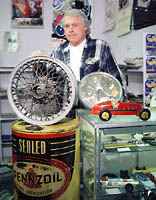 forever, but many have gravitated away from inexpensive clothing to more "high-end" collectible items.
And a trip to the swap meet reveals true "junk" peddlers side by side with people selling the same sort of antiques and collectibles you'd find at a shop, often without any discernible difference in price.
On top of that, there is a new crop of consignment stores that has sprung up in recent years, allowing people to leave their collectibles with a dealer who will sell the item and take a cut.
There are also people who "create" collectibles and furniture by taking older–not antique–furniture, then painting and "distressing" it à la Martha Stewart. From furniture to clothing to toys to automobile memorabilia to eyeglasses–old stuff is back and bigger than ever.
Retrospectacles
Andrea Chowins' husband, an optometrist, started collecting eyeglasses as curiosities, but Chowins soon found herself consumed by the hunt for unusual eyewear. Soon she was scouring collectible shops, taking over the collection and making a business out of it, selling them at swing-dance shows and over the Internet.
"I just got caught up in it. It's contagious. Now I use it as a ploy to drag [my husband] into antique stores."
Some of the specs in her collection are collectors items and wouldn't be considered very practical as functioning eyeglasses, at least by today's standards. For instance, she has 18th century glasses with extra long arms that are meant to attach to a wig, Civil War-era glasses, ancient Chinese sunglasses with hand-beveled tea-stone lenses, French scissors glasses, and several pair of lorgnette opera glasses made with hand-carved tortoise shell, including a pair that operate like a switchblade–press a button and out they pop.
But the bulk of the collection is ready to wear; prescription lenses are easily installed.
In total, Chowins has about 1,000 pair of vintage glasses including some never before worn, such as her supply of World War II-era Army surplus "birth control glasses," plain black frames so called because of their unattractiveness. They were made to instill a sense of uniformity and conformity among the troops.
Most of the glasses, however, are well used but refurbished.
"The minute I get a pair they go into the spa," said Chowins gesturing to a small steel glasses bath. "If they have major problems that can't be repaired, I'll part them out–they don't even make the screws for a lot of these glasses anymore. They're metric. Sometimes I'll find out I can't use anything but the screws."
Occasionally new hardware is installed, but Chowins takes special care to keep the glasses as authentic as possible. But function is first. They will, after all, be worn regularly.
There is admittedly something intriguing about old glasses. They seem more solidly built, more comfortable, and some of the designs are, well, nutty. From crazy cat eyes to rhinestone-encrusted disco glasses to nerdy horn-rims, vintage glasses demonstrate an insouciance that screams, "I'm fun to be around."
"I love watching people try them on," said Chowins. "They can really transform their faces, and they seem to have a good time with them."
Chowins tries to keep prices in the $75 range, although some are a bit more. And for about $55 more, prescription lenses can be installed.
"There's so much history in these glasses," she said. "Each one is like a little treasure of the past to me."
Chowins' website, www.retrospectacles.com, currently displays about 70 pair, but you can e-mail a search request for something special.
Automobilia
"I got into [automobile memorabilia] through 45 years of collecting full-sized old cars, which I still do," explained Peter Zobian, owner of Cambria shop Vintage Automobilia. "In fact, this store sort of grew accidentally out of collecting cars, because I found myself collecting everything related to cars–books, models, toys, literature about cars, and so on and so forth. I found I suddenly had a store. I didn't need to buy anything except a couple showcases."
Americans love their cars, but Zobian takes it to a whole other level. He's known far and wide as a collector's collector. And any time a car show is scheduled in the county he can count on an influx of business.
"They all come through here," said Zobian, who made clear this isn't a car parts store. "If you needed engine parts for a car, I'd tell you no, this isn't the place to go, though I could probably tell you where you could get the part you need. But if you wanted a car emblem or an original factory brochure or manual, that I've got. This is really automobilia, or memorabilia about cars."
Zobian himself is a collector of one-of-a-kind cars–the exotic and unusual. If he runs low on stock for his store, he goes home and gets some more. After nearly a half-century of collecting, his supply is almost limitless.
"Another thing I specialized in is antique toys. As a matter of fact, [comedian] Jonathan Winters was in the shop just yesterday and said I had the finest collection of antique toys he's ever seen from L.A. to San Francisco. He's a big toy collector and he bought three items."
The most expensive toy Zobian currently has in stock is a Keystone Bus from 1923. The pressed-steel toy is the largest Keystone toy made, 31 inches in length. The riding toy has a book value of slightly more than $4,000.
"I restored it and have it priced at $2,700," he said, noting that excellent original condition is best, but if the finish is almost all gone, it's better to refinish a toy.
"It's the same for both the antique gun and toy field–originality is the premium; it's far more valuable than the same item restored. But when you get to the point when the object has no finish whatsoever, you're already at the bottom of its value, so you can't hurt it by restoring it, unless you do a bad job. Now on my Keystone Bus, for instance, that had almost no finish. So I could either sell it for a low price, or refinish it and sell if for something more. Of course, I would never tell a customer it was in original condition [if I restored it]."
Zobian has a word of advice for prospective collectors: "My advice is to only collect what you like; then if it goes up in value, that's fine, and if it doesn't go up, you still have what you like."
He also sees such shows as the "Antiques Roadshow" as something of a mixed blessing.
"The 'Antique Roadshow' is an interesting thing. Where the show does a service is it gets people interested. But it also does a disservice by inflating expectations of what something's worth. They had a Keystone Paddy Wagon on the show that they said was worth $15,000! It's tough on retailers like me because you appear to be the charlatan when you have to get double what you paid for something to make a profit. So when someone brings something in to sell to you, they think you're not treating them fairly.
"The other thing, too, that happens is people, because of this inflated idea of what they have, don't sell the items. So they're not on the market; then they die and their relatives sell them for a nickel on the dollar at a garage sale."
Assessing the market can be tough. Guide books that list prices are often misleading.
"I always tell people that none of the stuff in this store has any value–none of it–until someone wants to buy it."
You can contact Zobian via e-mail at vintageautomobilia@thegrid.net.
Releasing Your Inner Child
Sunbear has been seriously collecting toys, bicycles, and unusual motorcycles for 20 years.
"I've collected all my life, but it became serious when I met this guy in L.A. who collects bicycles. I bought one and then I started going to bike shows and bought more and more."
From there he got into toys, mostly steel and tin cars, airplanes, motorcycles, and large-scale pedal toys.
"They say that this type of collecting stems from not having enough toys to play with when you were a kid," theorized Sunbear, who does seem to take special enjoyment from his collection, although he admits that everything has a price and everything's for sale.
And after so many years of trading and selling, Sunbear seems a little jaded. For instance, he didn't want his real name used in this article.
"I've been in magazines before and right after [you appear in print] you just get flooded with calls from idiots. They're not serious about buying, they just want to pick your brain or talk about how their grandmother had this or that. That's why I don't want my number listed."
One of Sunbear's associates, Fred (also not his real name), is worried about thievery, which is why he prefers to remain unidentified.
"When you have a lot of this stuff in one place, you really want to be careful not to announce it. It would just take one guy in a station wagon to make off with everything. Once you get a lot of stuff collected, paranoia starts to take over."
"One thing you've got on your side is, if it gets stolen it will turn back up," added Sunbear. "I know all the collectors, so all I'd have to do is put the word out."
According to both Fred and Sunbear, the toy market has taken an inexplicable dip in recent years. Things just aren't selling as quickly as they once did.
"I'm not sure what's going on," said Sunbear, who tried to explain the vagaries of selling prices: "It's more a thing of rarity rather than price. You could look up something in a guide book and it might say it's worth $500, but you may only be able to get $200 for it. Something else might list for $200, but you may have someone willing to pay $500. It's all about finding the right buyer."
Fred (who in addition to toys has a huge collection of movie memorabilia) and Sunbear go to swap meets, garage sales, estate sales, collectors fairs, and conventions, plus look through collectible magazines and secondhand, antique, and toy shops to find their items.
"I'm into authenticity," said Sunbear. "I've searched all over for an original bike part and gone so far as to buy a whole other bike just to get one part of it."
Sunbear is especially fond of Whizzers, motorized bicycles, but he's also collected Vespas, Cushmans, and Allstates–anything having to do with motorcycles, even paper goods.
In 1989 Sunbear and another partner bought 17 pallets full of paper products from the estate of motorsports pioneer Floyd Clymer. For $10,000 they bought the lot sight unseen except for one box they were allowed to open. As they began to explore the collection they discovered hundreds of vintage magazines, posters, and photographs, which they thought they'd sell at swap meets.
But they soon discovered there was simply too much to deal with. They finally rented out a huge Los Angeles-area hall and tables and had a three-day sale that netted $42,000–and only half the stuff sold! Ten years later Sunbear is still selling off the collection.
His one piece of advice echoes Zobian's: "My advice is to buy what you like, because if you don't buy things you care for, when you get stuck with them you'll be unhappy."
Sunbear welcomes serious inquiries through his e-mail address: soloso1@aol.com.
Antique Chic
Obviously antique and collectible dealers are a secretive lot. Not only do they want to protect their merchandise sources, but they often also want to protect their own identities, especially when they work out of their homes. Such is the case with a San Luis Obispo woman we'll call Ann Teak.
She does most of her business in Northern California and has her own secret "antique mines" where she buys items. She also has a team of "pickers," people who find her items from their own secret locations. Teak then refinishes or restores the items and pieces of furniture and resells them in various communities near the Bay Area.
"If everybody knew where I went [to find my merchandise] they'd go there themselves. They wouldn't need me. If you had a favorite thrift store in an out-of-the-way town, would you want to publish [its location] in the local paper?"
Teak's merchandise isn't technically antique; instead, she's in a fringe market known as "antique chic," which adds a distressed finish to older items which otherwise are nearly worthless.
"I kind of see myself as a recycler," said Teak. "People throw away so much."
Teak turns trash into treasure, sometimes dismantling pieces of furniture and creating something else. She recently dismantled a sagging oak desk she got for free and created wall sconces from the parts. She made $400.
"It feels like this job is so instinctual," she said. "You just look at stuff, and if you want to sell it for $40 you know you can't put more than $20 of work and materials into it."
Teak's first purchases were a Royal Copley rooster and hen that she bought in a Berkeley secondhand shop for $6. The pair are actually worth about $150 on the collectibles market. It got her thinking, and she soon found herself buying and selling items. Later she moved into her current focus, antique chic furnishings, which she refinishes according to what's "hot" in such magazines as Martha Stewart Living.
"You pretty well know what's hot, and that sometimes depends on the group I'm selling to. I tend to sell to people who are more eclectic, so I sell a lot of distressed furniture, for instance. I guess when you're a dealer you end up gravitating to a market that has similar tastes.
"I also go to the shows and see what people are selling. One thing that seems to be hot is any metal furniture, especially metal that has been dipped [and stripped of paint]. Quilts are always hot, and Fiestaware seems perpetually popular; but, once again, I'm into the funky."
Breaking the "Antique" Mold
There are plenty of antique stores in SLO County, but few these days deal solely in 100-year-old or older antiques. In fact, some "antique" stores have items just a few years old.
"Something can be brand-new, but if it's discontinued it becomes collectible," explained a dealer at the Antique Center who asked not to be identified. "But I avoid those kinds of items."
Traditional antique stores are becoming harder to find, with most now dealing in collectibles. For instance, California pottery, yellow ware, and jadeite–kitchenware made in the last 50 years–are all extremely "hot" right now.
Like Teak, many dealers are very secretive about where they locate their merchandise.
"That's our secret," said the Antique Center dealer. "We go all over. It's hard work, and it doesn't stop once we've found something. I research everything I have. And unlike a lot of other antique stores, if we get a good buy we pass it on to the customer."
Many antique shops, such as the Antique Center, accept occasional consignments, but nowadays there are stores that specialize in consignment. Pattea Torrence Kocan founded consignment clothing store Finders Keepers, but has since sold it and opened Old Edna, a consignment-only collectibles store located in the old tin-roof building out on Highway 227 south of San Luis Obispo, just before Price Canyon.
She hopes to capitalize on the "Antiques Roadshow" success.
"My vision is to see, hopefully this fall, Old Edna be the first to have twice-yearly roadside appraisal fairs. It's perfect for this old place, which was first conceived in 1897 and built in 1906. It used to be a grocery and mercantile.
"What I'm seeing is people pulling up with their goodies and having them appraised for a nominal fee. Then they would have the opportunity to place them on consignment at Old Edna. The key is for me to find the right appraiser–someone who can appraise many things. Most [appraisers] have a specialty."
Like Zobian, Kocan sees the "Antiques Roadshow" as a mixed blessing.
"In a way, yes, the show is helpful, because people are more aware that they may have things that are worth money, and they may release those things for sale. The show also shows that it now requires more expertise–you need to be more aware of what you have and [be sure to] not undervalue it. What people need to understand, though, is to get top dollar for this stuff you have to take it to a big city."
After wading through all the vagaries of the collectibles market, one thing seems clear: The best reason to get involved isn't with investment in mind, but rather because you find something you can't live without.
Glen Starkey has some vintage pet rocks he wants to sell you.