













After Nine Years, the Americans With Disabilities Act Is Still Being Worked Out
BY MARY SCHILLER
Jody Ramsland relaxes in the shady courtyard of Linnaea's Cafe, her bare toes the only part of her being warmed by the sun. She is a petite woman, her hands and feet as small as a child's but tanned from years of enjoying the outdoors.
"I love the sun," she says, pulling a blue cap down onto her forehead, "but not on my face."
One must listen closely to her, for at times Ramsland's soft voice almost disappears during particularly vibrant bird songs. But her small stature and soft-spokenness belie a strong woman who will always be, as she puts it, "the squeaky wheel" for people like her: people in wheelchairs.
Recently, she successfully campaigned to have the Community Garden at San Luis Obispo's Emerson Park made more wheelchair accessible. While she could get to her own plot–a raised bed at the right height for a wheelchair–she wanted to be able to see other people's green thumbs.
"I wanted to talk to other gardeners," she says. The way the path was originally designed, she continues, "they would have to come and talk to me, or I'd have to yell at them, ‘Hey, come over here!’"
She brought her concerns to the Parks & Recreation Department, and the path eventually was extended so that people in wheelchairs–"and mothers with strollers and people using a wheelbarrow," Ramsland adds–can enjoy more of the garden. But the project took time and, according to Ramsland, brought up an everyday concern of people with disabilities.
"I feel like we shouldn't have to go through all that," says Ramsland, who was diagnosed with muscular dystrophy at age 8. "It just shouldn't be that big of a procedure."
Before the Americans with Disabilities Act was passed in 1990 Ramsland may not have even had the option to broach the subject of accessibility. Although it took time to implement, the change to the garden was made. Which brings up a question: Where are we, exactly, nine years after the passage of the ADA?
The answer depends on whom you ask.
The Practical Side
"Certainly, there has been progress," says Jo Black, executive director of the Independent Living Resource Center, a group based in Santa Barbara that serves San Luis Obispo County and is the umbrella agency for SLOCO Access. Both agencies support the needs of people with disabilities.
"In an important way," Black says, "there's been validation that people with disabilities have been trying to be included in their communities."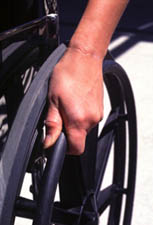
There is, Black points out, a real civil rights component of the ADA. Now people with disabilities "stop feeling so much that they are failing to overcome their disability and see it more as a barrier-removal issue."
On the practical side "many things have improved," she says, including the freedom to talk about disabled access, "and the response one receives is generally more positive. But there's still a long way to go. Hospitals and other places in communities like San Luis Obispo have had actual obligations since 1973 (the passage of the Rehabilitation Act). And California passed a corollary statute that state-funded entities need to be accessible. But when the ADA came along in July 1990 there still wasn't a lot of access."
As Black suggests, it's people's sentiments toward the disabled that haven't changed quickly enough.
"There is an attitude adjustment needed for organizations, companies, institutions," she says. "They need to begin to look at building the access issues in (at the beginning of a project). And staff training is always a component.
"The disabled person isn't just their condition. They're a person; some elements of their lives are simply different," Black adds, her voice becoming more impassioned. "It doesn't mean people are suddenly stupid. Disability doesn't mean incapacity.
"Disability has no context without barriers."
One of the goals of the volunteer-run SLOCO Access, explains director Polly Minteling, "is making people with disabilities more visible. Encouraging people to get out there, to use the businesses, go to lunch and use the services. Really take advantage of what the ADA has offered our community: accessible businesses and an accessible city (of San Luis Obispo)."
Minteling, who often uses a wheelchair because of a spinal cord injury, says "we have to be out there, and if we're sitting around complaining, ‘Gee, I can't go anywhere,’ are we really trying? It's as much asking the business or the city to be accessible as it is saying, ‘OK, be motivated enough to go out and use what has been made accessible for you.’"
Although Minteling believes access has improved over the past few years, there still are areas that need work. Michelle Mason, a SLOCO Access volunteer who has low vision, says traveling by bus is inconvenient because of the long waits between arrivals.
"At certain times of the day the buses only come every two hours," says Mason, making it difficult to get to work at a specific hour. "If you have a job that's flexible, it's OK. But not all of us have that option."
"That's what I've heard from other people," says Minteling. The service, whether it be transportation or disabled access, "is there, but it's often inconvenient. That's the biggest complaint."
Art Giumini, the risk manager for San Luis Obispo County and the designated ADA coordinator, says progress on disabled access is slow, "but we're moving forward."
The county has hired a consultant to evaluate all county-owned buildings as well as several leased structures. From there, the consultant drafts costs for repairs.
"We've been working on it for a number of years now," says Giumini. "It's an extremely long process and it's extremely expensive, in excess of $2 million." The biggest expenses, he explains, are modifying bathrooms and water fountains.
"We're trying to stagger [the projects] over a couple of years," he adds. "But if anything was major or critical, we tried to address it right away."
Giumini commends the city of San Luis Obispo in its compliance, naming curb cuts as one area the county will be addressing in the near future.
"We're doing a complete inventory right now" of all county buildings, says Giumini. "Groups like SLOCO Access do an awful lot of work on this issue, and we're all trying to work toward the same goal. But we're not in 100 percent compliance yet."
Despite the slow progress, the ADA, Black believes, "is a fabulous, usable statute. If we can keep it from being diluted, in another generation people will be saying, ‘What do you mean, there's no access? Of course there is!’ I believe there will be a paradigm shift."
The Legal Side
If we can keep the ADA from being diluted: That's the issue San Luis Obispo lawyer Allen Hutkin believes is at the core of a triad of U.S. Supreme Court decisions handed down June 22.
"It's a travesty," he says of the court's opinion on the main case, Sutton v. the United States. "It is outrageous. Now no one will be able to qualify as disabled."
It was already difficult to prove disability under the ADA. In fact, according to the American Bar Association, employers have prevailed in about 92 percent of the final case decisions. In addition, the American Bar Association cites the federal Equal Employment Opportunity Commission's statistic that employers prevail in 86 percent of the complaints resolved by the EEOC. Both figures suggest a rift between public perception and reality.
In Sutton v. the United States, the Supreme Court said by a commanding 7-2 majority that American Airlines was justified in denying employment to twin sisters who have bad eyesight. While their vision was correctable to within regulatory requirements, that didn’t meet the airline standard, which exposed a fundamental Catch-22 inherent in the ADA.
According to Hutkin and summarizing the American Bar Association's explanation, the act requires employees to prove they have a severe enough disability, but it cannot be so severe that they are unable to do their jobs competently. Clearly, very few employees can meet those requirements simultaneously.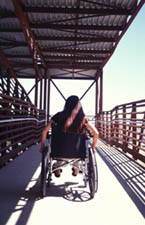
Moreover, that Catch-22 conflicts with the overarching purpose of the ADA: to protect employees with disabilities from disability-related discrimination. The question ought not to be what kind of disability the person has but, instead, if the employer is discriminating against the person on the basis of his or her condition.
Hutkin, who represents both employers and employees on this issue, believes the Supreme Court decision to be "very poorly reasoned. They basically eviscerated the whole ADA."
The Supreme Court decision effectively limits the reach of the ADA by ruling the law does not protect people with conditions that can be corrected. While the ADA was originally passed to protect the estimated 43 million disabled, "now, it's about 430," Hutkin says with a note of distressed sarcasm. "No one will be able to qualify, except people who are quadriplegic or terminally ill.... And no [attorney] will want to take these cases."
One needn't look far to find an opposing viewpoint. Two days after the court's decision, Washington lawyer Thomas Hungar, in an opinion piece in the Wall Street Journal, called it "a victory for employers and common sense."
Describing the original interpretations of the ADA's definition of disability as "broad" and "expansive," Hungar concludes that in the years since the ADA's passage, lawsuits by private citizens and claims under the EEOC have taken "extreme positions"–positions which they must now rethink.
The only bright spot Hutkin points to is California, which, he says, "is not as extreme as the federal law. We're much more liberal. Even someone who is HIV-positive without any symptoms is considered disabled in California."
Hutkin hopes there will be a movement to overturn the recent Supreme Court decisions.
"It's sad," he says. "People with disabilities finally got an ordinance that was supposed to help them be able to work. The Supreme Court just quashed it."
Going Too Far?
But while some argue that the ADA has been gutted, others complain that it requires too much.
Take theater productions. You may have noticed that some plays now feature signers who simultaneously translate the dialog through sign language. In some cases, those signers are employed as a community service, but increasingly they are being required under the guidelines of ADA.
The Performing Arts Center at Cal Poly this year employed signers when hearing-impaired playgoers requested it. This "reasonable accommodation" can cost the theater $1,000 or more (especially if multiple signers are needed to keep up with dialog). The PAC can absorb such a cost, but smaller theaters may have more difficulty, although none of the community theaters contacted say that it has had to face that yet.
Even more difficult, one of the few qualified signers in the county recently moved out of state. Would a theater be required to bring a signer up from Santa Barbara County? The law is not exactly clear on how much effort is "reasonable" to accommodate the disabled.
Ramps added to the size and cost of the Jennifer Street Bridge, but since getting from one place to another is an essential part of our freedom it was deemed necessary. The question becomes a little murkier when applied to recreational facilities.
Recently, local governments have also been petitioned to make the newly completed Bishop Peak trail handicapped-accessible. The argument is that public funds were used for the trail, so all of the public must be able to use it.
That makes sense for public libraries and other facilities. But is the intrinsic nature of a mountain trail changed if ramps and handrails, for instance, are required?
It might not be so out of the question. The trail from the parking lot to Glacier Point in Yosemite National Park not long ago was upgraded to make it handicapped-accessible with paving, handrails, and two routes–one of them easier and flatter.
These questions, nine years after ADA was implemented, are still being debated and revised with every court decision.
The Emotional Side
Anna Miller's voice quivers slightly as she talks about her life with multiple sclerosis. Her condition is characterized by intermittent attacks, which can lead to long periods of recuperation when she must use a wheelchair. Asking that her real name not be used because she's involved in a legal dispute with her employer, Miller says employers and others often don't consider the "small things."
"Like, how wide is the door, how heavy a door is.... My office door wasn't wide enough to fit my wheelchair," she says, "so I bashed up my wheelchair!"
But it's not so much the physical barriers as the emotional ones that cause Miller to pause.
"I don't want to be in a wheelchair," she says. "People come into my office and plop down in the wheelchair and say, ‘Oh, this is so comfortable.’ And they run it up and down the hall. I get kind of tired of that.... This is not fun for me.
"I wish all those people had to spend just one day in a wheelchair and see how hard it is to get through a door, to get in and out of the bathroom, get to the phone, all those things people take for granted," she says, her eyes filling with tears. "They'd learn a lot."
Miller says she does receive support from her family and friends, "people who understand the disease.... It's hard, sometimes, because depression is part of MS."
Joshua Stein understands depression–and the support of friends. Diagnosed with MS in 1995, he now uses a wheelchair, although he can walk with the aid of a walking stick–or a friendly shoulder. A few years ago, as his health began to deteriorate and "everything was going wrong," he says, he didn't want to go on.
"I was getting onto a spiritual path and was wondering, ‘God, where are you?’"
But with the help of caring friends, he says, he survived and is moving forward.
"This community has been great. I made a lot of good friends, back when I was athletic...and cool!" he adds with a broad smile. Many of those friends visit him daily, making sure he has everything he needs.
"Some people will say, ‘You'll always be like this,’ and they use logic," Stein says. "I believe I will heal from this disease.... I work on my faith and I listen to a song that says ‘never let go of your dreams.’ I'd love to run up and down these mountains again."
‘Not There Yet’
Ready to enjoy Farmers Market in San Luis Obispo, Ramsland rounds the corner near Rudolph's coffeehouse–and almost runs headlong into two bicycles locked to the railing of a wheelchair ramp.
"Well, look at that!" she says with a wry laugh. "This happens all the time. And I came this way purposely because I knew this ramp was here."
As someone holds the bicycles aside so she can squeeze past, Ramsland's careful not to bump them and cause any damage.
"What can you do?" she says, shaking her head. "I guess we're not there yet."
Mary Schiller is a freelance writer.