













Heckling Is a Big Part of SLO Blues Baseball Games, But Some Players and Fans Argue That It Goes Too Far
BY STEVEN T. JONES
Hecklers exploit shortcomings. That's just what they do, hoping to find a sensitive spot that will sting enough to disturb the concentration of an opposing player or coach.
So during the SLO Blues baseball team's second game of the season, when the coach for the visiting Oceanside Waves for some reason wore shin guards throughout the game, he became "Shin Guards," as in, "Hey, Shin Guards, are you afraid of getting an owee?!?!"
Throughout the game, Shin Guards and his team endured merciless and continuous heckling from the spirited crowd of pro-Blues regulars, led by 28-year-old SLO resident Chad Prescott, the loudest of the local hecklers.
Now, there are two ways to respond to being heckled. The first is to accept it, ignoring the taunts or maybe even smiling at the funniest lines. The second way is to demonstrate your contempt for the hecklers, a response that usually only makes the heckling worse.
Shin Guards chose the second way.
"If any of you want a piece of me," Shin Guards reportedly yelled, his face red and contorted, jabbing his fingers at the core of hecklers, "then I'll be waiting for you right down here after the game!"
True to his word, Shin Guards paced in front of the dugout after the game, furiously smoking cigarettes and waiting for challengers, long after his team had left the field.
The hecklers didn't want to fight. They had already won their battle. Their team had won the game, and they had contributed to that victory in their own small way by getting the coach to pay more attention to them than his team.
* * *
Heckling is a time-honored tradition among baseball fans, and it has been a big part of the Blues baseball experience since owner Tim Golden revived the semipro baseball team a few years ago.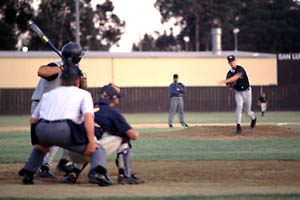
But not everyone is happy about that, for Prescott and company have as many detractors as supporters. Maybe more.
Just a week after the Shin Guards incident, Golden was confronted by an angry fan who didn't want his young son exposed to Prescott's invective.
"He said, ‘It's either my dollar or it's [the heckler’s] dollar,’" Golden said, explaining that this longtime fan said he won't come to the games anymore unless Prescott is muzzled.
Often fans that unwittingly sit in front of Prescott will change seats during the game. Others quietly express their discomfort. "I just feel so bad for him," one woman was overheard recently telling another Blues fan, describing one of Prescott's targets.
Those fans can often be seen moving to the first-base side, out of the range of most of the hecklers’ taunts. This has created a quasi-family side of the ballpark, similar to how Avila Beach sunbathers used to be divided by the pier.
Golden said he is sorry to hear that fans are bothered by Prescott and the other hecklers but he isn't going to do anything about them.
"If they don't cuss or say anything profane, we don't kick them out," Golden said. "We're waiting for him to cross the line, but he hasn't."
Prescott knows where that line is drawn. He uses no profanities in his heckling, not even the word "suck." He's even been known to chastise players and other hecklers for using profanities. Instead, his favorite phrase is "You stink!" usually followed by a player's number.
It is a phrase that he uses regularly during a running monologue of heckling that rolls out almost continuously from before the first pitch until after the last one. Rarely will a full minute pass without Prescott yelling something, even if he has to do it from the beer line.
"We told you you stink, 2-5, and you've proven us right. Believe, 2-5, believe that you stink," Prescott yelled recently at number 25 of the San Francisco Seals, while an animated teammate got, "Hey, 2, you still stink! Pitiful! Bad acting, bad hitting, just bad. Period."
Such gratuitous and constant abuse is spiced with humor whenever possible. After all, the heckler is a performer, playing as much to the crowd as the opposing team.
"That wasn't in the same time zone," Prescott yells at a particularly bad pitch.
While not profane, some of the comments are decidedly PG-13.
"What's the matter, 2-5, can't get it up?" another heckler yells at a low pitch. "Hey, get the pitcher some Viagra."
A pitcher is referred to as "Testicles," because all he has are balls.
Some of the stinging comments you know just have to get under a player's skin.
"If you're not going to swing the bat," Prescott yelled at the Seals' number 25, who was dragging himself back to his dugout after a called third strike that ended the inning, "you could at least make it back to the dugout a little quicker than that."
Two women new to the Blues games recently joined in the heckling fun, yelling out barbs like old pros and laughing uproariously with the group at the funniest lines.
"Heckling is fun," said one, a wicked smile playing across her lips.
* * *
Heckling has been around since the beginning.
"Disorderly fans are almost as old as the game itself. As far back as the 1870s, growing incidents of obscenities and rowdyism at the ballpark shocked respectable citizens and alarmed the press," Gerard S. Petrone wrote in his book "When Baseball Was Young."
He described a number of famous heckling incidents through history, with hecklers often having a big impact on the game.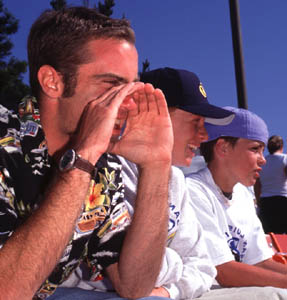
One was a 1903 game in Pittsburgh in which fans heckled visiting catcher Fred Bowerman so mercilessly during pregame warm-ups, mostly for a previous fight he had with Pittsburgh manager Fred Clarke, that Bowerman refused to play. And because he was the only catcher who could handle the scheduled pitcher's heat, the pitcher was also forced from the game.
Other hecklers achieved some modicum of fame for their art, such as Fred Olson and Jack "Megaphone" Atherton, two Portland Beavers fans from around 1907.
"They were the scourge of visiting teams. Their running fire of sarcastic comments poured out of the left field bleachers with the might of a Columbia River foghorn and was a source of considerable annoyance and distraction to opposing players," Petrone wrote.
Today most sports have hecklers–they are sometimes a big factor at Cal Poly basketball games–although baseball seems to have the most spirited hecklers and those who have the biggest impacts on opposing players.
During a workout in March, Tony Fernandez of the Toronto Blue Jays reportedly had to be restrained by his teammates after trying to go after some hecklers in the stands.
But the best players find a way to derive some motivation from hecklers, performing well to spite their detractors. Earlier this year basketball star Penny Hardaway of the Orlando Magic had a spectacular 30-point game despite nasty heckling from Pistons fans.
"Fans do get guys going, believe it or not," Hardaway told reporters after the game. "There was a guy who was heckling me the whole time."
For the fans heckling is a way to have an impact on the game, to in some small way help your home team.
"‘Heckle’ is a word that has been much maligned, pressed into the bottom of the bin of negative connotation. But we should dredge this word up, cleanse it and make it fit for use. This is the time of year when we need it most. The playoffs are upon us," Steve Luttner wrote in a commentary called "The Fine Art of Heckling" last September for the Plain Dealer, urging Cleveland residents to support the Indians baseball team.
Bill Zarras, in "Heckling 101" for the Florida Sports Network, advised hecklers: "Keep It in Control: Sure it is fun to hassle a player on the visiting team, but not constantly. If you do it once in a while, you are seen as a clown; everybody loves a clown. If you do it inning after inning, out after out, sooner or later the fans around you will see you as nothing more than a nuisance."
The Blues’ Golden especially likes heckling when it targets opposing players for lack of hustle, sloppy grooming, or poor sportsmanship–all things which he believes hurt the game's image.
"Heckling is to protect the spirit of the game," he said.
* * *
Blues fans are notorious for being among the loudest and most persistent hecklers in the league.
To give the Blues a taste of their own medicine, Golden said Santa Barbara Foresters coach Bill Pintard last season paid five spirited young men to sit behind the center field fence and aggressively heckle the visiting Blues throughout the game.
Golden thought it was hilarious. If it was meant to be a lesson to chasten Blues fans, it didn't work, because the heckling has only picked up this season at SLO's Sinsheimer Park.
More than something tolerated at the Blues games, heckling is actually encouraged , as with the officially designated "patsy of the game," an opposing player singled out for particularly intense abuse.
Frog and Peach Pub knocks 50 cents off selected beer prices after the game for each time the randomly selected "patsy" strikes out, a deal that creates some especially energetic heckling.
"The hecklers have an incentive to get in the guy's head to get him to strike out," says bar owner Bill Hales. "That's what really gives the home field advantage; it's the fans."
Frog and Peach also sponsors the "Peach Pit," a season-long special pass that includes free beer. Not coincidentally, the Peach Pit contains the core of the hecklers, who position themselves strategically, right behind the visiting team's dugout, close to the beer concession.
"And number 7 is the Frog and Peach patsy of the game," said the Blues announcer at one recent game, triggering a wave of taunts and abuse as number 7 stepped to the plate.
When late arrivals take their seats in the Peach Pit, one of the first things they do is ask who the patsy is and then join in the heckling.
"Hey, patsy, I'm thirsty. Don't disappoint me," Prescott yells.
The younger fans also get into the heckling, emboldened by Peach Pit veterans who laugh harder and harder at funny lines as the innings pass and the keg grows lighter.
"Whiff!" a group of four boys, probably 10 to 12 years old, yell in unison as an opposing player swings, cracking up the older hecklers.
"You suck!" they yell in unison a few minutes later, a rule-breaker that slides by with little notice from the heckling core.
* * *
Heckling certainly isn't unique to sports. In fact, a Lexis-Nexis search using the keyword "heckling" turned up as many political stories as sports stories.
Heckling happens everywhere from comedy clubs to public speeches to golf courses to the floor of the United States House of Representatives.
Yet some are bothered by the prevalence of heckling in modern society and say the tone of heckling has gotten especially personal and disrespectful these days.
"A lot of the heckling and taunts are clearly crossing the line of good sportsmanship and basic human respect," says Russell Gough. "These things, the taunting and the heckling, are another example of the growing incivility of society in general."
Gough is a "sports ethicist," a professor of philosophy and ethics at Pepperdine University, and the author of "Character is Everything: Promoting Ethical Excellence in Sports" and "Character is Destiny: The Value of Personal Ethics in Everyday Life."
"In general, heckling and taunts have gotten out of control and are actually hurting the game, in particular the young participants of the game," he said. "We have never seen the kind of dehumanizing, below-the-belt heckling we see today."
Profanity, comments about players' family members or personal problems, persistent derogatory comments–all are going too far, says Gough. He has no problem with enthusiastically rooting for a team and even taunting the opponents, only objecting when the heckling crosses the line of showing people a basic human respect.
Gough was pleasantly surprised to hear that the Blues’ most vocal and persistent heckler uses no profanity.
"To say the least, I have to commend the guy for his standards, I really do," Gough said. "Because that is quite unusual among the loudest sports spectators."
Gough advocates a return to the Golden Rule–treating others as we would like to be treated–as a way of creating a more civil, harmonious society.
"I think what we're seeing in sports is an unfortunate microcosm of what is happening in society in general," he said. "I know people say it is part of the game, but that doesn't mean it should be part of the game."
* * *
Physical stature is a big target for hecklers.
A tall player for the San Francisco Seals was hit with: "Hey, Jack, looking for your beanstalk?"
"It's the Jolly Green Giant."
"Hey, Lurch," followed by the singing of the theme song from "The Addams Family."
"What's the matter, 3-3, couldn't cut it in basketball?"
A minute later, a short player stepped to the plate.
"You're short!"
"Hey, she said you're short, and I don't think she was talking about your height."
"Hey, stumpy!"
"We're in the land of the little people now," before the group of hecklers breaks into a rendition of "Oompah, loompah."
"These kids want to play for you too, but they're too tall," Prescott says. "I guess nothing really grows up there in the fog."
"Hey, little people have feelings, too."
Then the player got a base hit.
"You've got to be Irish. Pick up that clover on the way down, will ya," Prescott yells, pausing for a beat, "But a pint of Guinness is still taller than you."
* * *
Why does Prescott heckle? For him, heckling is both the best way he can think of to support his team and a way to blow off steam.
"It's psychotherapy," Prescott said.
So it's an outlet for stress?
"Most definitely," he agreed.
"There were a few nights last winter when we were wishing there was a Blues game," said fellow heckler Craig Kehler.
Or, perhaps more to the point, it is a way of transferring stress from the heckler to the heckled, which gets back to the goal of helping the Blues win games.
The defense most offered by Prescott and other hecklers is that players need to learn to deal with hecklers, because it only gets worse in the big leagues. Golden agrees.
"To become a professional you need to be able to focus, whether it's trying to shoot a free throw [in basketball] with balloons waving in the background or someone is saying something about your mother," Golden said.
Besides, Golden says that in baseball the fans are more a part of the game than in any other sport, noting that catching a foul ball can be the game's highlight for many fans.
"It's the only sport where the stadium is part of the game," he said. "The fans are a big part of the game."
Heckle Steven T. Jones at sjones@newtimesslo.com. "Hey, what's the ‘T’ for, Jones, Tiresome?!?!"