













SLO County Artists Must Reconcile Making Art with Making a Living
BY GLEN STARKEY
It's an age-old problem for creative people–how to balance making money with making art. In San Luis Obispo County, far away from the vibrant arts communities of larger urban centers, the problem is widespread. Few local artists can support themselves solely from their artistic endeavors.
And yet they continue to create.
This week we profile five artists who have discovered different ways to solve the problem between the need to bring home a paycheck and the desire to make art.
Kevin Patrick Sullivan, realizing poetry never pays monetarily, is happy his custodian job pays his rent and affords him the opportunity for contemplation and solitude–essential elements to the fomentation of his art.
Bookstore clerk and single parent Lindsay Wilcox discovered that, for now, she just doesn't "give a damn" about sales, although she still intends to one day make a living from her sculpture.
For Jimmy de, he's found an equally fulfilling artistic endeavor in hair styling, the occupation that funds his fantasy photographs.
Musician-songwriter Wally Barnick, a loan officer in a mortgage firm, could make a comfortable living from his music, but supporting his wife and kids is his first priority, and the hot-and-cold music business doesn't offer enough security.
And stay-at-home-mom Lisa Deyo's career as a budding choreographer would have already been derailed if not for the kindness of strangers.
All five artists have found a way to solve the paradox which faces all artists–balancing art and money–and although their approaches are often different, they're also in many ways the same. All have found a way to support their art habits.
Kevin Patrick Sullivan: Poet, Custodian
People generally assume that it's at least possible to make a living as an artist, but poetry exists in a category all its own. Can anyone make a living writing poetry?
"I don't know if that critter exists," said 44-year-old Kevin Patrick Sullivan. "There might be a few. Edward Field is one. He's made his living writing poetry. He's also done some fiction. But his bread and butter is poetry. He doesn't teach and he doesn't give workshops, just readings and book sales. I once heard there were maybe four or five [people making their living solely from poetry] in this country."
Hence, Sullivan has no false notion of ever earning a living from his poems, although he's frequently published. His first book of poems, "First Sight," was published by Mille Grazie Press. His work has also been included in several journals, including Hummingbird, Cafe Solo, and Art Life.
"I do it because art is the true democratic process. That's how we make our public statements. It should be a forum, which is why I work so hard through Corners of the Mouth [a monthly reading series at Linnaea's Cafe] and the [annual] San Luis Obispo Poetry Festival to help work find its way to the public. I want to give poets a place to express their ideas. This is how democracy happens–in the cafes and art galleries. Does it happen in Congress? No way. There it's all about lobbies and special interests."
Democracy aside, poetry is a vocation totally devoid of monetary recompense.
"The whole system is out of whack," said Sullivan. "When we pay to build cars or machines, it's big bucks. But people who take care of our elderly–the nurse's aides and caregivers of our the hospitals and nursing homes–get minimum wage. It makes no sense: Those so precious you can't put a price tag on them are treated as worthless, but things–objects–they're the most important?
"Art, too, is deemed worthless, even while it serves the public by keeping the democratic system open and up front. Freedom of thought–that's where it's at. It's no coincidence that in totalitarian regimes freedom of expression through art is the first thing they crush.
"Sure, I'm offended by [the lack of financial support for artists], but not surprised. We can't even give those who take care of our own a decent living. Of course we're not going to reward artists."
But despite the lack of financial support afforded artists (and poets specifically), Sullivan marches on, unable to stop the outpouring of his heart and intellect onto to the page.
"I'll never stop writing. I'm hooked on the idea of service–service to art, service to poetry, which is service to mankind. It's such a large part of who I am. My life before poetry was aimless. I was wandering. I didn't have a clue. But I got on poetry and now I have a purpose. And it's enriched my life. I've had breakfast with Pulitzer Prize winners. Poetry has taken a laid-off factory worker from Detroit and made him an artist."
But like all artists, Sullivan must keep a roof over his head, the lights and gas on, food on the table, a car maintained, the insurance paid–in short, Sullivan has to pay the bills.
When he first moved to San Luis Obispo, he worked as a house painter before taking a job with San Luis Coastal Unified School District in 1990. Now he works as a custodian at SLO High School, a job that allows the artist time to think and contemplate, but more importantly, to support himself. Still, he'd like to devote more time to poetry, but the nature of being an artist on the Central Coast is compromise.
Said Sullivan: "Having to work decreases time for isolation and solitude, which are important for development of a rich inner life, for a dialog with the self. And that's what brings art to the forefront; it's what helps put us in an expressively creative place. But after working all day, sometimes I'm just too tired."
Sullivan hosts the next installment of Corners of the Mouth on Sunday, June 20, at Linnaea's Cafe in SLO.
Lindsay Wilcox: Sculptor, Bookstore Clerk
Lindsay Wilcox came late to art. The SLO High graduate first took a double-major degree from San Francisco State in the classics, with an emphasis on ancient languages, and in philosophy, with an emphasis on ancient philosophy. Her artistic awakening happened in 1983 when she took a class in sculpture from Cuesta College instructor Barry Frantz.
"Something clicked for me [while] doing sculpture," said Wilcox, 36. "I've never felt quite so satisfied doing anything else. I've dabbled in sculpture from that point on, but really, I spent the next 10 years in denial of myself as an artist."
She eventually studied for three years at the Art Students League of New York, a studio art school that doesn't grant degrees. Rather, it is simply a school for serious, practicing artists. Since returning to San Luis Obispo, the single mom has had to balance making a living, practicing her craft, and raising a 3-year-old son.
"Motherhood is very important to me. Part of the reason I'm going in the direction I am is because I want to set an example for my son. I want him to see someone who's dedicated and works hard. I've become much more dedicated since I became a mother.
"But it's common for people, when they hear I have a kid, to say ‘Oh, you're just a mommy,’ and dismiss me as an artist. People don't understand; you can be serious about your art and still be a parent."
Wilcox just showed a couple of pieces in "Salon of the Refused" at the Johnson Gallery in SLO, and beginning June 6 she mounts a solo exhibition at Linnaea's Cafe.
"For the next couple of months I've decided to be marginally employed so I can pursue my exhibition and so I can build a garden for my son," explained Wilcox, who was working at both Phoenix Books and Barnes & Noble Booksellers, the latter of which she quit to concentrate on her exhibition.
She believes sculpture is a potentially lucrative field, but she's not sure the artistic compromises one makes to be successful are worth it.
"If a person caters work to a certain market, certainly they could make a living. Unfortunately, the longer I do this the more I realize I just don't give a damn about sales. What I want to be able to do is explore an idea. I do intend to make a living from sculpting, but right now I'm more interested in exploring my ideas.
"I do it because I have no choice. I spent a lot of years in denial about who I am. I thought about returning to school to go into architecture, or going back for my master's degree to teach art history. I suppose I could give up pursuing sculpture commercially, but I couldn't give up doing it.
"Of course, I do want to succeed commercially; making money at this is an ancillary challenge. But even if I gave that up, I'd have to keep doing it. I'm just one of those people who has no choice. I'm this wacky artist person and I can't do anything about it."
Jimmy de: Photographer, Hair Stylist
Like Wilcox, Jimmy de came late to his art. After a 1984 knee injury effectively ended his career as a Sonic Cable Television employee, Jimmy de, 43, turned to rehabilitation and a new career as a hair stylist.
"They thought it was a strange choice for a guy who climbed poles and worked outdoors, who restored cars–physical work. But I've done painting, airbrush, and pencil drawing since I was a kid. Once they found I could work with my hands it made more sense.
"I wish I'd gone into hair right out of high school, but I graduated in 1974, and my dad being a cop I didn't want to give him a reason for a gun-cleaning accident," he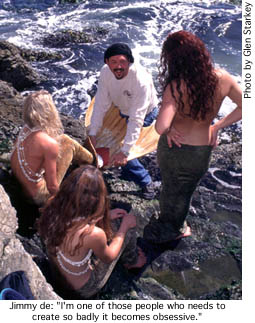 laughed.
Hair styling led to photography as he began documenting his cuts for inclusion in hair shows. In 1993 he won International Stylist of the Year for color and style, taking the picture of the winning entry himself. Suddenly the calls started pouring in.
"People wanted me to do their kid's senior portraits, weddings. I didn't know if I could do it, but I said, ‘Yeah, sure.’"
It turns out Jimmy de could do it, and soon he had a side business going in commercial photography, which subsidized a budding interest in fine art photography. "I have to do one so I can do the other," he said. But so far, he spends more money than he makes on his artwork. Last year he sold off his vintage truck to purchase new camera equipment.
The photographer's current project is a series of mermaid pictures. But since mermaids aren't readily available, he had to create his own, which meant finding models and making costumes. For Jimmy de, it became a collaborative affair.
"I love the camaraderie, the teamwork the most," he said. "I'm having fun being part of a team. That's why this has been such a great project."
Because he's doing a major project on a minor budget, he had to get others excited and involved in his vision. A donation from Buzz Morasca of Tubes in Morro Bay of 11 pairs of swim fins provided the base for his mermaid's flippers. Randy Coons of Motive Systems donated the stainless steel tubing and welding used for the flipper infrastructure. Jon Running of Jondu made the sculpted breast cups used in some of the shots. Linda Randolph helped with the costumes.
Even customers in Jimmy De's salon, Special F/X, got in on the act, donating the use of swimming pools for some underwater night shots. Tim Olsen of Jim's Campus Camera offered Jimmy de practical solutions to technical questions.
"Everyone has really come together and gotten behind this project," said Jimmy de, who went so far as to seek out Hollywood costumer Thom Shouse, the man who provided the mermaid suit for the 1984 Tom Hanks and Daryl Hannah film, "Splash." The costumes Jimmy de finally created are really remarkable.
"I had to learn how to sew to make these costumes," he said. Each costume was custom-made for each girl. Jimmy de logged about 125 hours on the 11 tails and created 15 bodices in another 75 hours. The whole project is being photographed over a year's time.
"These women are such troupers. We had [model] Holley [Atkins] in 48-degree water, and of course she had to look comfortable and happy. In between shots she was shivering."
Both Jimmy de and his wife, Linda, work on the makeup, hair, and costumes for the models, and Rex Saint-Onge and his son R.J. help as production assistants during the shoots.
"When you're doing landscapes or seascapes, it's really just you and God, but when you're doing the kind of work I'm doing, it always seemed unfair to only have the photographer's name listed on the photo credit. I'm only as a good as my team."
Luckily, Jimmy de has the kind of excitement-generating personality that gets others excited, too, and his personal vision is so dramatic and unusual that people just want to be a part of what he's doing.
"If I wasn't doing this, I'd probably be restoring cars or painting. It kills me to sit at home, relax, and watch TV. There's no way to turn it off. One of the reasons I like doing hair is because everyone's different; it's always a new experience, a new challenge. I'm one of those people who needs to create so badly it becomes obsessive."
Few artists find a job they like that also supports their art habit. Jimmy de is the exception.
"I love doing hair. Even if I won the lottery tomorrow, I'd still do it. I may not work seven days a week, but I'd still do hair."
You can see Jimmy de's images on the Web at www.tcsn.net/jimmyde.
Wally Barnick: Musician, Loan Officer
Wally Barnick is a chameleon. During the week he works hard as a loan officer at Cen Cal Mortgage, but on the weekends he becomes a member of the Cache Valley Drifters, one of the big names of contemporary bluegrass.
The Drifters first formed in 1972, but Barnick didn't come on board until 1975, right before the band backed Kate Wolf on one of her early albums, "Lines on the Paper."
Over the years the band has enjoyed record deals, choice festival gigs, and a cultlike following. But even a successful band can sometimes struggle to make ends meet, and early on it became clear that being a working musician would be a struggle.
"Luckily I have a patient and loving wife who has gone along with [my music career], but at one point it became clear it wasn't going to cut it," said Barnick. "I had to step back and analyze what I was doing.
"All three [members of the Drifters] did that. We asked ourselves, what would make us most happy? How much playing and how much touring were we willing to do? We've been able to answer that question and reach a balance, but I don't know how many solo artists or musicians get to this place.
"I tried quitting and Bill [Griffin] tried. In fact, Bill tried quitting for six or seven years, but found he couldn't quit playing. Since he's picked it up again, he's playing with even more fury. When I was running [the now-defunct night club] the Spirit, I quit playing, too, but it left some gap in me. Sure, I can get consumed in work here [at the mortgage firm], I can go full-bore and blank everything out, but I don't think I'd be a whole person.
"In any case, I have the best of all worlds: I get to play music and I have a job I love," continued Barnick. "And it's not just me; the whole band [which also includes Mike Mullins] has found day jobs that satisfy, that earn us enough money to be stable. Just the other day we were saying–tongue in cheek, of course–that for first time in our lives we're making enough money to be musicians.
"I saw this bumper sticker I just loved. It said, ‘Real Musicians Have Day Jobs.’ Bill's a retailer in Santa Barbara; he has his own clothing store. Mike is in the office machine business. Each of these jobs allow us enough flexibility to do what we want to do. Right now we're saving up vacation time. We tour Europe once a year because we're on a German record label [TaXim Records]. Usually we're leaving town on Friday nights and returning on Sunday after doing a couple weekend shows."
But could his band gig earn him enough to live on?
"If we wanted to damn the torpedoes and go for it–and I think that's risky–then, yeah, we could do it, but none of us are willing to do that. Maybe when we're older we'll want to do that, but for now I can honestly say we've reached a level where we're all really quite happy. It's our outlet. Some guys go out and play golf; we go out and play music."
But working 40 or more hours a week, being a family man, constant touring every weekend, late-night recording sessions, booking shows, and doing interviews–it's got to take a toll. Since Barnick already makes a great living at his day job, why do the music thing?
"Why do people play music? Why do they do anything? There's a kind of a bug that musicians catch. We have the bug, and it doesn't appear to be going away. I can only speak for myself and for Mike and Bill, because we're so interconnected after playing together for 25 years, but music is something we got caught up in as young men, and we've never been able to stop. Maybe it's something to do with leaving people with smiles on their faces. It's a real treat to do that. There's a certain satisfaction being able to create fun."
But Barnick and the other Drifters decided that if they were going to take time off from their work, it would have to be worth it financially, too.
"It is a business, without a doubt," said Barnick. "We have an accountant. Bill and I own our record company. We make money with it; we have to. If we're going to take time away from our jobs, we have a rule: We have to make twice as much each day we're away when we should be at work. When we go to Europe, we come home with that kind of money. Hey, man, we're big in Europe!"
The Cache Valley Drifters play Castoro Cellars Winery this Saturday, June 5. See this week's music section for more information.
Lisa Deyo: Choreographer, Stay-at-Home Mom
At 16 years old Lisa Deyo (then Lisa Freeman) left high school and San Luis Obispo to go, on her own, to New York, where she planned to begin her career as a professional dancer. After several years of hard work and eventual disillusionment with the dance world, she washed her hands of dance and returned to San Luis Obispo.
"I had about 20 jobs [when I returned]," said Deyo, 34. "I was a waitress, a bar-back, a silk-screen cleaner, worked in an art department, developed film, cleaned houses, pulled weeds–I did whatever I could. I tried going to school. I hated it all. I found I couldn't not dance."
She decided to return to the professional dance world, but in a smaller way. She took jobs at theme parks, the kind of thing "you do in the summer when you're in high school," which led to some other California jobs. But for a long time Deyo's knees had been deteriorating, and she knew her career as a professional dancer couldn't last forever.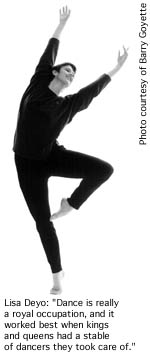
It was also an extremely poor existence. Even when she was at the top of her career she was barely eking out a middle-class income and was taxed further by the itinerant lifestyle that took her from hotel to hotel and city to city.
"I had one of the best concert company jobs in the country with Hubbard Street," said Deyo. "Unlike most dance jobs, it was a year-long contract and came with full health benefits. Most dance jobs are seasonal. You work for a few months, then go on unemployment until you find another job. But I was only making $24,000, and the highest-paid dancers in the company only made $30,000."
Since she stopped dancing professionally four years ago she's been slowly building a secondary art career as a choreographer–not an easy thing to launch from San Luis Obispo.
"I knew I wanted to choreograph since I was 10, but I didn't know I would like it as much as I do. I didn't think it would be as fulfilling as dance. But for this time in my life, it's the best thing I could be doing."
The first time Deyo was paid to choreograph was at age 19, for the San Luis Obispo High School production of "Bye-Bye Birdie." She was paid $50. Since then she has choreographed several local productions, but after traveling the world as a professional dancer and interpreting dances created by some of the world's greatest choreographers–Martha Graham, Bob Fosse–Deyo had her sights set a bit higher.
"Could I make a living doing choreography, just working in San Luis County? No," conceded Deyo. "I think there are choreographers at [Allan] Hancock [College] who make a living, but they're also teachers and dancers–resident artists. Those are full-time jobs.
"To really make a living as a choreographer I'd have to be selling pieces to out-of-the-area companies. And that is something I can do from here, but I'm at the beginning of my career."
Her career got a boost two months ago when one of her dances was chosen as one of eight finalists for the International Competition of Classical Choreography, part of the International Festival of Dance in Paris, France.
Just being chosen was a remarkable feat, but the difficult part was yet to come; Deyo had to form a company of dancers and get them to Paris to compete. There was simply no way she could pay for it herself. So she did what few artists are capable of: She asked the community to support her.
In just six weeks, Deyo was able to raise $11,000, which helped defray the cost of airline tickets, accommodations, costumes, and a small recompense for her dancers.
"My career is possible due to a combination of factors all working together. The people of San Luis have known me since I was a little girl dancing. I couldn't have done this anywhere else. That's what's so great about this town."
Even though she didn't win the competition, being a finalist gave her credibility in the dance world. Now major dance companies not only take her phone calls, but they also negotiate to buy her dances.
"Before I went to Paris only people [in the dance world] who knew me took me seriously. Now they all do."
But even if Deyo did manage to sell four or five pieces to companies every year, she'd still be making just $30,000.
"Luckily I married well," she said.
Her husband, Jacques, has a successful bicycle clothing company, allowing Deyo to be a stay-at-home mom and part-time artist.
"If I didn't have Jacques, I wouldn't be a choreographer. Dance is really a royal occupation, and it worked best when kings and queens had a stable of dancers they took care of. I also don't think it would be possible if I hadn't have gone to Paris, and that was due to the kindness of strangers."
Which brings up another point. The reason many local artists have to reconcile making art with making a living is because they choose to stay here, where it's extremely difficult to earn a living in the arts.
"I think if you scratch the surface, you'll find a lot of very talented artists who have put their careers on hold so they can live here," said Deyo. "You have to be willing to compromise. For me, it's worth it. When I was in New York I would go to the road median on Broadway, plug my ears, and look up through the few trees that were there and pretend I was in a park back in San Luis Obispo."
Glen Starkey writes for New Times so he can paint.