













Look Closely and You’ll Find a Bit of Restaurant History and Community
BY PAM WOOLWAY
The golden age of the diner has passed. Today, they are seen mostly in period movies from the 1940s and ’50s. The TV show "Alice" featured a diner, but that was in a throwback, an attempt to differentiate itself from the slick yuppie shows. And "Alice" has been off the air for years and years now.
The world has become filled with niche, ethnic menus–Thai, vegan, Cajun, you name it. And fad foods compete for our attention (remember wraps?). Diners come from a time when spaghetti was seen as daring dining.
Diners are so out that retro-diners have made a brief but largely unsuccessful comeback. But if you look closely, you’ll find that authentic diners continue to dot the Central Coast landscape.
* * *
Lil Swall’s perfect for the part of diner owner.
"I remember when Grand Avenue was nothin’ but eucalyptus trees. My folks had the Corner Drive-in down on Eighth Street, and that was my first job making burgers," says Swall, not looking up from the fresh ground beef being pressed between her hand and a wooden chopping block.
"We're celebrating 29 years," she says. "I worked for Goldie here in this cafe before I bought the place. Heck, I remember when Highway 101 was where Traffic Way runs now."
She concludes with a nod out the front window of Lil's Kozy Kitchen, the small diner triangulated by Traffic Way and Nelson and Bridge streets in Arroyo Grande. Although the 30-seat eatery was destroyed by fire in the early 1940s, it stands today in its original authenticity.
"I've seen four generations of families go through this cafe," she says and proceeds to list a dozen names of the living and deceased. "We're not going anywhere," she adds in a slow and metered voice. "We'll be here, Lord willing and the creek don't rise." Arroyo Grande creek runs, gently now, 100 feet out the cafe's back door.
* * *
What makes a diner a diner?
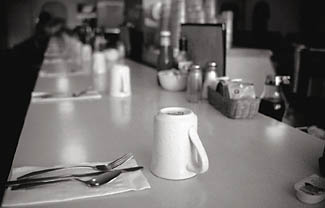
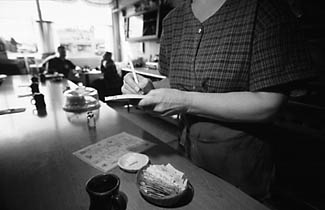
The first criterion that distinguishes a diner from a restaurant is the presence of a counter. In the home stretch of the 20th century, diners still play a central role in a community. The pulse of the neighborhood can be most keenly felt at the sleek and polished counter of a diner.
A diner will tell you much about the community around it. Is this a transient town or one of the twilight communities that's home to veterans and the retired? Is there a college population or one of career-oriented professionals? Sit at a vinyl-clad stool behind the counter's smooth surface and observe.
The long arm of Formica cradles the most vital part of the diner. It embraces the very heart of the establishment, the kitchen. Near the warmth of the oven, the action of the grill, the hustle of the waitresses, there is a palpable energy accessible to the counter patron. The counter invites the solitary diner a refuge behind home plate where all the action is taking place.
Those who are drawn to this specific seating arrangement are possibly drawn to the familiarity of the repetitive actions that say, "I am cared for." We thrill at the call of our names as we pass through the door and the blur of the waitress, coffee pot in hand, calling out, "Good morning!"
The second criterion imparts a familial impression of a diner. Sit in a diner for any length of time and you find a sense of kindness and inclusion. This is a spontaneous neighborhood gathering place, much as the local bar, but better.
There is a sense of belonging that only a meal shared around a table can instill. A seat at the circular counter of Louisa's Place in SLO provides such an atmosphere. Ed and Christy Sweeny moved into the diner at 964 Higuera in 1991.
As one patron put it, "Louisa's is representative of the entire town of SLO. It is the only place where there are National Guardsman sitting next to homeless, sitting next to lawyers, sitting next to the elderly, sitting next to students."
That community is important for the Sweenys. "This is so much more than a restaurant," Christy says with conviction. "It really has taken on a life of its own."
* * *
Diners can be 24-hour places, but the ones around here are mostly breakfast and lunch places. Spotlight features that one can be sure to find on most of these menus are liver and onions, chicken-fried steak, biscuits and gravy, corned beef hash, and homemade pies. Owner Larry Eastwood bought Vic's in Paso Robles from the original owner in 1973, but it has been the location of a diner since the 1940s. Eastwood has managed to preserve the stapes of an old-style diner while embracing the health-minded conscience of the ’90s with a variety of vegetarian fare.
The Orcutt Country Kitchen at 127 E. Clark Ave. is one of the only diners around where the grill is still in full view behind the counter. Even those seated at the four booths that bedeck the tiny establishment have a ringside view. Jose Garcia took over in ’92. The wall stretching the short span of this rectangular dining room pays homage to the ancestry of the town. Black-and-white photographs give a peek into Orcutt's oil drilling history.
"Once the people who were part of this era are gone, we'll have lost a huge piece of our history," Garcia exclaims.
"One of our regulars is Eddie Capitaui, who has been here most of his 80 years," Garcia continues. "He has helped identify the buildings and people in these pictures."
One photograph shows a pool hall and saloon which Garcia speculates is where the cafe stands now. "Eddie seems to think the Mirror Bar photo is where this diner stands today. But I am always looking for folks to help me piece this mystery together," he smiles with a shrug.
There is a rich and living history that is elusive to the newcomer. The depth and complexity of our community only reveals itself to the patient and the loyal. Californians with generations of family native to this state are not that hard to find if one simply slows down long enough to enjoy a pot of coffee and show some loyalty to the local merchants who have persevered throughout this growth-filled century.
Pam Woolway covers food for New Times.
Vincente's Meatloaf
From Louisa's Place
Ingredients:
1 lb. ground beef
3/4 cup oatmeal
2 eggs
1 tablespoon soy sauce
1 onion, chopped fine
1 green pepper, chopped fine
1 teaspoon salt
1 teaspoon pepper
Procedure:
Whip together eggs, soy sauce, salt, and pepper. In a large mixing bowl combine all other ingredients, mixing with your hands. Work in egg mixture. Bake at 350 degrees for 45 minutes in a well-oiled square pan.