













Unschooling Allows Children to Discover Learning in Daily Activities
BY GLEN STARKEY
Who should decide what your child learns today, a teacher, school board, or you?
You might be surprised to learn that a new trend in education suggests that the answer should be none of the above. In unschooling, the child decides what he or she should learn.
Unschooling rejects the idea that students must be taught by professionals and force-fed a predetermined curriculum. Instead it endorses letting kids explore the world, their own natural curiosity as guide and teacher.
These kids don’t go to school. They stay at home and learn fractions from measuring pancake batter, marine biology by exploring the beach, or language skills by writing letters.
While the American public education system has been slow to accept this notion, many home-schoolers here in SLO County and throughout the nation have embraced unschooling, suggesting that kids have a natural curiosity and want to learn without motivation and that they will naturally explore the subjects they need to succeed in life.
And unschoolers have an impressive list of dead intellectuals on their side:
• Albert Einstein: "It is a miracle that curiosity survives formal education."
• Isaac Asimov: "Self-education is, I firmly believe, the only kind of education there is."
• Mark Twain: "I have never let my schooling interfere with my education."
• Margaret Mead: "My grandmother wanted me to have an education, so she kept me out of school."
And the unschooling concept has received a surprising amount of support from mainstream educators. In fact, not one teacher or administrator interviewed for this story offered anything more negative than qualified reservations about the idea of unschoolers scrapping formal educational procedures.
So What’s It All About?
According to unschoolers, traditional public schools and the tactics they use to control and facilitate learning in a large and varied school population zap the natural learning instincts of children, instead teaching them to sit down, shut up, and follow directions.
"It's a kind of indoctrination," said Barbara Alward, a North County resident who has unschooled her two children, Suzanne, 12, and Nick, 15, their whole lives. "I understand why it has to be done; it's a form of crowd control. But it sets the stage for passive learning. But when they leave school we suddenly expect them to be self-directed, self-motivated self-starters. I think it makes for a rough start in the real world, which doesn't work like school."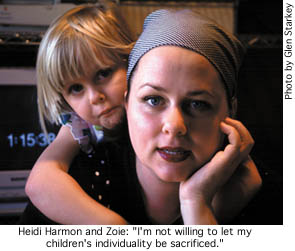
Unschooling isn’t exactly a model for real-world realities either. So unschoolers, and home-schoolers in general, are used to responding to a raft of questions.
For instance, if kids don't go to school, how will they be socialized? How will their learning be assessed? How will they build an educational transcript to determine which, or if, college is right for them? Won't they have holes in their education? How can they teach themselves math or science or reading? How can parents who don't understand more advanced forms of these skills teach their children?
And it doesn't help that home schooling has a bad rap already. For many people, the term "home schooling" conjures images of Christian fundamentalists or right-wing extremists "protecting" their kids from society while indoctrinating them in their marginalized philosophies.
According to Alward, learning the basics taught in school "takes about 100 hours, when students are ready to learn." And yet students spend about 1,100 hours a year in classes. Another charge unschoolers level against the traditional public school system is that learning doesn’t occur in neat 50-minute intervals and shouldn’t be turned off and on like a light switch.
Alward’s daughter Suzanne might spend several hours reading on one subject, totally neglecting things like math or science for days, then return to concentrate on those subjects when she’s in the mood. Alward finds both Suzanne and Nick learn faster and retain more information when they want to tackle a subject. She believes that whatever holes may appear in her children’s education will fill when the time is right.
"I think these holes occur in traditional school, too," said Alward, who writes a regular column for an unschooling publication. "Sure, you can sit in class, but what if you left your mind in the hallways? If a parent is interested, interested in their children, then they're going to do a complete job teaching them. And you've got time on your side; each day is interesting and new."
If students are sheltered from real life at home, how will they learn to thrive when they’re thrown to the lions as adults?
"I think the whole socialization thing is interesting," said Alward. "What does it mean, to be socialized? Doesn't it mean caring about others? I think they get that in the family structure already. Both of my kids are nice, kind people.
"And when you look at how cut-throat, how cruel our society is, when you look at what it dumps on kids, how they're made to feel [that] if they don't fit in, if they're the dumpy kid who gets picked on...it damages a lot of kids in a way they never recover from."
Certainly it’s true: Kids can be cruel. Nowhere is that clearer than on a school playground. But isn’t that merely a microcosm of the real world?
And what about extracurricular activities? Unschooled kids will never play a school sport, perform in the band, participate in a school play, or join an after-school club? Aren’t those some of the essential joys of traditional education?
‘I Didn’t Make This Decision Lightly’
One local 15-year-old, Ben Cavaletto, recently decided to join the ranks of the unschooled. Ben, whose dad is a professor in the Agriculture Engineering Department at Cal Poly and whose mom is preparing to receive her bachelor's degree there, had to talk his parents into letting him leave school.
"I didn't make this decision lightly," he said. "I talked to counselors and my parents. I weighed out all the things I would miss. I wouldn't see my friends every day. I couldn't go to dances and stuff unless I was invited [by another student]. I wouldn't be going through graduation ceremonies. I couldn't be involved with any campus groups like jazz band or sports.
"I went through each of these things and asked myself, could I get this somewhere else? I found that my interests were changing and that more and more I had things in common with adults. I finally decided it wasn't worth the trouble to stay in school when I could get the things I need elsewhere."
For Ben, unschooling seems right. The floor of his room has a neat pile of Cal Poly library books: mathematics in nature, alternative community planning, and architecture. Ben was going far beyond the sort of work he would do in high school.
"I've always been one to push the system," he said. "In the seventh grade I found I became more and more dissatisfied. My attendance started to drop. I still made A's and B's, but I began to resent the busywork they made us do. I understood most of the concepts they taught almost immediately, so doing a lot of homework when I already understood the material seemed like a waste of time. High school is a lot of jumping through hoops."
While he sees it as a logical decision, Ben gets many questions when people learn that he is unschooling.
"Usually I get two reactions," said Ben. "They’ll ask me how am I going to get socialized, or they’ll offer their opinion about unschooling–usually it’s negative. But for the adults who know me, there’s been no concern about whether or not I could learn on my own; they know I can teach myself."
Support From the Mainstream
You'd think, for instance, that public school teachers would have a vested interest in defending traditional education, and they do; but they, too, recognize unschooling as a viable alternative: "I think the traditional system works for the majority of students," said Linda Campeggi, president of the San Luis Coastal Teachers Association, "but for many students, home schooling is the right choice."
In fact, there are an increasing number of texts by reputable authorities that challenge traditional education methods. Jerome Bruner, author of the seminal 1963 text "The Process of Education," this year published "The Culture of Education," in which he argues carefully and persuasively that many well-established ideas about traditional schooling and the policies and practices that follow are as obsolete and incorrect as they are well-intentioned.
Of course, home or unschooling simply isn’t an option for most American households because both parents work. And even educational experts like Alice Tomasini of Cal Poly’s University Center for Teacher Education, who counts herself a proponent of self-directed learning, suggests that unschooling is not the panacea to cure all our educational woes.
"I would caution unschoolers to learn from our experiences with progressive education; turning increasingly to the needs of the individual student can be too much of a good thing," said Tomasini.
"Education in a democracy must balance subject matter, society, and students as basis for curriculum development. Unschooling in its optimal state could very likely connect individual students with powerful subject-matter learning. Students would learn how to direct their own learning. They could develop a love of learning, problem-solving strategies, and increased capacity for personal responsibility and resourcefulness.
"But unschooling must also prepare the student for society. Unschoolers, and public school students as well, must be given plenty of opportunities to work with diverse people and ideas. Education for democratic life must help children learn how to deal with controversy and collaboration, divergent opinions and multiple perspectives."
It's not as if the scared cow of public education isn't in need of some revamping.
Last week it was announced that, once again, California school children are bringing up the rear in national education statistics. Fourth- and eighth-graders came in at the bottom of the reading scores–for fourth-graders, only Hawaii, the District of Columbia, and the Virgin Islands had lower scores; only Hawaii, Louisiana, Mississippi, the District of Columbia, and the Virgin Islands scored lower than California eighth-graders. Of course, much of these scores have to do with the high population of non-native English speakers in California. But still, most agree public education could do better.
Teachers Who Unschool
One local San Luis Obispo family has made the decision to home school, even though both parents are trained educators, one working as a high school teacher.
"Public schools are sacrificing individuals for the needs of the group, and I'm not willing to let my children's individuality be sacrificed," said Heidi Harmon, a liberal arts grad from Cal Poly who’s unschooling her 5-year-old daughter, Zoie, and 3-year-old son, Jack.
In Zoie's case, she's already reading at about a second-grade level, even though she would barely be eligible for kindergarten this year. But according to Harmon, schooling her kids at home isn't about trying to speed up the process of education.
"I'm not trying to make a supergenius kid, I just want them to have full, interesting lives."
According to Harmon, learning is a process, not a product.
"It's all about ‘product’ in the public school system," she said. "I was a preschool teacher for two years, and a lot of the kids there had two working parents, and when they'd come to the school, they'd want to see what their kids made, what they did. They wanted to see something tangible, a product. I think they felt a little guilty about not being with their child, so they wanted proof that something was being accomplished. But learning is a process, not a product. Unfortunately, people aren't interested in that."
The day I visited the Harmons they had just returned from the beach, where they collected shells, and the library, where they checked out books on shells. Zoie and her mom were using the books to identify the types of shells and the creatures that lived in them, and both Zoie and Jack were drawing pictures of the shells.
"My mantra is expose, expose, expose them as much as possible," said Harmon. "[We do] unstructured and structured learning both. But I try to let them pick what they're most interested in and explore that more."
These little excursions are a favorite of unschoolers. For Suzanne Alward, her favorite thing about being unschooled is being able to "go out and do stuff" with fellow home-schoolers. Ben Cavaletto, too, enjoys research trips to the library. But when you’re junior high or high school age and out and about during a school day, it can raise some eyebrows.
"The annoying part is when people ask me why I’m not in school," said Suzanne. "If I go to a store with friends [during school hours] they watch us really closely, like they think we’re going to shoplift or something."
No Testing
That raises perhaps the biggest question about unschooling: How do you know the child is learning anything? In the public school system, assessment tests are suppose to assure everyone that learning is indeed taking place.
According to Mark Buchman, research and information coordinator of the SLO County Office of Education: "Assessment is incredibly important for two reasons in public education: For one, taxpayers spend a lot of money and have a right to know how that money is being spent. Second, and this is the more critical part, we use it to assess that the students are learning. If you're working on spelling and the students haven't learned words ending with 'th,' then the teacher needs to go back and recover that material. We also use it to determine teacher training.
"So the assessments are so we can be accountable for both the teachers and the students. As it applies to home-schoolers, I don't know; I'm not a politician or a school board member."
None of the unschoolers I spoke to are tested.
"[Public education is a] self-enclosed system. It’s like the fox guarding the henhouse. They set the standards and then test themselves to see if they’ve met them," Alward said.
However, according to Ken Palmer, former SLO County superintendent of schools and current Cal Poly professor of education administration at the University Center for Teacher Education, home schooled kids usually do no better nor worse on assessment tests as publicly educated kids.
"I don't have any data from this county that would address that in one way or another," said Palmer. "But data from across the country says that, typically, kids not schooled in the traditional way don't do any more poorly than kids who are, nor do they do any better, for that matter. Now, the caveat on that is this: The kids typically home schooled or schooled in a nontraditional setting are usually supervised by parents that are vitally concerned with their kids' schooling.
"Several studies say that, if not the single most important variable, among the most important is the education level of the mother–which is interesting–and the parents involvement in the kids' life. So that ranks right up there with [quality of the] teacher in importance. The fact that most home-schooled children have heavy parental involvement may explain the test results."
Just last week as Gov. Gray Davis sought support for his $444 million education package for California schools during the White House Initiative on Educational Excellence for Hispanic Americans, he encouraged parents to play a larger role in their children's education. Davis said that while he owes much credit to his teachers, it was really his home environment that helped him succeed in school.
Shifting Away From Competition
There is good news for those who see merit in the unschooling philosophy but aren’t capable for one reason or another of unschooling their kids. More and more progressive public schools are trying to re-create many of the same ideas in traditional classrooms.
"In America’s best classrooms, again, the emphasis has shifted," said Tomasini. "Instead of individual achievement and competition, the focus is on group learning. Students learn to articulate, clarify, and then restate for one another how they identify and find answers. They learn how to seek and accept criticism from their peers, solicit help, and give credit to others; this is an ideal preparation for lifetimes of symbolic analytic work.
"I was lucky to be involved once with a group of sixth-graders at Ocean View Elementary School [in Arroyo Grande] who created a radio station [KKID]. The project began with one boy, a few electronic components, and a courageous principal," continued Tomasini.
"I believe that many public school teachers do try very hard to infuse their curriculum with intrinsically fascinating learning experiences that develop their students’ capacity for self-directed, lifelong learning. Looping, multiaged classrooms, constructivist teaching, literature-based reading programs, classrooms as learning communities are just a few of the current educational practices that are designed to make classrooms more familylike and less factorylike."
Glen Starkey learned everything he needed to know about life at New Times.