













The Paycheck Advance Has Become Big Business, But Credit Counselors Argue That These Short-Term Loans Aren’t Worth the Cost
By Leslie Stevens
Times are tight. Your credit cards are maxed out or cut up. You have to roll nickels and dimes just to cobble together enough money to buy some Top Ramen and a can of soup. Worse, it's the 23rd, so payday is a long week away. Worse still, when you start your car, it groans and sputters and dies.
What are you going to do?
For many SLO County residents living on the financial edge, a new, albeit expensive, option has become increasingly popular in recent months. It's called paycheck advance.
Customers at a handful of new paycheck advance stores locally can get an advance on their paychecks of up to $300 with minimal questions asked.
Basically these paycheck advance stores offer only one service. If you have a permanent, full-time job and a bank checking account, they will loan you up to $300 against your next paycheck.
The latest addition to this growing phenomenon is Check ’n Go, which opened its Marigold Center location in San Luis Obispo last week.  The new location is an addition to the two other Check ’n Go outlets in Atascadero and Paso Robles that have opened since November.
Check ’n Go has a service tailored for college students.
"A lot of companies will not loan to anyone who is not full-time employed. If you are a student and working part time, we will consider students," says Emily Emanual, manager of the Marigold store.
The payday or paycheck advance stores first showed up in San Luis Obispo County with the opening of Check Into Cash in SLO in March 1998. The six-year-old company claims to be the largest cash advance operation in the nation with more than 370 stores in 15 states.
Customers seem to like the new service.
Monica Campbell is smiling. She and her little girl have driven down from Paso Robles for their monthly visit to Check Into Cash. Campbell and her husband prefer the paycheck advance stores to using credit card and bank loans.
"This is easier to get to. We have really good rapport with them. We don’t really like credit cards. We are well-treated here, and they know us by name. We only get paid once a month, and we realize halfway through that we need more money. They hand us the cash right away."
Campbell says it is worth it to her to drive to the San Luis Obispo store because the staff is really friendly. "It is almost like family," she says.
As stated in Check Into Cash’s ads, "It’s Easy as...1, 2, 3." Customers write out a check for the amount they need plus the service fee. The customer walks out with the needed cash, and the outlet holds the customer’s personal check until the next payday. 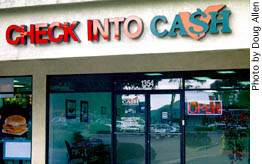
So what’s the catch? This service doesn’t come cheap. The one-time check advance fee runs about 15 percent of the amount of the check for a typical two-week loan period. A $100 loan at Check Into Cash carries a $15 fee, and at Check ’n Go it costs $17.50. On an annualized interest rate basis, consumers are looking at loan rates of 500 to 600 percent.
When questioned about the seemingly exorbitant interest rates, Sandra Rowland of Check Into Cash’s corporate marketing department responds that annual percentage rates don’t apply to their business.
"It is different. Our fee is based on amount only, not on time. APR would be based on a long-term situation. This is a one-time fee, not a long-term loan. You do not consider APR on a short-term loan," Rowland says.
Those in the paycheck loan business stress the importance of the service they provide to their customers.
"We are bridging the gap between paying insufficient funds fees and bad-check fees [at banks]. Rather than take a chance on writing an insufficient-funds check, they just write a cash-advance check," Rowland explains.
Indeed, bank customers can run into expenses and problems when they write bad checks. For checks overdrawn more than a few days, bank fees can easily exceed the amount of the original check.
According to written information describing insufficient funds fees charged by a San Luis Obispo Bank of America branch, a customer could wind up owing $163 in overdraft fees on a $100 check that was overdrawn for 10 days. Bank of America initially fines customers $10 per day for an overdrawn check, but that amount quickly escalates to $25 daily after the ninth day.
And delinquent bank customers’ problems don’t end there. Bank of America branch manger Marcel Bloomer explains that most banks use ChexSystems, a computer reporting service that provides records on bank customers whose accounts have been overdrawn by more than 45 consecutive days. Names of customers who have been reported to ChexSystems remain in the reporting system for seven years, and banks will generally not do business with them.
Bloomer says her bank branch has to turn away 10 to 15 people weekly, or about 20 percent of those who apply for checking accounts, because of their poor check-cashing histories.
And remember, writing a check without the money to cover it is illegal, even if you don’t think the bank will bounce it.
Managers of paycheck advance outlets and their corporate officers stress that their customers are middle-class Americans who just need help with some of the little emergencies of life.
The high number of San Luis Obispo County residents who receive monthly government checks is a big factor in his business, according to Check Into Cash’s manager, George Numez.
"The reason we are successful is that most Social Security (recipients), state employees, teachers, and state hospital employees–everybody gets paid once a month." Numez points out that for many people 30 days can be too long to wait for a check when they experience emergencies.
The downside to all this, of course, is that not everyone can manage their emergencies. For a person already experiencing credit and other financial problems, these check advance outlets are like opening up a casino across the street from a compulsive gambler. The more they borrow, the more difficult it becomes to pay it back.
Sharon Morse of Consumer Credit Counseling Service in San Luis Obispo says she became aware of the new check advance outlets through her clients. She said people started coming into CCCS offices for help catching up with their bills after using the cash advance services as a short-term fix.
"I tell you it is a trap. It looks like a short-term solution, but you are forfeiting your future earnings," Morse says.
She explains that oftentimes clients will take out paycheck advances to cover unexpected expenses like car repairs. Then when they find that they can’t get caught up, they turn around and use it again and again, Morse says.
One of the popular features of this type of credit is its speed and accessibility. Unlike credit cards and bank loans, paycheck advance services require only a simple one-page application requiring minimal credit history. Other than job and checking account verification, any credit woes need not be disclosed.
Being able to get the money fast with minimal hassle is what attracted Isela Maez to paycheck advance loans. She also likes that the loan is repaid quickly, and she is done with it.
"Sometimes I do it to help my daughters-in-law–not for myself. I mostly use it to help someone else who needs money right away. I put myself in jeopardy for someone else," Maez says.
In the last five years paycheck advance operations have been cropping up in any state that will allow them. In 1996 the state of California revised its regulations for check cashiers to include "deferred deposits," another word for check advances. California’s regulations are fairly minimal for deferred deposits, but do include requirements that set a maximum fee of "15 percent of the face value of the check" and a maximum check amount of $300. The loans are not to exceed a period of 30 days.
Consumer groups around the country are very concerned about the growth and potential impact of these lending services. States that report annually on paycheck lending in their states are showing business doubling every year or two.
The Consumer Federation of America, based in Washington, D.C., signals its views pretty clearly in its report titled "The Growth of Legal Loan Sharking." The Consumer Federation also reports that paycheck lending is now a $1-billion-a-year business.
All of this growth follows major increases in customer fees by banks in recent years. Consumers Union reports that minimum balances for checking accounts have increased an average of 40 percent since 1994 and that the average cost of a checking account is $218 per year. In addition, it reports that charges on checking accounts have increased 50 percent between 1990 and 1996.
These changes spell potential trouble for the consumer. Higher fees can propel those living close to the financial edge into serious trouble more quickly, and "quick fix" loans can either pull them out or bury them. Depending on how it is used, this new form of credit can be an added consumer convenience or increased business for credit counselors like Morse.
Leslie Stevens is a New Times intern.