













Aloha Spirit Prompts Surfer to Give Free Lessons
By Lea Aschkenas
Volunteer surfing instructor Andy Aquino can show you how to gracefully mount a board amid the most turbulent waves. He can model the exact angle at which you should bend your legs to stay balanced. He can talk for hours on end about the history of surfboard design. And, in addition to sharing this compulsory surfer lore, the 54-year-old Pismo Beach Surf Club co-founder and president will school you in the less-glamorous side of this much-romanticized sport.
"You’ve gotta beware of surfer’s ear," Aquino says on a summer-perfect mid-December morning as he adjusts his ear plugs and suits up next to his cherry-red ’56 Pontiac at the Pismo Beach Pier.
Aquino is a short, robust man who regularly flashes the "hang loose" hand sign and concludes his phone conversations with "Mahalo," surfer lingo for "Thank you."
He has a youthful face and an animated, interactive way of telling stories, evidenced in his description of surfer’s ear.
"What happens is the hole inside your ear gets infected and it gets smaller," Aquino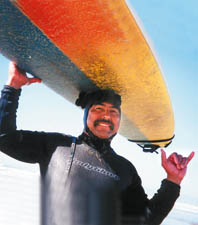 says.
says.
His surfing apprentice, 22-year-old Cal Poly student Rosalind Rondash, grimaces at this image as she zips up her Wavelengths wetsuit. But Aquino is on a roll.
"Then you have to get an operation. They cut around your ear like this," he continues, pulling Rondash over to demonstrate. "They have to cut it so they can work on the nerve right here...."
But Rondash pulls away, wrinkling up her face and laughing before Aquino can complete his surfside faux-operation.
"OK, OK," Aquino says, shrugging his shoulders and heaving his surfboard over his head as he leads the way to the beach.
Rondash follows and Aquino instructs her on how to maneuver her board down the beach steps.
"Hold onto the hand rail and keep the wax side toward your body," he says. "Then if you slip you can grab onto it."
When they reach the swing set on the north side of the pier, Aquino sets down his board and reminds Rondash to attach her board leash to her ankle.
"I call the people who don’t use leashes ‘knuckleheads,’" he says, before launching into another story of surfing mishaps. "That wetsuit guy Jack O’Neill designed it and lost one of his eyes doing it. He was using an elastic chord and popped that eye right out." Rondash winces, but then she smiles.
Like Aquino’s many friends and surfing disciples, Rondash suffers through the horror stories, knowing that they’re all part of Aquino’s efforts to promote safety and change the stereotypical image of the cocky, competitive surfer.
"We want to break out of the bonehead surfer stereotype," Aquino says, referring to the goals of the Pismo Beach Surf Club.
Aquino taught himself how to surf 15 years ago when his teenage son Aaron took up the sport. When Aquino started meeting local surfers at Pismo Beach, he realized there was no organized social outlet for them and few positive role models for young surfers.
"You’ve got a lot of really aggro guys out there," he says. "They try to hit each other over the head with their surfboards."
Aquino shared his thoughts with fellow surfers Jerry Grantham, Dan McFarland, and Marilyn Schmidt. In 1996, the four of them founded the Pismo Beach Surf Club.
"I don’t remember exactly how it started," he says. "We were just talking and then...," his voice drifts off as he searches his memory. "Then we just formed the club. That’s how things happen on the beach."
* * *
Today the club has 140 members, with some as young as 7 years old. Aquino leads the surfers on monthly beach cleanups and regular overnight trips to nearby state beaches. He concludes the meetings by wishing everyone a "gnarly cutback."
For the kids in his club, Aquino gives out an annual "Academic Hero" award for the student member with the best grades, surfing behavior, and school citizenship.
Amber Whelchel, a 21-year-old club member and Cal Poly English major, judged applicants essays for the ’98 contest.
"This club is really good for the younger kids," says Whelchel. "It brings them respect for older surfers and shows the kids another side of surfing, away from surfers hitting each other with their boards and that type of surfer terrorism."
Aquino says, "We try to teach the kids the importance of decent grades and good behavior. We try to show them that they can have fun without smoking and drinking. I tell them I don’t do that."
Aquino laughs, his eyes taking on a distant look.
"Well, when I was younger," he says. "But not anymore."
Aquino tries to counter the competitive side of surfing by fostering compassion among his members.
"I tell them, you can’t criticize someone because they’re not as good as you," he says. "We all work at our own pace, and criticism is cancerous to the club. When the older kids start arguing about who surfed the biggest wave, I tell them, ‘Not here. If you want to hear someone argue, go home and listen to your parents.’"
* * *
It took Aquino six months to teach himself to surf, and he says he still gets scared in the ocean sometimes. He describes himself as only a "mediocre surfer."
"That sounds like something Andy would say. He’s so modest," says Whelchel, who also taught herself.
Rondash, too, has learned to surf largely on her own, with occasional tips from her surfing friends.
"But it’s nice to have someone take the time to actually teach you," she says. "With Andy, I can spend a whole day just focusing on balance."
On this Thursday morning lesson, Aquino leads Rondash in several stretches to increase her sense of balance. He draws the outline of a surfboard in the sand and shows her how to lay down with her arms straight out so her body is a flat t. In an almost dancelike move usually obscured by the waves, Aquino jumps to a squat position, his hands out to either side for balance. He motions for Rondash to try and places his hand behind her for support.
Aquino and Rondash spend a good two hours in the water. On her first try, Rondash coasts on a wave, her hands out to the side like a child on a roller coaster. Aquino claps, encouraging her to stand up.
Rondash jumps up a split second too late, missing the wave, and her surfboard goes popping like a jack-in-the-box.
Aquino dives through a crashing wave, and they continue the lesson.
When Rondash finally executes a successful surf, she raises her arms in victory as the current recedes, nipping at her feet.
"She’s got pretty good balance," Aquino says when they come in, discussing plans for Saturday’s lesson.
"I feel tired," says Rondash. "Fighting the waves is the most tiring part. The current is strong, and it rips you around like a washing machine."
Aquino nods, adding, "I’ve got guys I take out and the whole time, they’re doing this." He turns his head frantically as if trying to avoid the gaze of an invisible intruder. "They’re afraid of getting water in their face. And I say, ‘This is not a beauty contest.’"
* * *
After the lesson, Aquino and Rondash head for the Honeymoon Cafe, the local surfer hangout.
Along the way, Aquino honks at passing pedestrians.
"Hey, what’s up?" he asks.
"Hi, Andy. How’s it going? How’re the waves today?"
At the Honeymoon, owner Aaron Baldwin slips into the driver’s seat of Aquino’s car to try out the horn.
"He opens the cafe after hours for our meetings," Aquino says.
On the cafe bulletin board is the surf club’s newsletter, and on a window ledge is a trophy the club won for a float in the Grover Beach Christmas parade.
"Really, it’s the kids I do this for," says Aquino.
When he’s not giving lessons, he earns his living by doing electrical construction. Although surf instructors charge as much as $35 an hour for lessons, Aquino says he’s never considered charging for his instruction.
"I started out by just taking out friends," he says. "It’s just about having a good time."
Out of the surf, Aquino is in storytelling mode again. He refers to Duke Kahanamoku, the Hawaiian father of surfing.
"He’s the one who brought surfing to the mainland," says Aquino. "And he taught people in Australia how to surf. He didn’t charge anyone. It’s called the Aloha Spirit."
Lea Aschkenas is a New Times staff writer.